proomt

Search

Search posts, papers, and topics

Hall of Fame

Hall of FameHironobu Suzuki20157 min readintro

The Internals of PostgreSQL

Summary

The Internals of PostgreSQL is a continuously updated, chapter‑based documentation covering PostgreSQL’s subsystems—from process architecture to replication—targeted at developers and DBAs. It serves as a comprehensive reference but the article itself offers little new technical detail.

  • The site provides a structured deep‑dive into PostgreSQL internals across 12 chapters, updated for versions up to 19‑beta.
  • It is maintained by Hironobu Suzuki, a long‑time PG community contributor, and is cited in academic papers.
  • Updates include new sections on asynchronous I/O, logical replication, and buffer management, reflecting recent PostgreSQL releases.

PostgreSQL engineers and DBAs looking for an authoritative, version‑aware reference on the database’s inner workings should be aware of this resource.

4/10
Related reading

  1. Architecture of a Database System

    The paper surveys the internal architecture of modern relational DBMSs, describing the main components—client communications, process management, query processing, storage, and transaction management—and how they interact during a query lifecycle. It highlights design decisions such as admission control, buffer management, and concurrency control that are critical for scalability and reliability.

    Hall of Fameberkeley.edu161 minpaper
  2. Introducing Neon Labs

    Neon Labs is a new experimental web app (Next.js + TypeScript) that offers two PostgreSQL upgrade tools: a live‑catalog Upgrade Assessment that flags version‑specific blockers, and a Migration Assistant that auto‑generates import, pg_dump/restore, or logical‑replication pipelines based on DB size and downtime needs. The tools run read‑only against a Neon project, never expose connection strings,…

    Neonneon.com6 minrelease
  3. PostgresCompare 2.2.0 Released

    PostgresCompare 2.2.0 is a major rewrite (Electron → Tauri) that adds pipelines, quick compare, data‑change scripting, an MCP server for AI‑driven migrations, parallel connections, and a CLI for schema export. UI is restyled, multilingual, and self‑updating. Supports PostgreSQL 9.2‑18 on Windows, macOS, Linux.

    PostgreSQLpostgresql.org3 minrelease
  4. pgsql-test: Real Postgres Testing for Faster Development Loops

    pgsql-test is an MIT‑licensed harness that spins up a temporary PostgreSQL instance, seeds it once, and rolls back after each test so you can verify real database behavior (constraints, triggers, RLS) from your application test suite. It integrates with Jest, Supabase, Drizzle, Graphile, and CI tools, delivering fast feedback—e.g., 246 tests across 44 databases completed in four seconds.

    PostgreSQLpostgresql.org3 min
  5. SQL Manager for PostgreSQL 7.0: meet the AI Assistant

    SQL Manager for PostgreSQL 7.0 adds an AI Assistant that can generate, explain, fix, and optimize SQL, produce migration scripts from schema diffs or business requirements, and lets users control how much schema is sent to the model. It supports multiple LLM providers and local Ollama deployments.

    PostgreSQLpostgresql.org1 minrelease
  6. The architecture of Neki

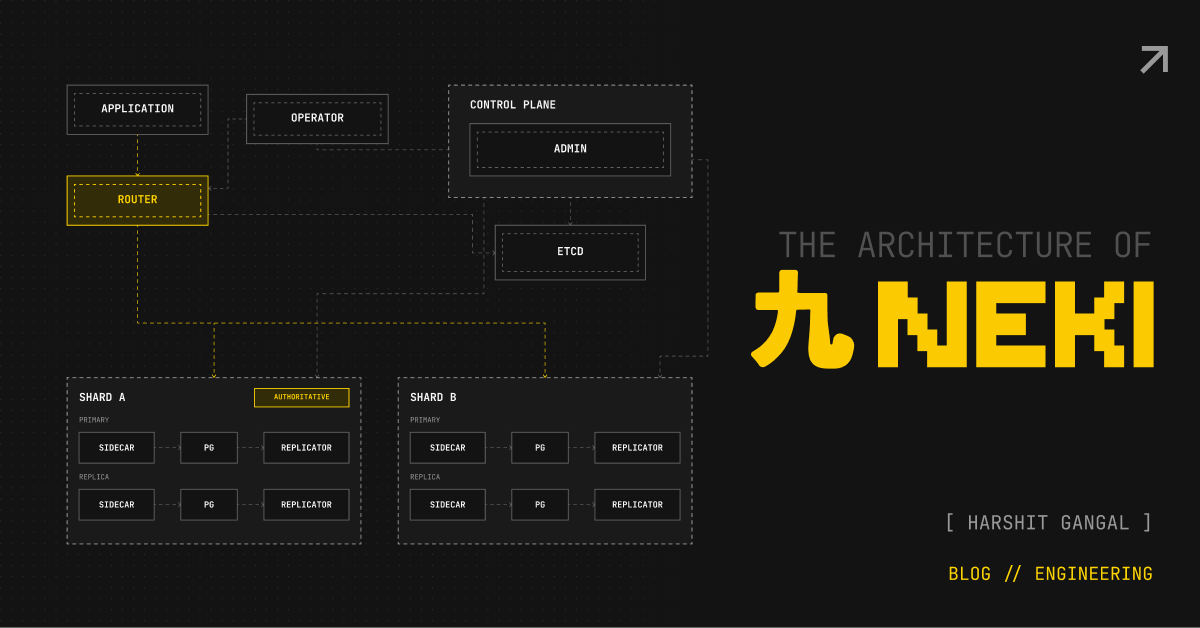
    Neki is PlanetScale’s sharding layer for vanilla PostgreSQL that presents a single Postgres endpoint while routing queries across a fleet of Postgres instances. It does this with a set of tightly‑coupled components—Router, Sidecar, PostgresManager, Admin, Operator, and etcd‑backed Data Topology—each handling a specific piece of the scaling, failover, and query‑planning puzzle.

    PlanetScaleplanetscale.com8 min