proomt

Search

Search posts, papers, and topics

All posts

DatabricksDaniel Zoccali, Jack Yallop6 min readintermediate

How energy teams turn theft detection into governed action with Genie and AI business processes

Summary

Databricks shows how to turn energy‑theft ML scores into a governed, end‑to‑end workflow using a Databricks App, Lakebase for live case state, Unity Catalog for data governance, and Genie One for natural‑language executive reporting. The pattern lets utilities act on alerts faster while staying compliant, and can be reused for other fraud‑type use cases.

  • A Databricks App writes flagged accounts and recovery totals to Lakebase, providing low‑latency, live case state for investigators.
  • Unity Catalog and Unity Gateway enforce data lineage, PII labeling, and model guardrails to satisfy UK regulator OFGEM requirements.
  • Genie One enables executives to ask natural‑language questions about recovery metrics, and Agent Bricks can auto‑generate board‑pack reports.
  • The lakehouse‑centric pattern (Lakeflow → model serving → Lakebase → app) is reusable for fraud, predictive maintenance, churn, etc.

Utility revenue‑protection teams and ML‑ops engineers need a regulated, low‑latency pipeline to convert fraud alerts into field actions and measurable recovery.

6/10

Related reading

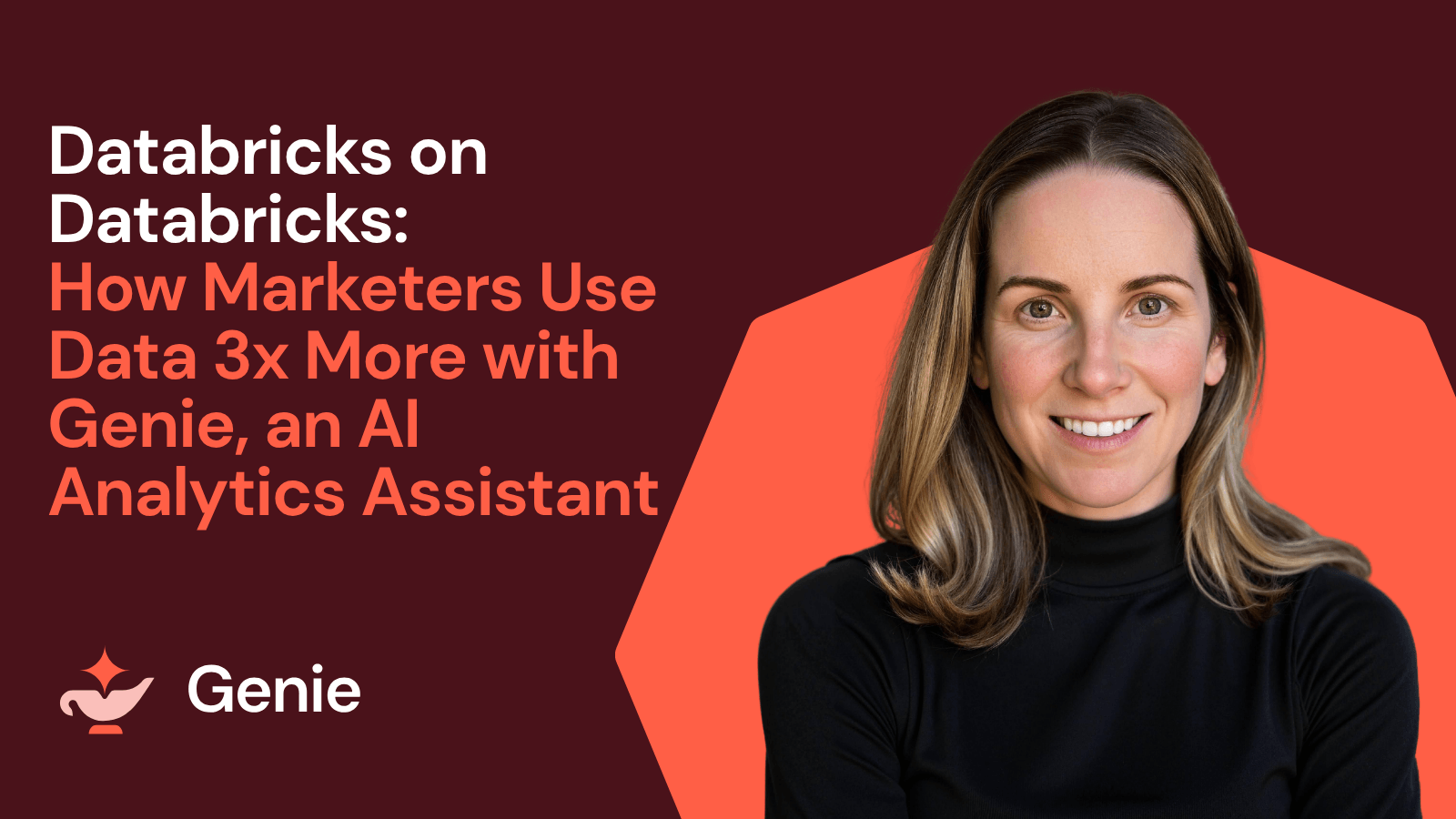
  1. How Databricks’ marketers use data 3x more with Genie, an AI analytics assistant

    Databricks built Marge, a Genie‑powered conversational analytics assistant on a governed Marketing Lakehouse. By starting with a single high‑value use case (email campaign performance), documenting data, encoding verified answers, teaching business terminology, and embedding the tool in existing ticket workflows, they achieved 85% adoption, 3× higher data usage in decisions, 50% QoQ usage growth,…

    Databricksdatabricks.com10 min
  2. Modernizing the Trade Lifecycle With Governed Data and AI

    Databricks argues that modernizing the trade lifecycle now hinges on building a governed, real‑time data foundation that spans research, trading, risk, ops and compliance, rather than isolated AI pilots. Starting with a few high‑value questions—execution cost, shock risk, exception rates—and using Unity Catalog and Agent Bricks lets firms achieve measurable speed and auditability gains before sca…

    Databricksdatabricks.com5 min
  3. Database for AI Agents: 5 Evaluation Criteria

    Databricks outlines five criteria for a production‑ready database for AI agents—branch‑per‑agent isolation, serverless scale‑to‑zero, hybrid search, ACID guarantees, and a unified platform that eliminates ETL lag—illustrating each with features of its Lakebase offering and brief customer anecdotes.

    Databricksdatabricks.com10 min
  4. Enabling secure, productive work on personal devices

    Databricks outlines a four‑layer BYOD mobile security model—MDM enrollment (account‑driven user enrollment), identity‑based access with contextual signals, continuous zero‑trust posture checks via per‑app VPN, and managed‑app controls—while emphasizing employee privacy and transparent communication to drive adoption.

    Databricksdatabricks.com7 min
  5. RADAR: Catch gray failures with anomaly detection

    Databricks built RADAR, a four‑stage, metric‑agnostic pipeline that uses streaming anomaly detection (SPOT) to surface gray failures in minutes with >90% precision. The blog shows how to recreate the system on Databricks for any metric, from billing to model drift.

    Databricksdatabricks.com7 min
  6. What is AIOps?

    Databricks’ blog post explains what AIOps is, its core components (data ingestion, normalization, anomaly detection, correlation, RCA, automation, collaboration), and why it’s gaining traction now. It positions AIOps as a layer between observability and action, emphasizing human‑in‑the‑loop for high‑risk steps, and outlines domain‑centric vs. domain‑agnostic approaches and common use‑cases like R…

    Databricksdatabricks.com13 min