proomt

Search

Search posts, papers, and topics

ml infra

RSS
  1. 1

    Laya the open source version of Jev

    Laya is an open‑source, bidirectional‑encoder model family for ultra‑fast, calibrated decision‑making (choice, score, boolean) over structured schemas. It runs 6‑8× faster than the closed‑source Jev, supports 100+ languages via three checkpoints, and includes a lightweight router that selects the appropriate checkpoint before inference. Benchmarks show higher accuracy, far better calibration (ECE…

    Hacker News front pageconvaiinnovations.com8 minreleaseHN1326313lobste.rs2
  2. 2

    Bonsai 2 27B: Near-Lossless Compression in a 9x Smaller Footprint

    Ternary Bonsai 2 27B is a new multimodal LLM based on Qwen3.8 27B, utilizing ternary weights for a 5.9GB model footprint. It achieves over 9x compression while retaining 98.2% of the full-precision model's aggregate benchmark performance across various tasks. This enables highly capable 27B-class models to run efficiently on local devices.

    Hacker News front pageprismml.com5 minreleaseHN579198lobste.rs12
  3. 4

    Show HN: Cactus Needle 3: 8-29MB automation models can match DeepSeek V4 Flash

    Cactus Needle 3 is a laddered attention LLM (29‑121 M params, CQ2‑bit quantised) that fits in 9‑29 MB binaries and runs on devices like a Raspberry Pi 5 (400‑4k t/s decode, 1‑10k t/s pre‑fill). It can perform tool‑calling, structured extraction, and text embedding locally, matching DeepSeek V4 Flash on downstream tasks after a single fine‑tune epoch. The post includes architecture details, benchm…

    Hacker News front pagecactuscompute.com7 minreleaseHN537185
  4. 5

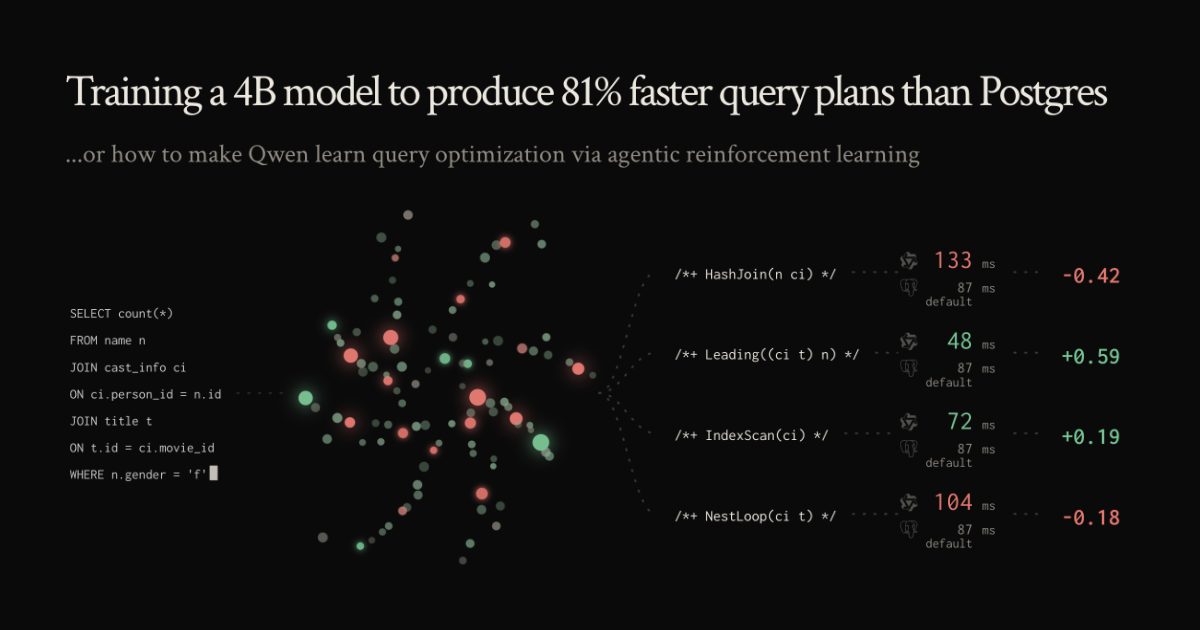
    Training a 4B model to produce 81% faster query plans than Postgres

    A 4‑billion‑parameter open‑weight LLM, fine‑tuned with supervised learning and a custom RL loop, learns to emit PostgreSQL join plans that cut query latency by 44.7 % on a 113‑query benchmark. The author built a low‑noise measurement harness, a GRPO‑style reward function, and ran off‑policy distillation from ~500 GPT‑6‑style trajectories, demonstrating that a modest model can outperform Postgres’…

    Hacker News front pagerohanbansal.com51 minHN692143
  5. 6

    Reverse-engineered Jev-like model

    Jevlike is an open‑source starter model that scores a list of text options in a single forward pass. It provides a minimal architecture (option queries, shared dot‑product scorer), synthetic data generation, training/evaluation CLI, and examples on Doom and chess. The repo supports a byte‑level encoder or a frozen Hugging‑Face encoder (e.g., Qwen2.5‑0.5B), runs on CPU/MPS/CUDA, and reports benchm…

    Hacker News front pagegithub.com4 minreleaseHN16224
  6. 7

    OpenJev

    OpenJev is a browser‑only demo that lets you load small LLM checkpoints (e.g., MiniCPM‑5 2B, Qwen3 0.6B) onto your GPU and compare two inference paths: reading raw logits for a set of options versus prompting the model to emit a JSON with option probabilities token‑by‑token. The page reports model sizes, download times, balanced accuracy on a few benchmarks, and wall‑clock timings measured with `…

    Hacker News front pageopenjev.com2 minreleaseHN709288
  7. 8

    Breaking the 1.58-bit Barrier for Ternary LLMs

    BITCOS is a distribution‑aware storage layout for ternary LLM weights that replaces the standard five‑trit packing. By storing a presence bitmap and a compact sign vector, it reduces the effective bits‑per‑weight to 2 − z (z = zero density), achieving as low as 1.485 b/w on sparse models. The authors provide AVX‑512, AVX2, and Xe2 GPU unpacking kernels and show up to 1.28× speedup in matrix‑vecto…

    Hacker News front pagearxiv.org1 minpaperHN24241
  8. 10

    JEPA-Anything: Learning Predictive Models across Different Worlds

    JEPA-Anything extends joint‑embedding predictive architectures with orthogonal predictive factorization, letting a single model learn complementary latent factors that can be recombined for prediction across disparate domains. The paper shows consistent performance gains on ten dynamics tasks, molecular simulations, and clinical event forecasting, plus experimental validation of a biologically‑de…

    Hugging Face Daily Papersarxiv.org1 minpaper
  9. 11

    Claude Cowork and chat are now one Claude

    Claude merges its Cowork and chat interfaces into a single assistant and adds beta Docs, Slides, and Design capabilities, rolling out first to Pro and Max plans. The unified UI lets users ask Claude to generate reports, presentations, and other artifacts within the same conversation, with optional auto‑action settings. No new technical details or implementation specifics are provided.

    Hacker News front pageclaude.com3 minreleaseHN232226
  10. 13

    IntBMoE: Integrating Block-Level Conditioning into Expert Composition for Full-Participation Mixture-of-Experts

    IntBMoE introduces block‑level conditioning to MoE, decoupling token participation, compute execution, and memory materialization. A hypernetwork merges all experts into a composed expert per block, while routing remains sparse. Dual‑Path Residual Gating further mixes two composed paths. Experiments show consistent gains on vision, language, and recommendation tasks, and the model is live in AMap…

    Hugging Face Daily Papersarxiv.org2 minpaper
  11. 14

    CodeMidas: Scaling Agentic Coding RL Environments from Code Itself

    CodeMidas builds RL environments directly from open‑source code: agents explore a repo, infer a spec, generate tests from the original implementation, and filter tasks via execution checks. The pipeline yields 5,545 high‑quality coding tasks across 23 languages and 15 domains. Training the MiMo‑V2.5 agent with GRPO on this dataset improves benchmark scores by 8‑18% (e.g., DeepSWE +11.7%, ProgramB…

    Hugging Face Daily Papersarxiv.org1 minpaper
  12. 17

    Infinite-Parameter LLMs: Generating and Adapting Weights from Live Data

    The paper presents Infinite-Parameter LLMs, where a compact hypernetwork creates feed‑forward weights from live user data and updates a Bayesian latent code online, keeping the stored model size constant while effectively having infinite parameters. This design aims to improve over standard in‑context learning and retrieval by persisting knowledge in weights and freeing context space.

    Hacker News front pagearxiv.org2 minpaperHN15743
  13. 18

    Grok 4.7

    xAI announced Grok 4.7, a new LLM for coding and knowledge work. The post claims it’s twice as fast and half the price of comparable models, and shows a CursorBench 4.0 chart with a 46.3 % “Extra High” score at $6.01 average cost per task. No architecture details, training data, or engineering rationale are provided.

    Hacker News front pagex.ai2 minreleaseHN469384
  14. 19

    ScienceIDE: Turning World's Scientific Codebase into Agent Learnable Environments

    ScienceIDE is a framework that turns existing scientific software repositories into programmable environments that agents can use for task generation, execution, and verification. Training on these environments yields LLMs (PhAI‑IDE series) that outperform baselines on scientific code repair and several general code‑reasoning benchmarks.

    Hugging Face Daily Papersarxiv.org2 minpaper
  15. 20

    Agora: Git as Shared Memory for Collective AutoResearch

    Agora treats a Git repository as a shared, append‑only memory for autonomous research agents, recording each claim as an immutable commit in a DAG. In a 12‑day run with 13 language‑model workers it generated 1,703 reproducible contributions and closed 62 % of the gap to a trained GPT‑2‑124M, demonstrating that shared research state can accelerate discovery.

    Hugging Face Daily Papersarxiv.org2 minpaper
  16. 21

    Feyospace-v1: How the Cyber Mercury Seven Trained Frontier Cyber Models

    Feyospace‑v1 presents a data‑centric training pipeline for cyber‑security agents, combining five systems (Choulea, SkyReal, Hongzwang, PSBreakup, Kreator) to generate and verify 164 k long‑context trajectories across diverse exploit environments. The resulting checkpoints improve baseline performance by ~24% on CyberGym and achieve a 63% verified success rate, ranking top among similarly‑sized op…

    Hugging Face Daily Papersarxiv.org1 minpaper
  17. 22

    Designer-RSI: Evolving Procedural Memory from User Traffic for Agentic Graphic Design

    The paper introduces Designer‑RSI, a continual‑adaptation system that couples a frozen design‑software‑controlling LLM with an external procedural memory of natural‑language design skills. Over five adaptation rounds on real user briefs, the memory grows from 76 to 139 procedures and lifts execution success from 72.7% to 99.3%, showing that skill accumulation and selective replay can dramatically…

    Hugging Face Daily Papersarxiv.org1 minpaper
  18. 23

    RecreationWorld: Scalable and Verifiable Environments for Hybrid Computer-Use Agents

    The paper presents RecreationWorld, a five‑platform framework that lets hybrid computer‑use agents learn by recreating the behavior of a running reference, and introduces RecreationBench, a 250‑task benchmark with programmatic and visual assertions. Experiments show GPT‑6 Astra reaches 58.1% overall but struggles with deeper programmatic tests, highlighting gaps in current agents.

    Hugging Face Daily Papersarxiv.org2 minpaper
  19. 25

    Grounded Skill Synthesis from Code at Scale for Agentic Intelligence

    Code2Skill is an automated pipeline that mines popular GitHub repositories to extract verifiable, implementation‑anchored procedural “skills”. It builds a bank of ~1 M skill records (atomic ops, workflows, patterns) with provenance metadata, verifies each via blind reconstruction, and shows that augmenting LLM‑based agents with these skills yields an average 11.7% performance lift across 72 proto…

    Hugging Face Daily Papersarxiv.org1 minpaper
  20. 26

    Video DeltaNet: A Video-Native Hybrid Attention for Livestream Video Generation

    Video DeltaNet (VDN) replaces full‑softmax attention in video diffusion models with a hybrid: per‑frame local Softmax for fine detail and a bidirectional linear memory (Video Delta Attention) for long‑range context. A teacher‑alignment schedule injects the linear branch into a pretrained MiniMax H3 model, preserving Softmax for text/audio streams. On eight NVIDIA B200 GPUs VDN‑H3 denoises a 14.3‑…

    Hugging Face Daily Papersarxiv.org1 minpaper
  21. 27

    BI-Agent and BI-Bench: Towards Automating End-to-End Business Intelligence

    The paper introduces BI‑Bench, a new benchmark of real‑world BI questions derived from public dashboards, and BI‑Agent, a tool‑augmented LLM system that breaks BI workflows into search, join, and transform subtasks. Baseline LLMs hit <50 % accuracy on BI‑Bench. By orchestrating specialized data‑management tools and post‑training the model with supervised fine‑tuning and reinforcement learning on…

    Hugging Face Daily Papersarxiv.org2 minpaper
  22. 29

    Confidence Comes from Experience: Experiential Confidence Estimation from Reasoning to Agents

    XConf (eXperiential Confidence) is a novel method for estimating language model confidence by leveraging the model's accumulated experience from past graded episodes. It significantly outperforms existing methods like self-consistency in discrimination and calibration, at a fraction of the computational cost, across various tasks.

    Hugging Face Daily Papersarxiv.org2 minpaper