Related reading
An Empirical Study of Harness Design for Coding Agents
This empirical study dissects coding agent harness components like planning, action space, and context management. It finds context management is critical for tight windows, rule-based elision is efficient, and planning shifts from accuracy to cost savings for stronger models.
Hugging Face Daily Papersarxiv.org2 minpaperHN12621CodeMidas: Scaling Agentic Coding RL Environments from Code Itself
CodeMidas builds RL environments directly from open‑source code: agents explore a repo, infer a spec, generate tests from the original implementation, and filter tasks via execution checks. The pipeline yields 5,545 high‑quality coding tasks across 23 languages and 15 domains. Training the MiMo‑V2.5 agent with GRPO on this dataset improves benchmark scores by 8‑18% (e.g., DeepSWE +11.7%, ProgramB…
Hugging Face Daily Papersarxiv.org1 minpaperUsing coding agents on a migration: Three practices that mattered
Coding agents proved most effective for cleaning up temporary code and legacy configurations during a migration, rather than for initial code construction. This effectiveness stemmed from three specific practices: documenting cleanup needs upfront, co-locating rules with code and their enforcement, and actively managing instruction staleness.
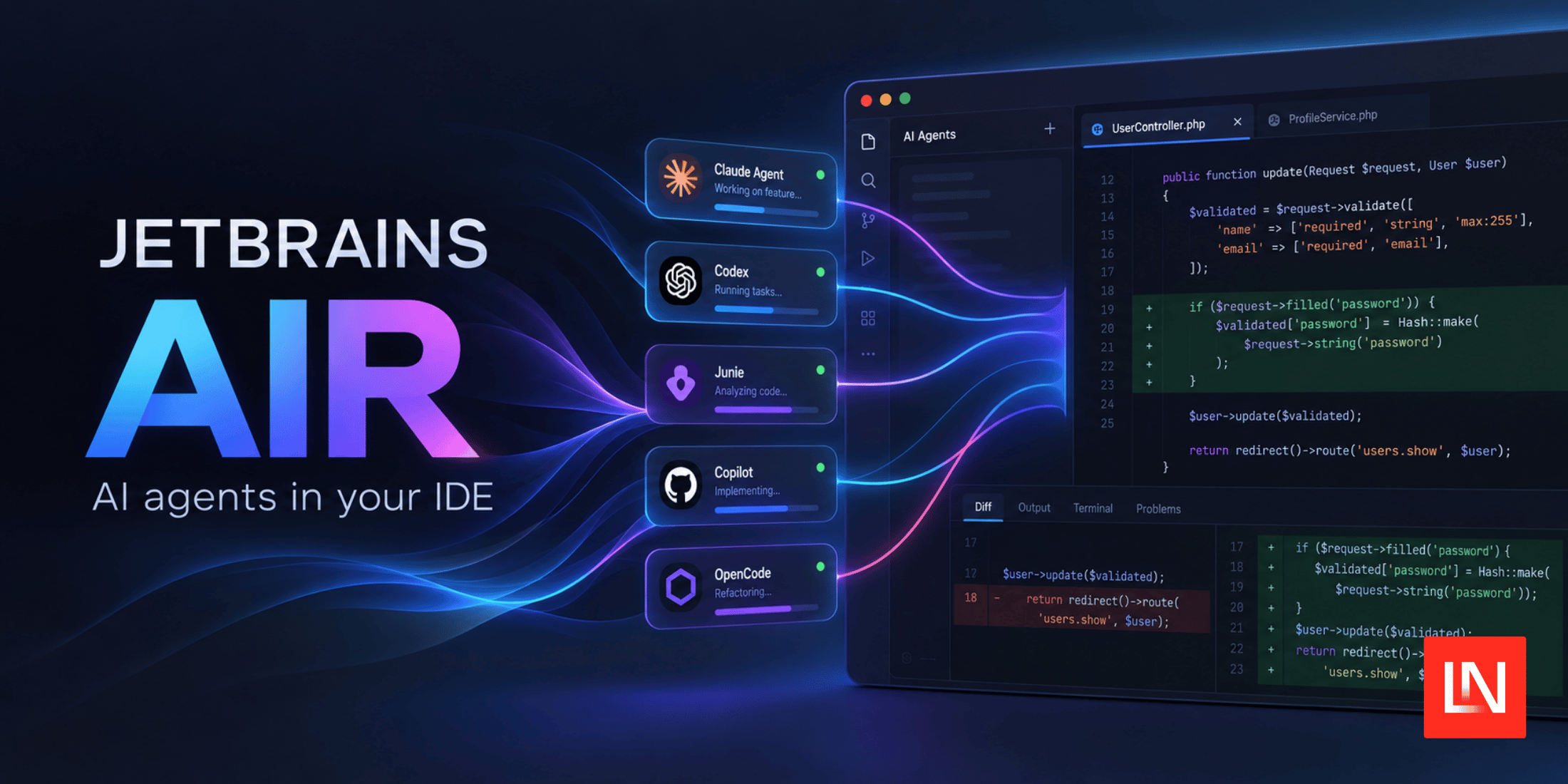
Temporaltemporal.io7 minJetBrains Air: Run AI Coding Agents in JetBrains IDEs
JetBrains introduced Air, a suite that lets developers run and manage AI coding agents inside JetBrains IDEs, in cloud‑shared team projects, and with organization‑level governance. The preview plugin works with any ACP‑compatible agent and offers built‑in controls for usage and costs.
Laravellaravel-news.com1 minrelease