proomt

Search

Search posts, papers, and topics

All posts

Zapier EngineeringMiguel Rebelo19 min readintermediate

Supabase vs. Firebase: Which backend platform is right for you? [2026]

Summary

Supabase and Firebase are the two leading BaaS platforms; Supabase offers an open‑source PostgreSQL backend while Firebase provides a proprietary Firestore document store with extensive built‑in services. The choice hinges on data model preferences, real‑time needs, open‑source vs lock‑in, and pricing predictability.

  • Supabase uses PostgreSQL relational tables; Firebase uses Firestore document collections, affecting schema enforcement and query complexity.
  • Firebase’s native real‑time sync scales better; Supabase adds a real‑time layer that can slow with many subscribers unless broadcast mode is configured.
  • Supabase is fully open source and self‑hostable, whereas Firebase is proprietary with a hard migration path.
  • Pricing differs: Supabase has tiered plans with per‑MAU auth costs; Firebase Blaze is pay‑as‑you‑go and can quickly exceed budgets on heavy read/write workloads.

Engineers picking a backend‑as‑a‑service need to understand these trade‑offs to avoid costly migrations or performance surprises.

5/10

Related reading

  1. One Java Model from the App to PostgreSQL

    Codename One introduces a backend runtime allowing a single Java model to define entities and validation rules for both client applications and the server. This approach aims to reduce duplication and ensure consistent data rules from the app to PostgreSQL.

    CodeName Onecodenameone.com7 min
  2. Running OpenBao on Kubernetes with a CloudNativePG PostgreSQL backend

    Step‑by‑step recipe to run OpenBao (Vault fork) on Kubernetes using CloudNativePG as a password‑less, TLS‑authenticated PostgreSQL storage backend. Shows how to spin up a Kind cluster with the cnpg‑playground, deploy a 3‑node CNPG cluster with synchronous quorum replication, configure DatabaseRole‑based client certificates, set up pg_hba rules, and initialize OpenBao’s schema via a one‑off Job.

    CNCFcncf.io16 minHN2
  3. The architecture of Neki

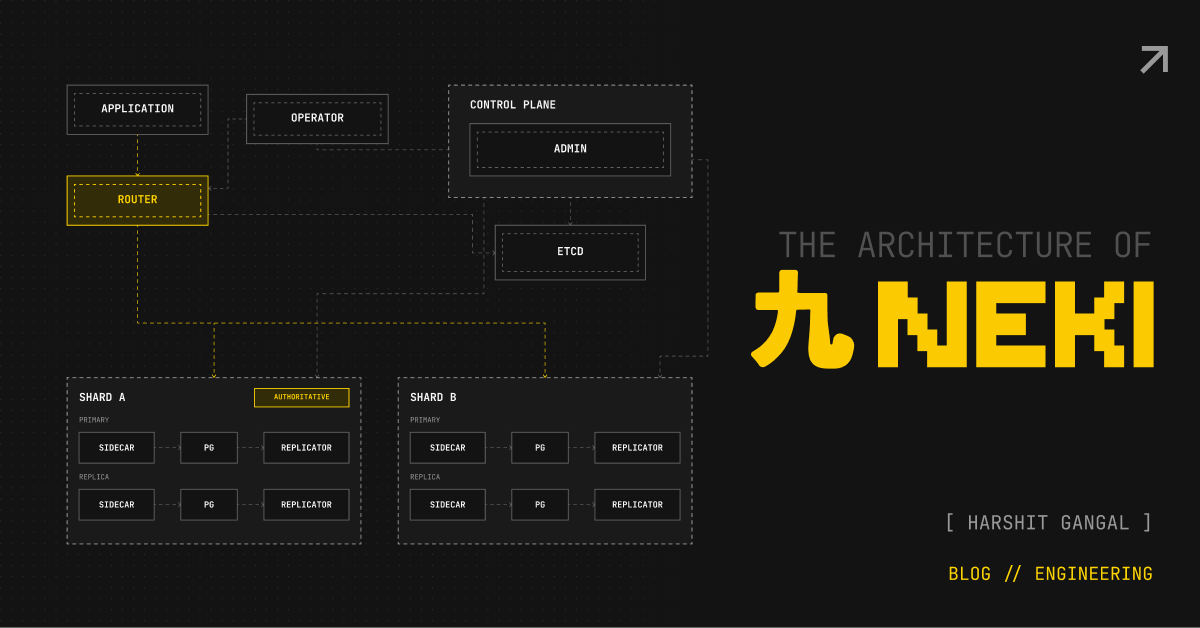
    Neki is PlanetScale’s sharding layer for vanilla PostgreSQL that presents a single Postgres endpoint while routing queries across a fleet of Postgres instances. It does this with a set of tightly‑coupled components—Router, Sidecar, PostgresManager, Admin, Operator, and etcd‑backed Data Topology—each handling a specific piece of the scaling, failover, and query‑planning puzzle.

    PlanetScaleplanetscale.com8 min
  4. Announcing Native BM25 Ranking in AlloyDB and Cloud SQL

    Google Cloud adds native BM25 ranking to AlloyDB and Cloud SQL (PostgreSQL 17+) via the open‑source pg_textsearch extension, letting you run keyword‑based full‑text search inside the database. This removes the need for a separate search backend and, on AlloyDB, speeds up vector queries up to 10×.

    Google Cloud Bloggoogle.com2 min