Hacker News front page1 min readintermediate
The Heilbronn Problem
Summary
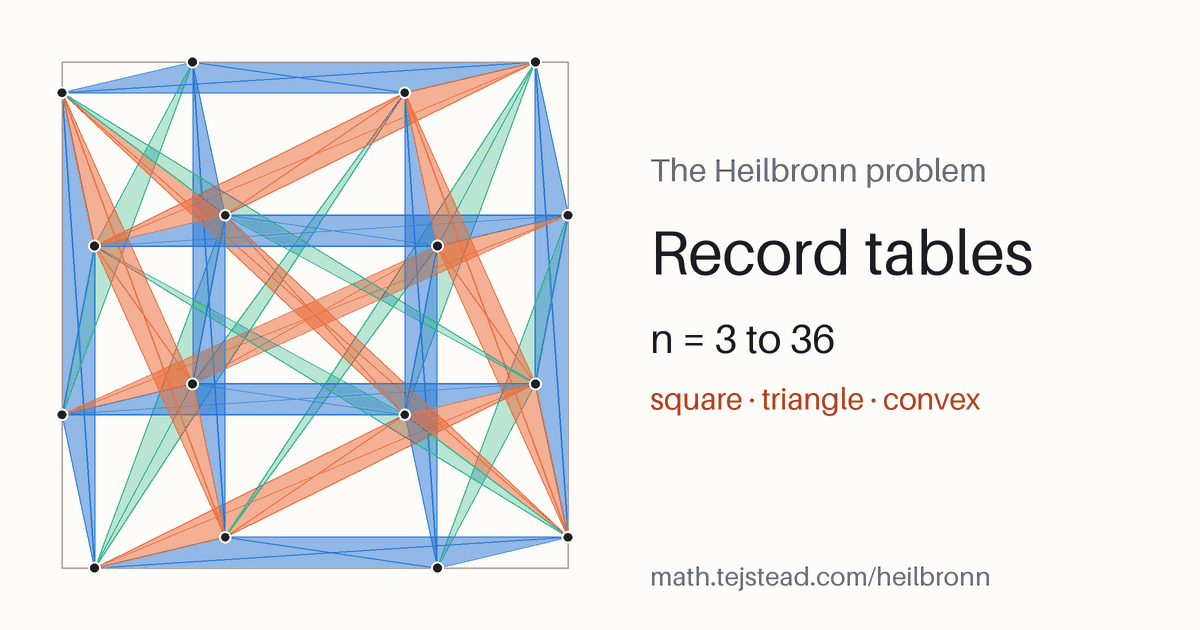
The Heilbronn problem asks how to place n points in a unit‑area shape so the smallest triangle formed by any three points is as large as possible. This site logs the best known minimal‑triangle areas for squares, triangles and convex regions, with recent record‑breaking configurations and exact coordinates.
- Provides up‑to‑date A(n) values for n≤36 in square, triangular and convex containers, with percent improvements over previous records.
- Each entry includes exact point coordinates, symmetry analysis and a browser‑based rational‑arithmetic verifier.
- Recent improvements were contributed by Rob Gardiner and others, showing incremental gains of 0.5‑3 % on prior bests.
- The data serve as benchmarks for computational‑geometry algorithms that need worst‑case triangle area guarantees.
Developers of geometry‑heavy software (meshing, graphics, spatial indexing) can use these optimal point sets as test cases or baselines for algorithmic performance.
5/10