PlanetScaleAhmed Darwich6 min readintermediate
When to choose x86-64 vs aarch64
Summary
When provisioning PlanetScale Postgres clusters you must pick either x86‑64 or aarch64, because the two architectures differ in core counting, clock speed, SIMD width, and on‑disk file compatibility. ARM gives more cores per vCPU and lower power, which helps many small queries, while x86‑64 offers higher single‑core performance and wider vector instructions, which helps heavy queries and certain…
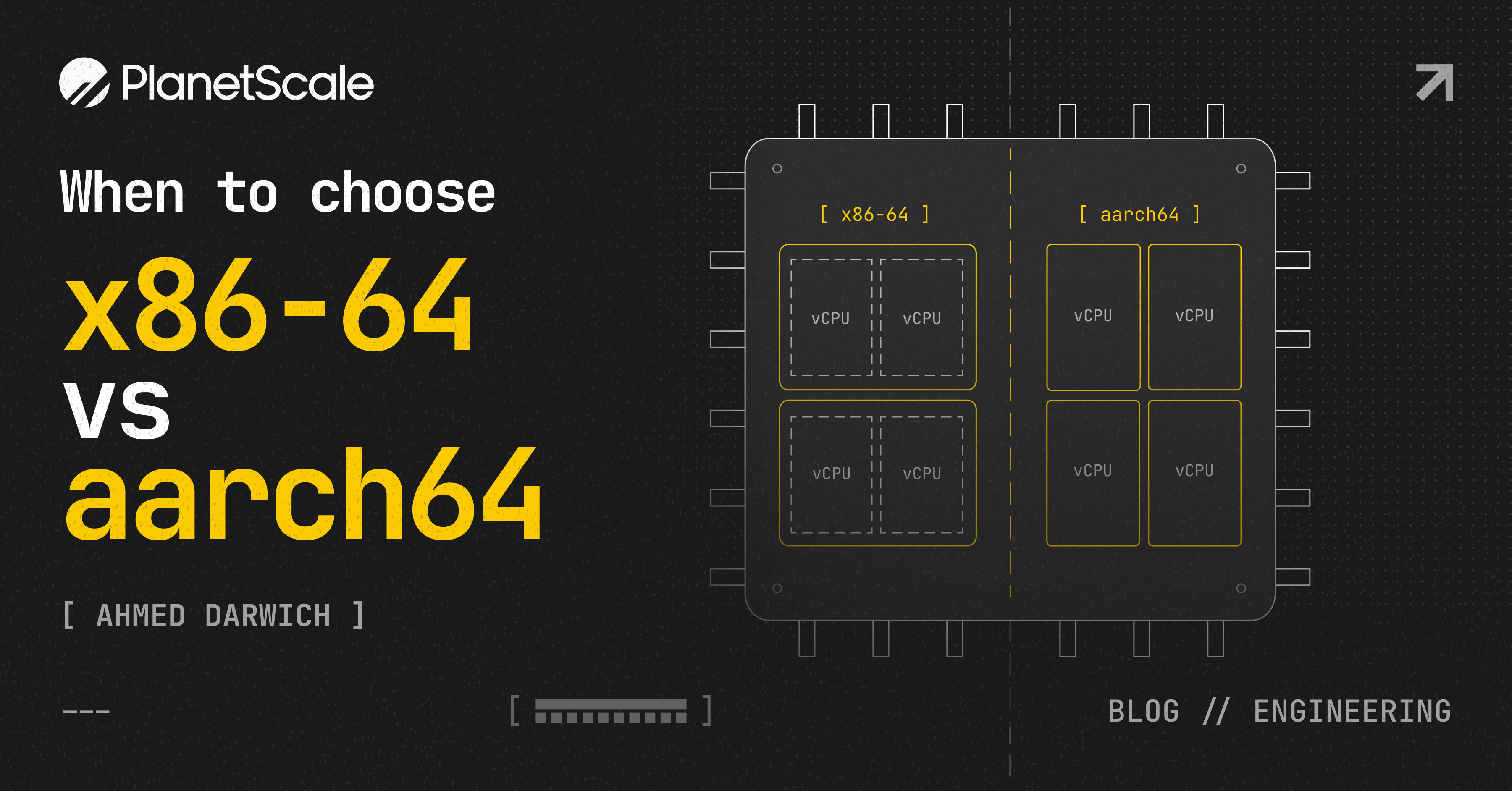
- ARM (aarch64) instances use whole cores per vCPU (no hyperthreading), giving more cores for the same vCPU count, which benefits workloads with many concurrent small queries.
- x86‑64 instances use hyperthreading, so a vCPU may share a core; they also have higher single‑core clock speeds, making them better for single heavy, CPU‑bound queries.
- Vector instruction width differs: x86 supports 256‑bit AVX2 and optional 512‑bit AVX‑512, while current Graviton ARM chips only have 128‑bit vectors, giving x86 an advantage for extensions that rely on wide SIMD (e.g.,…
- Postgres on‑disk files are not portable across architectures; you cannot replica‑promote across ARM ↔ x86, so choose architecture up‑front.
DBAs and engineers deploying Postgres workloads in the cloud should care, because the choice directly impacts query latency, throughput, and migration flexibility.
6/10