proomt

Search

Search posts, papers, and topics

performance

RSS
  1. 1
    1 points

    Saving another 100TB of RAM with math (and Rust)

    Cloudflare reduced the memory footprint of its Pingora Backend Router by re‑examining the consistent‑hashing implementation in the pingora‑ketama library. By increasing the number of virtual hash points per server from the default 1 to the standard 160 (and applying weighted hashing based on disk capacity), they cut the per‑node overhead enough to reclaim >100 TB of RAM across the fleet. The post…

    Hacker News front pagecloudflare.com13 minHN478120lobste.rs33
  2. 2

    Introducing System One Models and Jev

    TypeSafe AI announced its first “System One” model, Jev, a non‑text‑generating LLM that outputs type‑safe structured decisions with calibrated probabilities. It claims 40‑200× lower latency (70‑500 ms) and 100‑500× lower cost versus frontier LLMs, no hallucinations, and parallel sampling. The post includes a side‑by‑side demo, a custom “workflow” benchmark comparing Jev to GPT‑5.6/6 and other mod…

    Hacker News front pagetypesafe.ai9 minHN1824480lobste.rs26
  3. 3

    Laya the open source version of Jev

    Laya is an open‑source, bidirectional‑encoder model family for ultra‑fast, calibrated decision‑making (choice, score, boolean) over structured schemas. It runs 6‑8× faster than the closed‑source Jev, supports 100+ languages via three checkpoints, and includes a lightweight router that selects the appropriate checkpoint before inference. Benchmarks show higher accuracy, far better calibration (ECE…

    Hacker News front pageconvaiinnovations.com8 minreleaseHN1326313lobste.rs2
  4. 4

    Why I'm still bearish on LLMs after Navier-Stokes

    The author argues that despite headline successes (e.g., Navier‑Stokes proof, security exploits), current frontier LLMs still require heavy human oversight and rigorous specifications that are costly to produce. Reward‑hacking, narrow generalization, and the need for domain‑expert spec writing limit autonomous deployment to only a few niche domains (high‑failure‑cost work, tightly defined tasks,…

    Hacker News front pagedank.systems5 minHN487644lobste.rs49
  5. 5

    Bonsai 2 27B: Near-Lossless Compression in a 9x Smaller Footprint

    Ternary Bonsai 2 27B is a new multimodal LLM based on Qwen3.8 27B, utilizing ternary weights for a 5.9GB model footprint. It achieves over 9x compression while retaining 98.2% of the full-precision model's aggregate benchmark performance across various tasks. This enables highly capable 27B-class models to run efficiently on local devices.

    Hacker News front pageprismml.com5 minreleaseHN579198lobste.rs12
  6. 7

    Benchmarking Wild vs Mold

    Reproduces Mold’s linker benchmarks on a 16‑core Ryzen, shows that configuration (filesystem, delete‑output, fork) explains most of the Wild vs Mold speed gap, and notes recent Mold releases and upcoming Wild tweaks that close the gap.

    Lobstersgithub.io4 minHN461lobste.rs52
  7. 8

    Introducing GNOME 51

    GNOME 51 ("A Coruña") is a release‑focused update that adds smoother frame scheduling, screen‑capture speedups, auto‑rotate, touch‑pad auto‑disable, SSH‑socket remote login, offline maps, smart‑card remote desktop, visual signatures in Papers, and a raft of accessibility tweaks. Most changes are UI‑level refinements; there’s no deep technical exposition or performance data.

    Lobstersgnome.org9 minreleaseHN4715lobste.rs103
  8. 10

    Show HN: Cactus Needle 3: 8-29MB automation models can match DeepSeek V4 Flash

    Cactus Needle 3 is a laddered attention LLM (29‑121 M params, CQ2‑bit quantised) that fits in 9‑29 MB binaries and runs on devices like a Raspberry Pi 5 (400‑4k t/s decode, 1‑10k t/s pre‑fill). It can perform tool‑calling, structured extraction, and text embedding locally, matching DeepSeek V4 Flash on downstream tasks after a single fine‑tune epoch. The post includes architecture details, benchm…

    Hacker News front pagecactuscompute.com7 minreleaseHN537185
  9. 11

    Nvidia announces native GPU programming in Rust

    NVIDIA released CUDA‑Rust, letting you write GPU kernels directly in Rust and compile to PTX. Two programming models are supported: the traditional SIMT model via the `cuda-oxide` backend (nightly Rust, custom codegen) and the newer Tile model via `cutile‑rs` (stable Rust, JIT‑compiled Tile IR). Both provide Rust‑typed safety guarantees (e.g., `DisjointSlice`, tensor partitioning) and simple Carg…

    Hacker News front pagenvidia.com11 minHN961402
  10. 12

    Vectorized and performance-portable Quicksort (2022)

    Google’s Highway library now includes a fully portable SIMD‑vectorized quicksort that runs 9‑19× faster than C++ std::sort. By using compress‑store (or permute‑based emulation) for partitioning, the same C++ code targets AVX2, AVX‑512, NEON, SVE and RISC‑V V. Benchmarks show 0.5 GB/s on an Apple M1 and >1 GB/s on a 3 GHz Skylake, beating prior architecture‑specific sorts. The implementation and a…

    Hacker News front pagegoogleblog.com3 minHN460142
  11. 13

    Training a 4B model to produce 81% faster query plans than Postgres

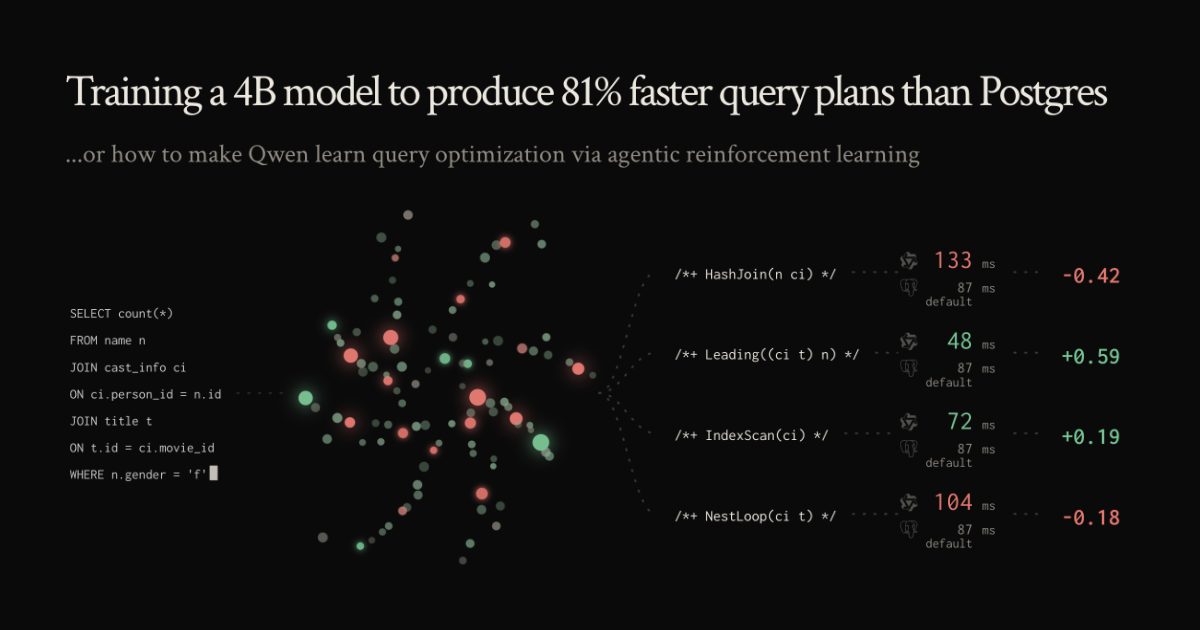
    A 4‑billion‑parameter open‑weight LLM, fine‑tuned with supervised learning and a custom RL loop, learns to emit PostgreSQL join plans that cut query latency by 44.7 % on a 113‑query benchmark. The author built a low‑noise measurement harness, a GRPO‑style reward function, and ran off‑policy distillation from ~500 GPT‑6‑style trajectories, demonstrating that a modest model can outperform Postgres’…

    Hacker News front pagerohanbansal.com51 minHN692143
  12. 15

    OpenJev

    OpenJev is a browser‑only demo that lets you load small LLM checkpoints (e.g., MiniCPM‑5 2B, Qwen3 0.6B) onto your GPU and compare two inference paths: reading raw logits for a set of options versus prompting the model to emit a JSON with option probabilities token‑by‑token. The page reports model sizes, download times, balanced accuracy on a few benchmarks, and wall‑clock timings measured with `…

    Hacker News front pageopenjev.com2 minreleaseHN709288
  13. 16

    Show HN: Mini-AGI – Dynamic continual learning model trained on 8GB VRAM

    mini-AGI is a byte‑level continual‑learning language model that fits on a single 8 GB GPU by paging expert weight files from disk. It uses two dense prelude blocks followed by a recurrent block applied up to 24 times per character, with adaptive depth (PonderNet halting) and per‑application top‑8 expert routing. The system maintains a RAM cache and a VRAM resident set, swaps experts based on dema…

    Hacker News front pagegithub.com20 minHN14525lobste.rs2
  14. 17

    Introducing TIN: full-text search for Postgres

    PlanetScale’s TIN is a new PostgreSQL extension that implements a full‑text search index supporting Boolean, phrase, span, fuzzy, wildcard, regex, case/accent folding, COUNT(*) and BM25 top‑k queries. In a suite of benchmarks on an i7i.8xlarge EC2 instance (8 vCPU, 32 GB RAM), TIN built in 8 min 10 s (50.7 GB index) and outperformed ParadeDB, pg_textsearch and the built‑in GIN index by large marg…

    PlanetScaleplanetscale.com15 minHN20175
  15. 18

    Breaking the 1.58-bit Barrier for Ternary LLMs

    BITCOS is a distribution‑aware storage layout for ternary LLM weights that replaces the standard five‑trit packing. By storing a presence bitmap and a compact sign vector, it reduces the effective bits‑per‑weight to 2 − z (z = zero density), achieving as low as 1.485 b/w on sparse models. The authors provide AVX‑512, AVX2, and Xe2 GPU unpacking kernels and show up to 1.28× speedup in matrix‑vecto…

    Hacker News front pagearxiv.org1 minpaperHN24241
  16. 20

    M5 Ultra Mac Studio Review

    The M5 Ultra Mac Studio (256 GB RAM) uses a quad‑die M5 Max architecture with an 80‑core GPU and 1.2 TB/s memory bandwidth, delivering ~70 % faster prompt‑to‑first‑token and token‑generation rates than the M3 Ultra. In the author’s tests Qwen3.8‑Flash‑Next hits 100 tokens/s on short prompts and 60‑85 tokens/s with 64‑256 KB context, making local AI agents (Open Minis, Hermes, Codex) feel snappy a…

    Hacker News front pagemacstories.net39 minHN191174
  17. 23

    Shapelearn Qwen 3.8 27B (13.1 GB VRAM)

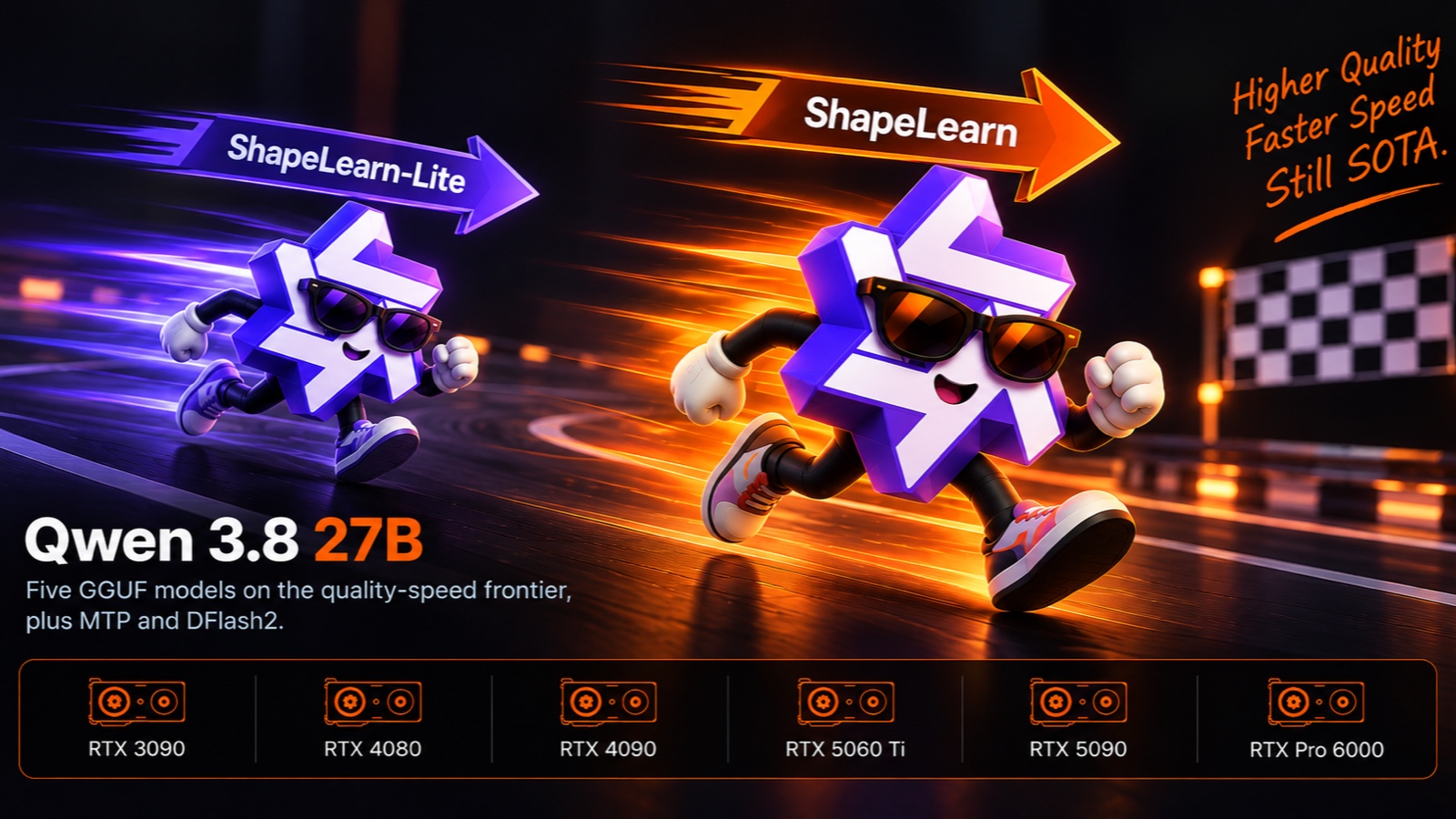
    ByteShape releases full ShapeLearn quantizations for Qwen 3.8 27B, showing that their GPU‑specific GGUFs (GPU‑1…GPU‑5) dominate the quality‑throughput frontier across six GPUs, with GPU‑5 hitting 99.63 % of BF16 accuracy at 90 TPS on a 13.1 GB model. Speculative decoding (MTP, DFlash2) further boosts throughput, and the Lite set remains competitive.

    Hacker News front pagebyteshape.com17 minHN10439
  18. 25

    IntBMoE: Integrating Block-Level Conditioning into Expert Composition for Full-Participation Mixture-of-Experts

    IntBMoE introduces block‑level conditioning to MoE, decoupling token participation, compute execution, and memory materialization. A hypernetwork merges all experts into a composed expert per block, while routing remains sparse. Dual‑Path Residual Gating further mixes two composed paths. Experiments show consistent gains on vision, language, and recommendation tasks, and the model is live in AMap…

    Hugging Face Daily Papersarxiv.org2 minpaper
  19. 26

    CodeMidas: Scaling Agentic Coding RL Environments from Code Itself

    CodeMidas builds RL environments directly from open‑source code: agents explore a repo, infer a spec, generate tests from the original implementation, and filter tasks via execution checks. The pipeline yields 5,545 high‑quality coding tasks across 23 languages and 15 domains. Training the MiMo‑V2.5 agent with GRPO on this dataset improves benchmark scores by 8‑18% (e.g., DeepSWE +11.7%, ProgramB…

    Hugging Face Daily Papersarxiv.org1 minpaper
  20. 29

    Labeled matches: why is this not in every regex engine?

    The author shows how to label tokens (dates, money, emails, etc.) with a single regex pass using extended operators (`&` for intersection, `~` for complement) in the resharp library. A tiny benchmark compares 10 patterns against spaCy’s NER, reporting ~1.9 GB/s (≈4500× faster) on 8 threads. The post lists the concrete patterns and argues that for deterministic, regular‑language entities regex can…

    Lobstersiev.ee7 minHN5lobste.rs27