proomt

Search

Search posts, papers, and topics

All posts

ByteByteGo13 min readintermediate
AI Agents Can Think. Now They Can Pay.

Summary

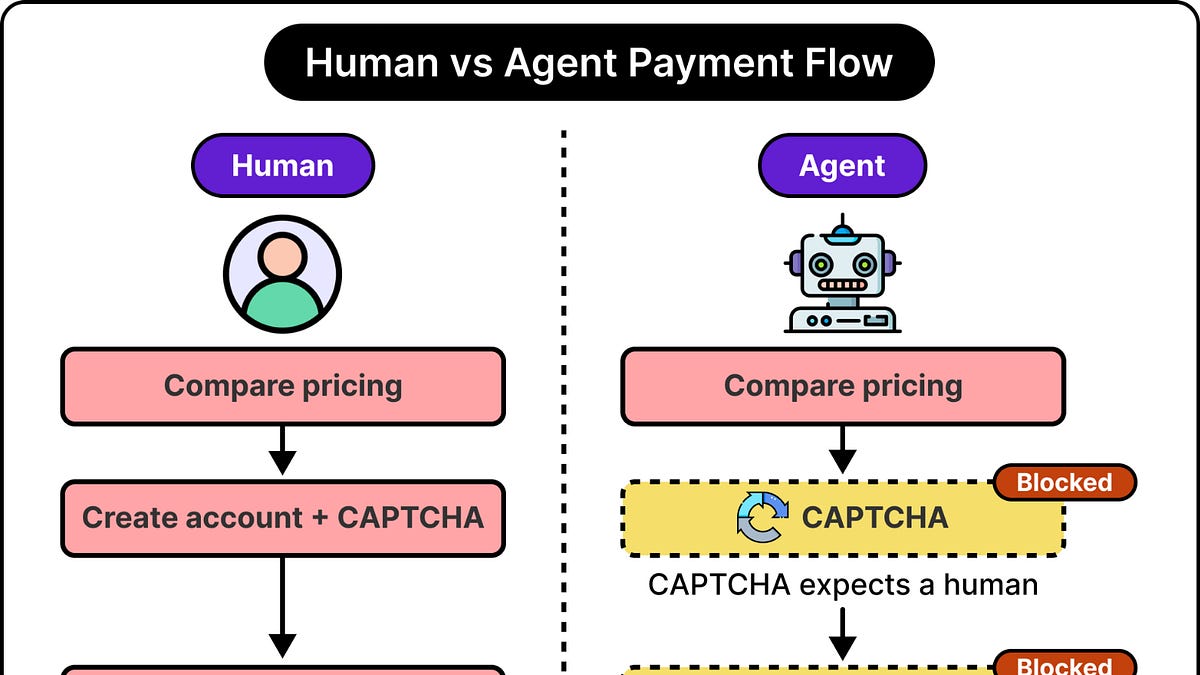
The Machine Payments Protocol (MPP) is a new standard co-authored by Stripe and Tempo, designed to enable AI agents to make direct payments to internet services. It uses HTTP headers and 402 responses to standardize automated transactions, moving away from human-centric payment flows.

  • MPP allows AI agents to make direct payments to internet services using a standardized protocol.
  • The protocol leverages HTTP 402 "Payment Required" responses and specific HTTP headers for transaction flow.
  • Core components include the Challenge (server's payment request), Credential (client's proof of payment), and Receipt (server's confirmation).
  • Payment methods are pluggable, allowing various rails (e.g., card networks, blockchain) to integrate with the core protocol.

This protocol is crucial for developers building autonomous AI agents or services that need to interact financially with agents, as it provides a standardized, machine-readable method for transactions.

6/10
Related reading

  1. Securing Agentic Commerce Using Auth0 and the Universal Commerce Protocol (UCP)

    Auth0 introduces "Auth for UCP" to secure agentic commerce, allowing AI agents to make purchases on behalf of shoppers using the Universal Commerce Protocol (UCP). This solution provides identity verification, scoped access, and audit trails for transactions initiated by AI agents, addressing security and personalization challenges for retailers.

    Auth0auth0.com4 min
  2. APort Vault: Benchmarking AI Agent Payment Authorization with the Open Agent Passport

    APort Vault is a benchmark that replays 4,371 human‑written attacks against a live payment‑handling AI agent across 14 models and multiple policy configurations, generating 225,964 evaluations. Adding the Open Agent Passport pre‑action check eliminated all unauthorized transfers in the test, showing a per‑session breach upper bound of 0.38%.

    Hugging Face Daily Papersarxiv.org2 minpaper
  3. Mila and Mozilla announce new initiative to build trustworthy open source AI for everyone, with Canadian government support

    Mozilla and Mila, backed by $5 M from Mozilla and $1 M from Hypertec plus Canadian government support, announce an open‑source AI foundation layer aimed at letting small organisations run private AI models. The post describes the high‑level vision (open standards + reference implementation) and a two‑year rollout plan, but provides no technical details, design rationale, or measurable results.

    Mozilla Automation Teammozilla.org5 min
  4. Temporal expands its Google Cloud Partnership with Gemini integration and pay-as-you-go pricing on Google Cloud Marketplace

    Temporal added a public‑preview integration with Google’s Gen AI Python SDK, letting Gemini calls survive crashes, and launched Temporal Cloud on Google Cloud Marketplace with pay‑as‑you‑go pricing and a $1,000 starter credit. The updates aim to simplify AI agent orchestration and procurement for teams already on Google Cloud.

    Temporaltemporal.io2 minrelease