Related reading
How to Build a Scalable SVG Icon System for Your Web App
This guide outlines building a scalable SVG icon system using sprites, a shared component for accessibility, and automated sprite generation. It helps prevent inconsistent icons, DOM bloat, and accessibility issues in web applications as they grow.
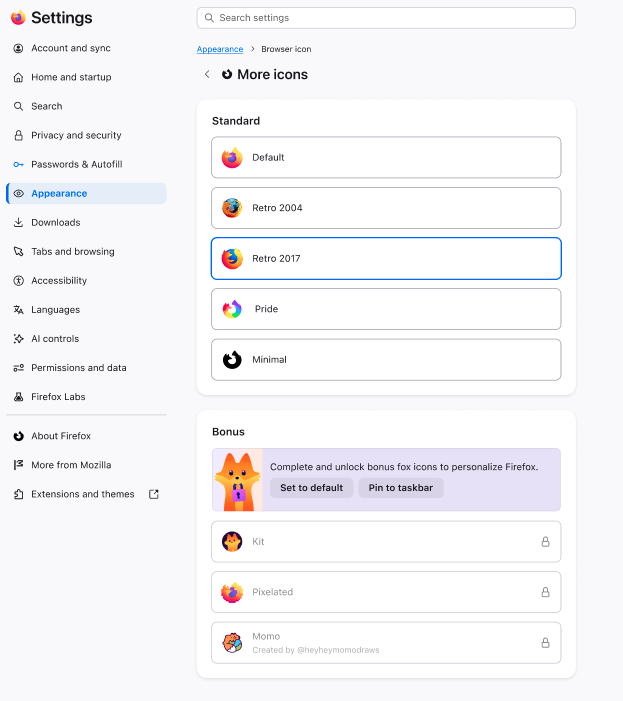
SitePointsitepoint.com5 minIcons! Lots of them! – These Weeks in Firefox: Issue 206
Firefox 154 adds a Windows‑only UI to change the default browser icon, exposes a new Picture‑in‑Picture WebAPI, and ships a raft of small but concrete improvements across Add‑ons, DevTools, WebExtensions, WebDriver and the Rust‑based login storage component. Most changes are toggles or bug‑fixes (e.g., CSS handling in the Debugger, startup‑performance regression fix, storage.local auto‑reset, and…
Mozilla Automation Teammozilla.org13 minCan we make default Tailwind a more accessible choice?
The post examines Tailwind’s default rem‑based breakpoints, showing how they scale with a user’s root‑font‑size and can shift layouts, which helps some users but can break designs. It argues that pixel breakpoints remain a defensible alternative for preserving layout stability while still supporting accessibility.
Freek Van der Hertenfreek.dev1 minUFO: Chain-of-Evaluation for Omni-Condition Alignment in Multi-Modal Image Generation
UFO introduces an Atomized Chain‑of‑Evaluation (AEU) framework that breaks omni‑condition alignment in multi‑modal image generation into a sequential set of fine‑grained checks, achieving a 15.25 % boost in correlation with human judgments. The authors also release UFO‑Bench, a benchmark for testing how well models satisfy combined textual and visual conditions.
Hugging Face Daily Papersarxiv.org1 minpaperDesktop Calendar: A Design Journey
The Thunderbird Automation Team outlines the redesign of the desktop calendar UI, moving to a three‑pane layout (grid, navigation bar, collapsible sidebar) and updating dialogs for better visual hierarchy. Community feedback via surveys and TopicBox shaped the direction, and the new design will be rolled out incrementally for further testing.
Mozilla Automation Teamthunderbird.net5 minHN7327A Zeroth-Order Paradigm for LLM Preference Alignment
The paper proposes Comparison-based Preference Optimization (ComPO), a zeroth‑order method that uses comparison oracles to align LLMs without a differentiable loss. Experiments on several LLM families show it improves win rates and mitigates likelihood displacement compared to direct alignment approaches.
Hugging Face Daily Papersarxiv.org1 minpaper