Related reading
Uber Redesigns M3DB Sharding with Subclusters to Limit Failure Impact
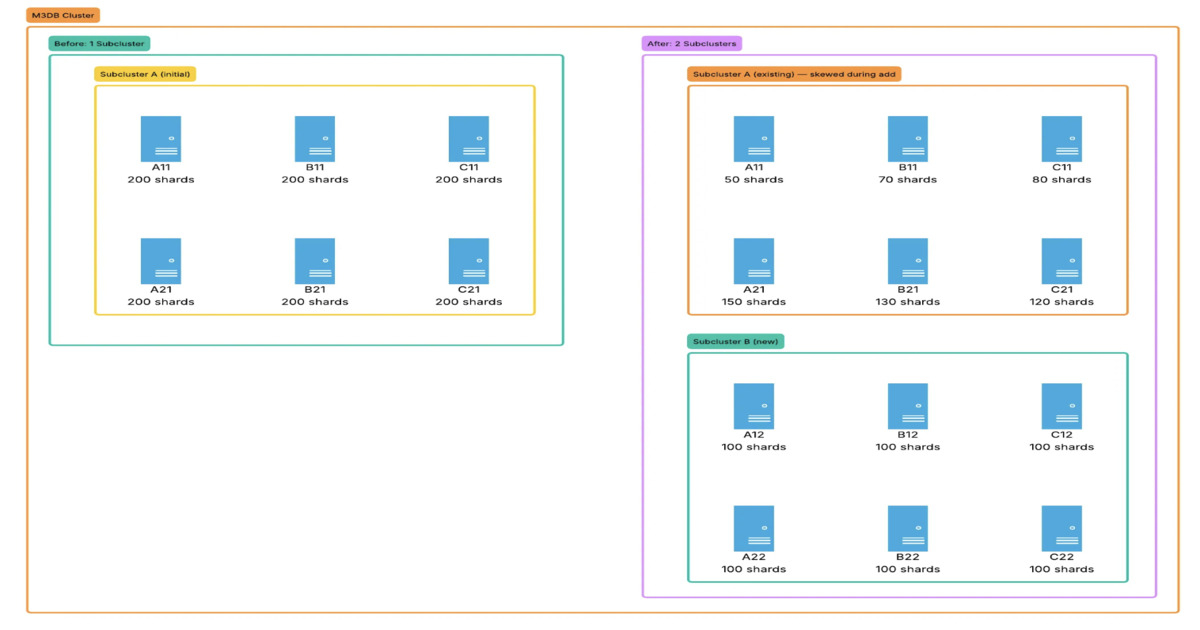
Uber reworked M3DB's shard placement by grouping nodes into fixed-size subclusters, each owning a disjoint shard range, to bound the blast radius of node failures. A greedy shard‑move algorithm (O(S log S) + O(S×N)) handles scaling while preserving existing placement tooling.
InfoQinfoq.com2 minI vibed a proof of Conway's conjecture
The author used Claude to generate a Lean formalisation and proof of Conway’s refinement conjecture for omnific (surreal) integers. The proof passes mechanical checks and informal review but lacks independent verification. The post narrates the workflow, token cost, and reflections on AI‑assisted theorem proving.
Hacker News front pageoverreacted.io32 minHN269294- 1 points
Saving another 100TB of RAM with math (and Rust)
Cloudflare reduced the memory footprint of its Pingora Backend Router by re‑examining the consistent‑hashing implementation in the pingora‑ketama library. By increasing the number of virtual hash points per server from the default 1 to the standard 160 (and applying weighted hashing based on disk capacity), they cut the per‑node overhead enough to reclaim >100 TB of RAM across the fleet. The post…
How to Build a Browser-Based File Integrity Checker with JavaScript
The article walks through building a browser‑based file integrity checker that reads a file, computes its SHA‑256 hash with the Web Crypto API, and compares it to a trusted hash supplied by the user. It also covers handling large files, accessibility, and the security limits of client‑side hashing.
SitePointsitepoint.com5 minThe E-Signature Pricing Models That Bite You in the Production
This tutorial demonstrates building a browser-based file integrity checker using JavaScript's Web Crypto API. It calculates a SHA-256 hash of a local file and compares it against a provided trusted hash, all client-side without server interaction.
SitePointsitepoint.com5 min