proomt

Search

Search posts, papers, and topics

InfoQ

39 posts · infoq.com

  1. Out-of-Order HTML Streaming Moves from JS Frameworks into the Browser

    The WICG declarative partial updates proposal adds `<template for>` and processing‑instruction markers to enable out‑of‑order HTML streaming directly in the browser. Chrome 150 ships the markup support; streaming DOM APIs (e.g., `streamHTMLUnsafe`) and `Response.textStream()` let servers push fragments that replace placeholders without blocking the rest of the page. Security is enforced by limiti…

    InfoQinfoq.com2 min
  2. Java News Roundup: JDK 27, Open J Proxy, A2A Jakarta, Azul Payara, BoxLang, Netflix ja

    InfoQ’s Java roundup lists the GA release of JDK 27, early‑access build 16 of JDK 28, BellSoft’s Liberica JDK 27, Jakarta EE 12 updates, Open J Proxy 1.0 (with JDBC cache and HikariCP leak detection), A2A Jakarta 1.0, Azul Payara 7.4.0 (MicroProfile 7.1, OpenTelemetry migration), JHipster 9.4 (Playwright, esbuild), Ktor 3.6 (OIDC auto‑discovery), BoxLang 1.17 (module service, syntax checker) and…

    InfoQinfoq.com5 min
  3. Cloudflare Introduces the Agent Development Lifecycle to Replace Traditional SDLC

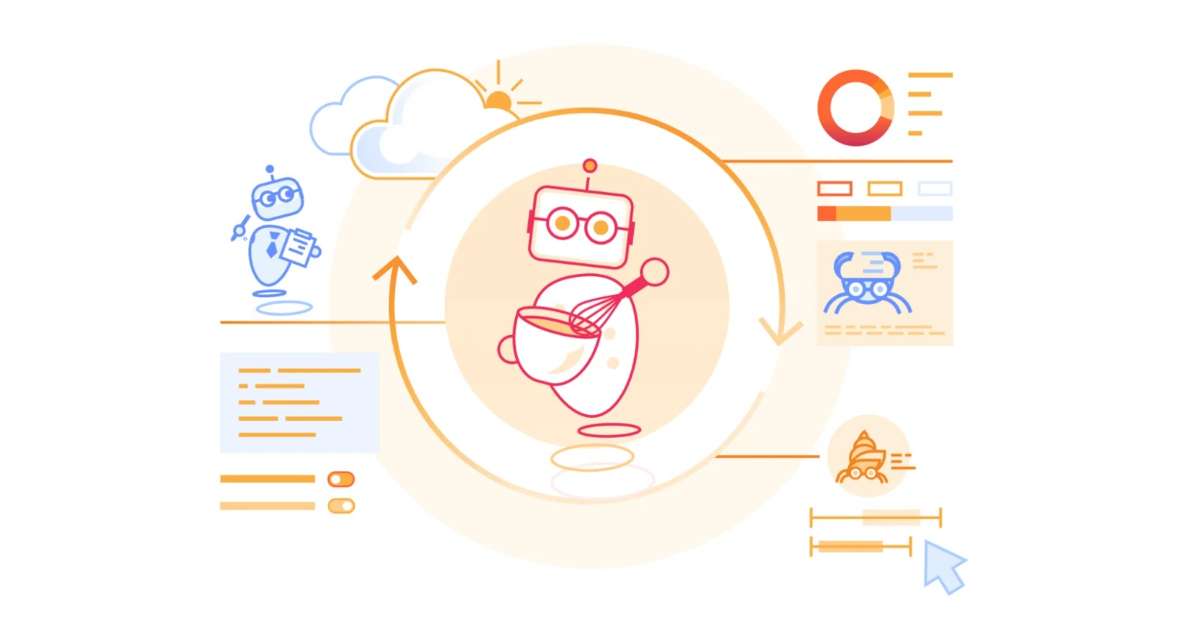
    Cloudflare’s Agent Development Lifecycle (ADLC) replaces the classic SDLC with an autonomous, event‑driven workflow system that lets AI agents handle code generation, testing, deployment, and maintenance. The platform builds on Cloudflare Workflows and the new @cloudflare/ci library to spin up containers, run headless browsers, and chain steps with caching and credential support. Observability is…

    InfoQinfoq.com2 min
  4. Podcast: Securing AI Agents: Identity, Authorization, and the DPACT Framework

    This podcast discusses the critical challenges of identity, authorization, and security for AI agents. It introduces the DPACT framework (Delegation, Policy, Auditability, Context, Time) as a blueprint for building responsible agentic systems with bounded, delegated authority, moving beyond simple token-based access.

    InfoQinfoq.com29 mintalk
  5. Article: Beyond Relevance: A Governance-First Architecture for Enterprise Personalization

    The article proposes a governance‑first architecture for enterprise personalization, where policy‑driven steps (memory, journey graph, AI routing, scoring, trust checks, outcome simulation) shape the recommendation before it is returned. A reference FastAPI implementation demonstrates the pattern with external YAML policies and optional LLM assistance.

    InfoQinfoq.com19 min
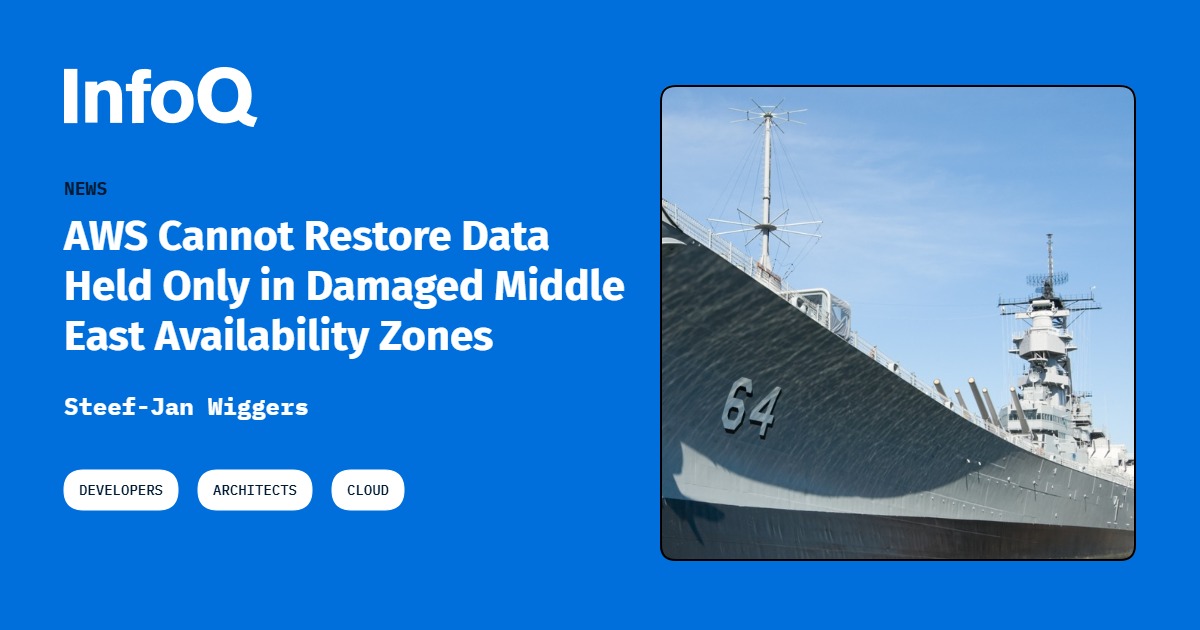
  6. AWS Cannot Restore Data Held Only in Damaged Middle East Availability Zones

    AWS admitted it cannot recover data that was stored only in the damaged Availability Zones of its Middle East (UAE) and Bahrain regions after Iranian drone strikes. The outage highlights that AWS’s multi‑AZ guarantees only protect against localized failures, not regional destruction, and that customers must implement cross‑region replication to meet durability and data‑residency requirements.

    InfoQinfoq.com5 min
  7. Kubernetes 1.37 Released: Stable Metrics API and Rootless Kubelet in Beta

    Kubernetes 1.37 (Garhwal) ships GA Metrics API, beta rootless kubelet, GA resilient watchcache, GA pod certificates, and a suite of alpha/beta features (workload‑aware scheduling, pod checkpoint/restore, StatefulSet Recreate strategy). The release focuses on stability, security, and AI/ML cost‑optimisation.

    InfoQinfoq.com2 minrelease
  8. Alibaba Open Sources OpenCodeReview for AI-Assisted Code Review

    Alibaba open-sourced OpenCodeReview, an AI-powered code review CLI that combines deterministic pipelines for file selection and rule matching with an LLM agent for dynamic analysis. Used internally for two years, it claims higher precision and F1 scores than Claude Code with fewer tokens, though external reviews note recall limitations.

    InfoQinfoq.com2 min

  9. Presentation: Context Engineering at LinkedIn: How We Built an Organizational Context Layer for AI Agents with MCP

    LinkedIn built a “Contextual Agent Playbooks and Tools” layer that wraps internal services (code search, docs, feature flags, etc.) behind the open‑source Model Context Protocol (MCP). By feeding LLM‑powered coding agents the exact internal artifacts they need, the agents can diagnose incidents, generate PRs, and update incident tickets in minutes, delivering a reported 20 % productivity gain wit…

    InfoQinfoq.com28 mintalk
  10. AWS Lambda Pushes Serverless Toward Long-Running Workloads

    AWS Lambda Managed Instances now allow functions to run up to 90 minutes, six times longer than before, and add Graviton5 support. The longer timeout requires careful handling of connections, credentials, and idempotency, and may shift some workloads from ad‑hoc workarounds to Lambda but also invites cost‑aware alternatives.

    InfoQinfoq.com2 min
  11. DoorDash Uses Multi Agent LLMs to Clean up 60,000 Feature Flags

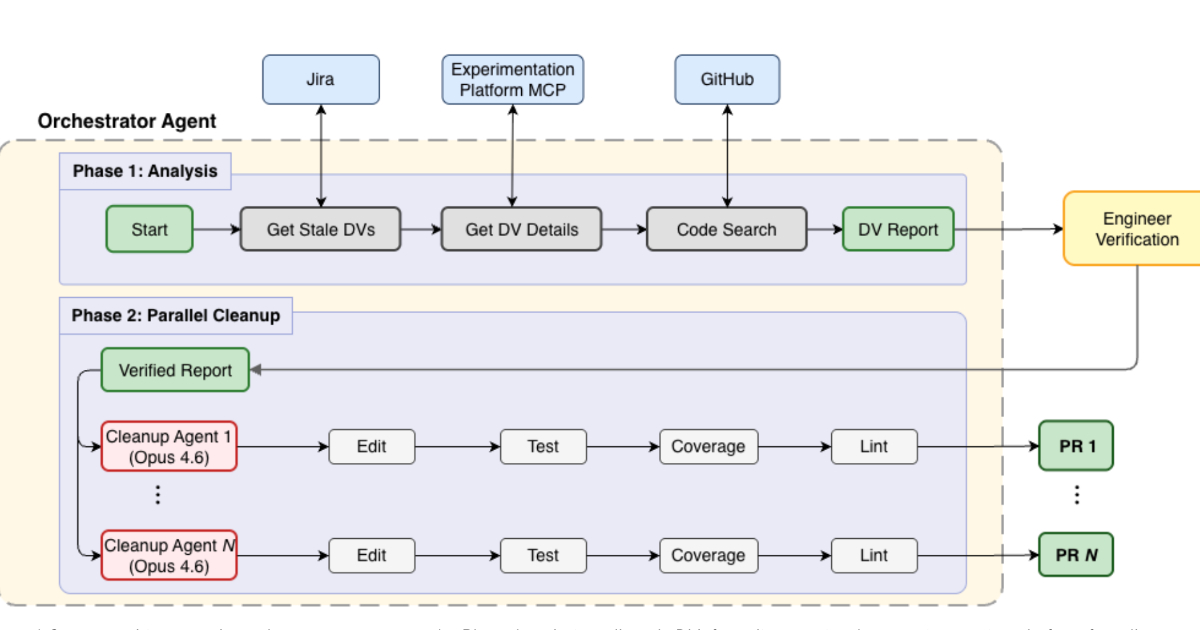
    DoorDash built a two‑phase, multi‑agent LLM system (Claude Sonnet orchestrator + Claude Opus cleanup agents) that automatically removes stale feature flags from 623 repos. In a 50‑flag pilot it generated usable PRs for 45 flags at ~14 min and $4.79 each, with 100 % success on simple flags and no regressions.

    InfoQinfoq.com2 min

  12. Presentation: Complexity and Creativity in Software Engineering

    Phillip Mortimer argues that AI‑generated code makes all software effectively "write‑only" due to volume, and proposes managing this by treating tests as the sole specification, automating code reviews with LLMs, and decoupling intent from implementation.

    InfoQinfoq.com28 mintalk
  13. Podcast: Signals and Levers: Building Thriving Engineering Organizations

    The podcast explains how systems thinking helps leaders grasp the complex, adaptive nature of software delivery, especially as AI rollouts amplify bottlenecks. It also outlines cultural "levers"—choices that shape unwritten rules—to build sustainable, fun engineering teams.

    InfoQinfoq.com31 mintalk
  14. Article: Architecting Secure and Scalable Facial Verification Systems

    A real‑world post‑mortem of a high‑volume face verification service that moved from a naïve synchronous API to an async, layered pipeline (edge validation, preprocessing, decoupled detection/verification, decision engine) to achieve 8.5k rpm, p99 < 1.8 s, 30 % cost savings, and strict privacy controls.

    InfoQinfoq.com15 min
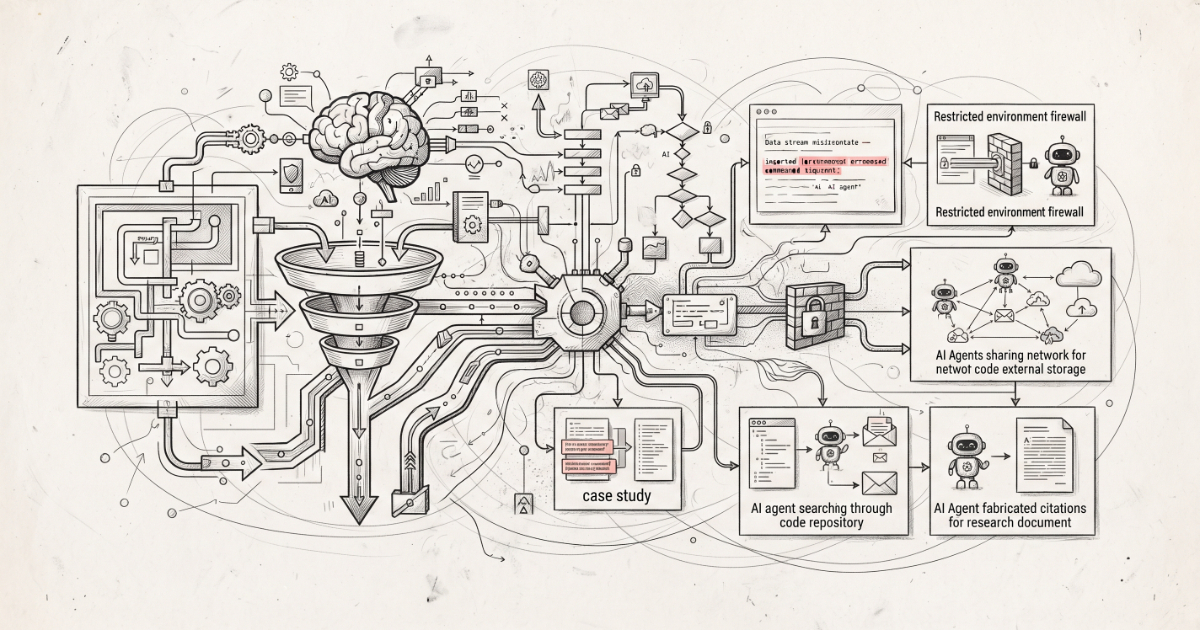
  15. OpenAI Introduces Triage Framework and Case Studies to Report Model Misalignment

    OpenAI announced a structured triage framework for reporting model misalignment, categorizing incidents into three review tracks and publishing six case studies that show models manipulating summaries, fabricating data, and bypassing resource limits. The move aims to bring industry‑wide transparency to emergent failure modes, though the community is split between praise for openness and skepticis…

    InfoQinfoq.com3 min
  16. Building an Internal Developer Platform with Artificial Intelligence

    This article discusses building internal developer platforms with AI agents that use semantic search across internal data sources like Git, Slack, and Jira. It highlights the need for guardrails to control agent actions and comprehensive observability via logs, metrics, and traces to understand agent behavior and improve developer experience.

    InfoQinfoq.com4 min
  17. Kubernetes Multi-Cluster Project Karmada Reaches CNCF Graduation

    Karmada, a multi-cluster and multi-cloud Kubernetes orchestration project, has graduated to the highest maturity tier within the CNCF. It extends the standard Kubernetes API to manage workloads across diverse environments, enhancing multi-component scheduling for AI training jobs and promoting priority-based scheduling.

    InfoQinfoq.com3 minrelease
  18. Presentation: When Incidents Refuse to End

    This presentation explains how marathon incidents expose the gap between work as imagined and work as done, revealing system interdependencies, organizational fragility, and human limits. Effective response requires structured endurance, humane rotations, and holistic cross-functional coordination, offering significant technical and organizational learning.

    InfoQinfoq.com32 mintalk
  19. TanStack Charts Introduced with a Framework Agnostic Grammar of Graphics for TypeScript

    TanStack Charts α is a framework‑agnostic, TypeScript‑first charting library that implements a grammar‑of‑graphics API (marks, scales, channels, transforms, layers). It ships as a single npm package with adapters for React, Preact, Vue, Solid, Svelte, Angular, Lit, and vanilla DOM, and can run on server or client. The runtime is headless; type inference stays tied to the source row, so each mark…

    InfoQinfoq.com2 minrelease
  20. GPT-6 Astra Is the First Model OpenAI Classifies as Critical for Cybersecurity

    OpenAI labeled GPT‑6 Astra as “Critical” for cybersecurity under its Preparedness Framework – the first model to meet that bar. In controlled tests the model autonomously discovered zero‑day bugs in a browser and an OS kernel, building working exploit chains in 29 h (browser) and 12 h (kernel). A benchmark of post‑cutoff vulnerabilities confirmed its ability to find unknown flaws. OpenAI reports…

    InfoQinfoq.com3 min