Related reading
GAVEL: Graph World Models for Verified and Efficient Long-Horizon LLM Task Planning
GAVEL augments LLM‑driven robot planners with an explicit graph world model that verifies actions, repairs violations, and reasons over belief distributions, boosting single‑task success from 41 % to 92 % and multi‑task success from 20 % to 93 % on BEHAVIOR‑1K.
Hugging Face Daily Papersarxiv.org1 minpaperOn-Demand Masked Sessions with Twilio Proxy, Voice and Serverless
A step‑by‑step tutorial showing how to build a Just‑in‑Time masked‑call workflow with Twilio Voice, Proxy, and Sync, using a two‑bounce out‑of‑session pattern to collect a tracking code via IVR, resolve the counterpart’s number, stash it in Sync, and auto‑create a Proxy session on the fly—all deployed as Twilio Serverless Functions.
Twiliotwilio.com18 minBuilding Deterministic Multi-Agent State Machines in TypeScript
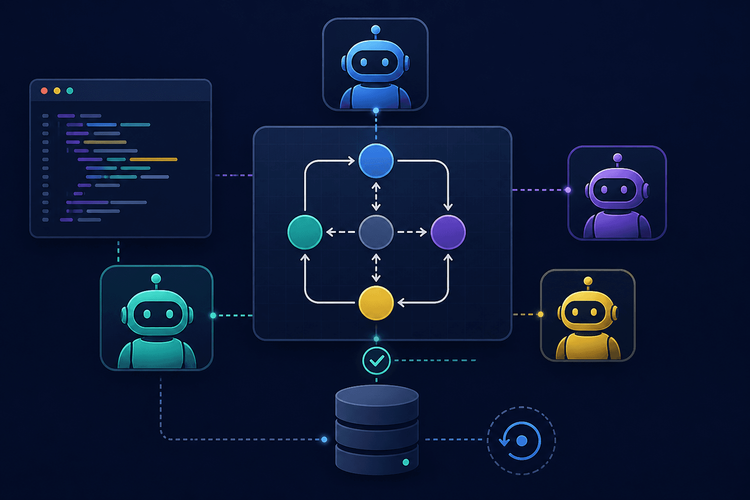
The article shows how to build a deterministic, checkpoint‑backed finite state machine engine in TypeScript for orchestrating multi‑agent AI workflows. It uses Zod for schema validation, better‑sqlite3 for atomic persistence, and a pure transition function to make workflows traceable and recoverable in serverless environments.
SitePointsitepoint.com18 minHuRo: Robotizing Human Videos for Scalable VLA Pretraining
The paper introduces a pipeline that converts heterogeneous human videos into robot‑aligned observations and actions, creating the 630K‑episode HuRo dataset. Pretraining vision‑language‑action (VLA) policies on this data boosts real‑world manipulation success from ~51% to ~80% and improves out‑of‑distribution robustness.
Hugging Face Daily Papersarxiv.org1 minpaperOpenTelemetry everywhere: Migrating a metrics platform at scale
Atlassian replaced its decade‑old gostatsd‑based metrics pipeline with a fully OpenTelemetry‑based stack by keeping the StatsD‑UDP contract on the client side and swapping in purpose‑built OTel Collector distributions for collection, ingest, aggregation, and forwarding. The migration was done incrementally, saved ~3.9% CPU per service, cut sidecar cost ~30% fleet‑wide, halved aggregation CPU, and…
Transferring the Intelligence of VLMs to Robotic Control
RoboDawn lets a vision‑language model (VLM) drive a robot via a tiny discrete command set (translate/rotate/gripper). Using a few in‑context demos, the VLM learns the interface and task strategy, then runs closed‑loop: observe image → reason → act → re‑observe. On the RoboTwin 2.0 C2R benchmark RoboDawn hits 53.2 % success zero‑shot, 73.6 % with one demo (vs. 46 % baseline). On RoboDojo it goes f…
Hugging Face Daily Papersarxiv.org1 minpaper