proomt

Search

Search posts, papers, and topics

All posts

GitHub OldMargaret Tucker5 min readintermediate

Developer policy update: Transparency, state policy, and what’s ahead

Summary

GitHub updated its transparency reporting, showing a significant increase in government takedown requests due to revised counting methods, not more content removals. The company also detailed its engagement in 2026 state legislative sessions, influencing AI transparency and age assurance laws to protect open source projects from unintended impacts.

  • GitHub's reported government takedown requests surged in H1 2026 due to expanded reporting, not increased content removals.
  • Community engagement helped refine California's AI Transparency Act (SB 1000) to be compatible with open source licenses.
  • Broad definitions in age assurance laws (e.g., California, Illinois) could unintentionally impact open source tools and developer infrastructure.
  • GitHub advocates for developer input in policy-making, especially for DMCA exemptions and AI regulations affecting open source.

Developers and open source maintainers should care as evolving government policies on AI transparency, age assurance, and copyright directly impact how they can build, distribute, and use software.

6/10

Related reading

  1. Git v2.56.0 released

    Git v2.56.0 has been released, featuring 748 non-merge commits from 104 developers. Key updates include a safer conflict resolution workflow, a new `git history drop` subcommand, and smaller path-walk repacks, alongside various usability and performance enhancements.

    LWN.netlwn.net51 minrelease
  2. The 2026 State of Code Abundance Report: Exposing the Enterprise AI Readiness Gap

    A report highlights a significant gap between enterprise confidence in AI-generated code and operational reality, with 81% of leaders reporting increased production issues despite high readiness scores. This "code abundance" means code is generated faster than organizations can effectively test, govern, and manage it, leading to challenges in cost attribution and governance.

    Codeshipcloudbees.com5 min
  3. Inside ZCode: Silently uploading your Git history to the cloud

    ZCode (Zhipu’s AI coding desktop) silently archives your entire workspace—including full .git history, LFS cache, and config—encrypts it with a server‑supplied RSA public key, and uploads the ciphertext directly to Aliyun OSS. The upload runs unconditionally for any logged‑in user, cannot be disabled via UI, and the decryption key lives only on the server, giving Zhipu full read access to your co…

    Hacker News front pageferstar.org6 minpostmortemHN336113
  4. How we AI-updated 1,138 Error-code Docs Pages

    Twilio built a two‑phase pipeline that first scores each error‑code doc with a deterministic script, then feeds only low‑scoring pages to an LLM (gpt‑5.4) using a strict prompt. The model’s diff is applied via git, linted, and opened as a PR for a reviewer. In 12 weeks they updated 1,138 pages (≈34.6 s/page) with a human reviewing every change, cutting manual effort from an estimated 18 k hours a…

    Twiliotwilio.com11 min
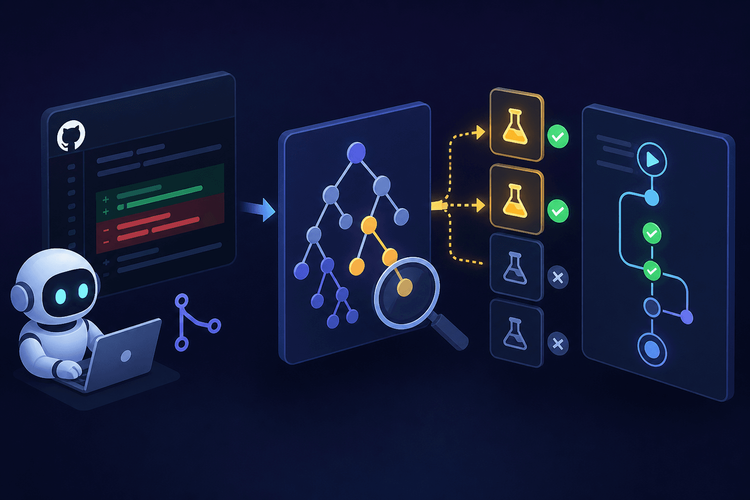
  5. Optimizing GitHub Actions for Agent PRs: Speculative Test Slicing and AST Impact Analysis

    A step‑by‑step guide for handling the flood of pull requests generated by code‑generation agents. It builds a TypeScript CLI that uses ts‑morph to do AST‑level change‑impact analysis, maps affected symbols to tests, and runs only those tests in a “speculative” GitHub Actions job while a full‑suite verification runs in the background. The article includes concrete CLI code, dependency choices, con…

    SitePointsitepoint.com17 min