proomt

Search

Search posts, papers, and topics

All posts

Hacker News front page6 min readintermediate
I asked Meta’s Muse for its filesystem and it sent me 6.8GB

Summary

The author prompted Meta’s Muse AI agent to archive its visible filesystem and export it to Google Drive, receiving a 2.7 GB compressed (6.8 GB unpacked) zip. The archive revealed the full Linux container used for the session, including Ubuntu system files, internal documentation, skill definitions, a “Spaces” TypeScript app framework, bubblewrap sandbox binaries, and SSH keys. Detailed listings…

  • Muse’s runtime container can be instructed to archive and export its entire filesystem, exposing system binaries, internal docs, and SSH keys.
  • The exported layout reveals a complex agent architecture: Markdown‑based memory, skill modules, a TypeScript “Spaces” framework, and sandboxed media processing via bubblewrap.
  • Meta’s bug‑bounty response classified the report as “Not Applicable”, leaving the security impact unclear.

Exfiltrating an AI agent’s full runtime environment via a normal conversation bypasses typical isolation assumptions, potentially leaking internal code, credentials, and integration configurations. The finding highlights the need for stricter output sanitization and export controls in LLM‑driven ag…

6/10

Related reading

  1. Introducing Filestore agent volumes: fully managed storage for agent workspaces

    Google Cloud adds Filestore agent volumes, a fully‑managed, elastic file‑system that automatically provisions isolated POSIX workspaces for GKE‑based AI agent sandboxes. Volumes attach in milliseconds, support RWX with file‑level locking, and charge only for used capacity with automatic tiering, aiming to cut cold‑start latency and storage waste for large‑scale agent fleets.

    Google Cloud Bloggoogle.com4 min
  2. Muse, Meta's extraordinarily privileged AI assistant, has a serious 0-day

    A zero‑day in Meta’s macOS AI assistant Muse lets any local app or terminal command steal the user’s authentication token by changing an undocumented setting that redirects transcription to an attacker‑controlled server. The flaw enables a simple ClickFix‑style attack that can write files, snap pictures, and exfiltrate data, and was patched by Meta within 12 hours.

    Hacker News front pagearstechnica.com6 minHN11048
  3. Inside ZCode: Silently uploading your Git history to the cloud

    ZCode (Zhipu’s AI coding desktop) silently archives your entire workspace—including full .git history, LFS cache, and config—encrypts it with a server‑supplied RSA public key, and uploads the ciphertext directly to Aliyun OSS. The upload runs unconditionally for any logged‑in user, cannot be disabled via UI, and the decryption key lives only on the server, giving Zhipu full read access to your co…

    Hacker News front pageferstar.org6 minpostmortemHN336113
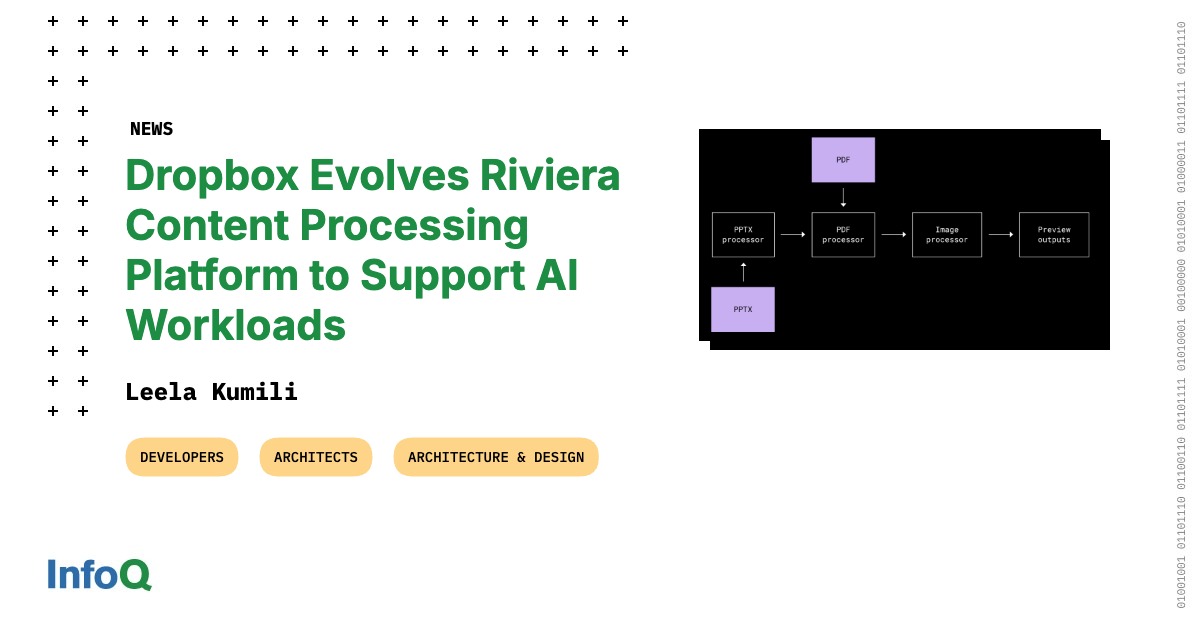
  4. Dropbox Evolves Riviera Content Processing Platform to Support AI Workloads

    Dropbox’s Riviera platform has been expanded from a preview service into a universal, composable content‑processing system that now handles hundreds of thousands of transformations per second across 300+ file types. The architecture separates orchestration from execution, adds a plugin model, and offers async public APIs so internal and external AI workloads can reuse cached transformations.

    InfoQinfoq.com2 min
  5. 1 points

    Saving another 100TB of RAM with math (and Rust)

    Cloudflare reduced the memory footprint of its Pingora Backend Router by re‑examining the consistent‑hashing implementation in the pingora‑ketama library. By increasing the number of virtual hash points per server from the default 1 to the standard 160 (and applying weighted hashing based on disk capacity), they cut the per‑node overhead enough to reclaim >100 TB of RAM across the fleet. The post…

    Hacker News front pagecloudflare.com13 minHN478120lobste.rs33
  6. Accelerating the borderless Lakehouse: Announcing preview of cross-cloud caching

    Google Cloud previewed cross‑cloud caching for its Borderless Lakehouse. The feature caches sub‑file Parquet blocks in Google Cloud, encrypts them with GMEK, isolates cache per tenant/region, and validates freshness via metadata checks. In tests it can reduce cross‑cloud data transfer to <5% of the original size, lowering query latency and cost for Iceberg tables stored in other clouds. BigQuery…

    Google Cloud Bloggoogle.com3 minrelease