proomt

Search

Search posts, papers, and topics

All posts

Hacker News front page3d retro graphics2 min readintermediate
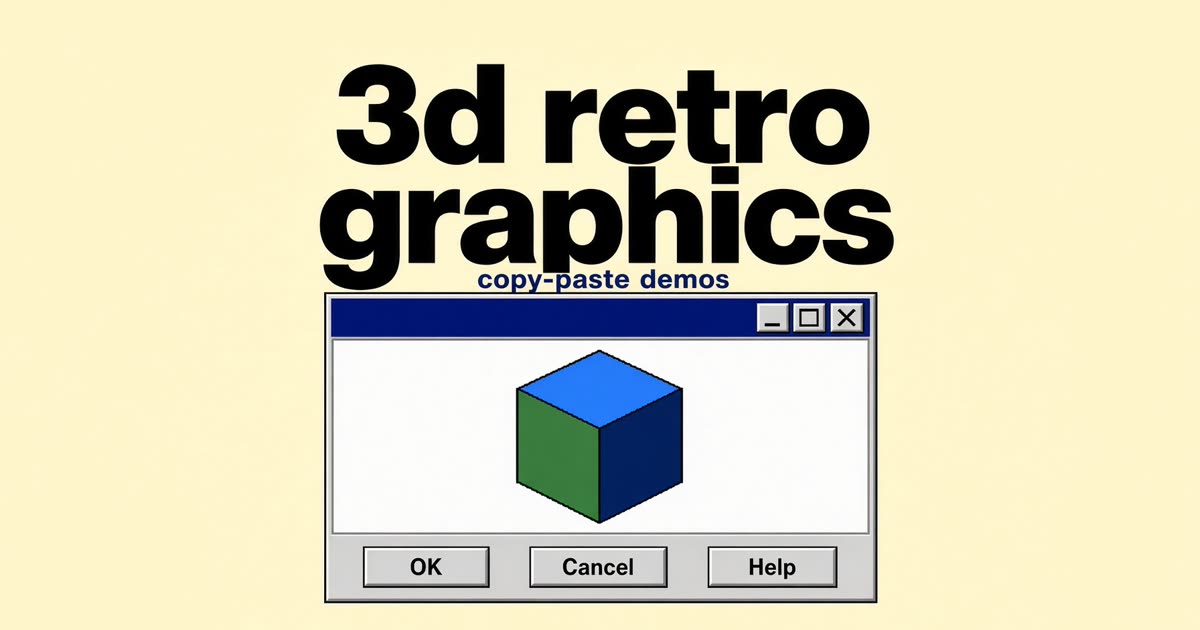
Show HN: A CC0 museum of retro 3D tricks you can paste into a page

Summary

This site is a CC0-licensed museum of retro 3D graphics tricks, offering copy-pasteable demos from various eras (1970s-2000s). It provides implementations for effects like plasma, raytracers, and voxel rendering, usable with WebGL 1 or 2D canvas.

  • Collection of 30+ retro 3D graphics demos, from Demoscene to workstation tricks.
  • Each demo is copy-pasteable, designed for WebGL 1 or 2D canvas.
  • Covers historical techniques like Wolfenstein raycasting, Voxel Space, and SNES Mode 7.
  • Includes classic algorithms such as Metaballs, Navier-Stokes fluid, and Whitted raytracing.

Web developers and graphics enthusiasts can use this resource to explore historical computer graphics techniques, learn from practical implementations, or quickly integrate nostalgic visual effects into their projects.

8/10

Related reading

  1. SNAP3D: Physically Grounded 3D Parts for Assembly from a Single Image

    The paper presents SNAP3D, a physics‑guided pipeline that converts a single image into a set of 3D parts that can be assembled without interpenetration. By using simulation‑driven connector placement and a new physics‑based evaluation, the method yields assemblies that are both geometrically accurate and stable enough for 3D printing.

    Hugging Face Daily Papersarxiv.org1 minpaper
  2. Flip Fluid on Flip Dots

    The author built a FLIP fluid simulation on a flip-dot display, overcoming challenges with sourcing panels and their slow, matrix-driven update mechanisms. The solution involves using cheap H-bridge motor driver chips to individually control dots, requiring modification of existing panel PCBs.

    Hacker News front pagemitxela.com51 minHN39826
  3. CADWorld: Computer-Use Benchmark for Long-Horizon Computer-Aided Design

    CADWorld is a new benchmark suite of 200 long‑horizon mechanical CAD tasks in FreeCAD, covering sketching, part modeling, assembly, CAM, FEM, and more. Agents interact via screenshots and GUI actions; success is checked by executable validation of the saved CAD artifacts. Seven existing agents achieve at most 17.5 % success versus an 87 % expert baseline, highlighting the gap between GUI competen…

    Hugging Face Daily Papersarxiv.org1 minpaper
  4. LEGO-Anything: Coding Agents for 3D Scene Reconstruction

    LEGO-Anything is an Image-to-Code framework where a coding agent iteratively writes and executes Blender code to reconstruct 3D scenes from single images. It introduces LEGO-Bench for evaluation, showing GPT-6-astra performs best but struggles with scene initialization and self-evaluation, which LEGO-Plugin helps mitigate.

    Hugging Face Daily Papersarxiv.org2 minpaper