Related reading
Bypassing inference bottlenecks: Accelerating complex AI search with Retrieve-for-Train
Retrieve-for-Train addresses LLM inference bottlenecks in complex AI search by using offline reinforcement learning to train a lightweight diffusion model. This enables efficient, single-pass generation of diverse, property-aligned sub-queries, bypassing slow autoregressive reasoning.
Google Researchresearch.google8 minHN2BI-Agent and BI-Bench: Towards Automating End-to-End Business Intelligence
The paper introduces BI‑Bench, a new benchmark of real‑world BI questions derived from public dashboards, and BI‑Agent, a tool‑augmented LLM system that breaks BI workflows into search, join, and transform subtasks. Baseline LLMs hit <50 % accuracy on BI‑Bench. By orchestrating specialized data‑management tools and post‑training the model with supervised fine‑tuning and reinforcement learning on…
Hugging Face Daily Papersarxiv.org2 minpaperSelf-Evolving Search Index
The paper introduces SELF-INDEX, a framework that lets a search index automatically diagnose retrieval failures, revise its keys, and validate changes, using a query simulator to anticipate future queries. Experiments show consistent gains across corpora and downstream LLM agents.
Hugging Face Daily Papersarxiv.org1 minpaperAustralia's AI opportunity starts with data
Elastic argues that Australia’s AI rollout hinges on solid data foundations and observability, not bigger models, and calls for a dedicated data pillar in the national AI plan.
Elasticelastic.co4 minBuilding an Internal Developer Platform with Artificial Intelligence
This article discusses building internal developer platforms with AI agents that use semantic search across internal data sources like Git, Slack, and Jira. It highlights the need for guardrails to control agent actions and comprehensive observability via logs, metrics, and traces to understand agent behavior and improve developer experience.
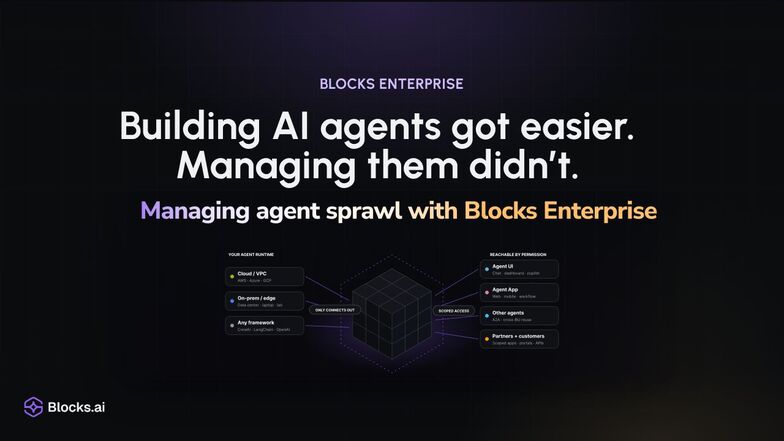
InfoQinfoq.com4 minBuilding AI Agents got easier; managing them didn’t: Managing agent sprawl with Blocks Enterprise
Building AI agents is now easy, but as deployments grow into dozens or hundreds, companies lose visibility into ownership, usage, and cost—a problem called agent sprawl. Blocks Enterprise offers a private network that lets heterogeneous agents be discovered, permissioned, and audited across clouds without forcing a single framework.
PubNub:pubnub.com4 min