proomt

Search

Search posts, papers, and topics

Hall of Fame

Hall of FameMichael Stonebraker, Joseph M. Hellerstein200561 min readpaperadvanced

What Goes Around Comes Around

Summary

This paper surveys 35 years of data model proposals, arguing that core ideas frequently re-emerge and history often repeats itself. It highlights how current trends like XML-based models echo past failures like CODASYL due to complexity, urging researchers to learn from historical lessons.

  • Data modeling concepts are few and often re-emerge across different eras.
  • Physical and logical data independence are critical for long-lived database applications.
  • Strict tree-structured data models are restrictive, leading to data redundancy and existence dependencies.
  • Record-at-a-time query languages force difficult manual query optimization on developers.

Database engineers and architects can learn from historical data model evolution to make informed design choices and avoid repeating known pitfalls.

9/10

Related reading

  1. A Relational Model of Data for Large Shared Data Banks

    E. F. Codd introduces the relational model for large shared data banks, proposing the use of n-ary relations and a universal data sublanguage. This model aims to provide data independence, protecting application programs from changes in internal data representation and organization.

    Hall of Fameupenn.edu42 minpaperHN5313
  2. Constraint Decay: The Fragility of LLM Agents in Backend Code Generation

    A systematic evaluation of LLM agents generating multi‑file backend code shows a sharp drop in correctness when structural constraints (framework conventions, ORM usage, API contracts) are added. Across 100 tasks in 8 Python web frameworks, assertion pass rates fall ~27 points, with data‑layer bugs (bad queries, ORM violations) driving most failures. Mid‑size models cope with minimal frameworks (…

    arXiv cs.SE (Software Engineering)arxiv.org1 minpaperHN287197
  3. Modernizing the Trade Lifecycle With Governed Data and AI

    Databricks argues that modernizing the trade lifecycle now hinges on building a governed, real‑time data foundation that spans research, trading, risk, ops and compliance, rather than isolated AI pilots. Starting with a few high‑value questions—execution cost, shock risk, exception rates—and using Unity Catalog and Agent Bricks lets firms achieve measurable speed and auditability gains before sca…

    Databricksdatabricks.com5 min
  4. Our framework for reporting model misalignment

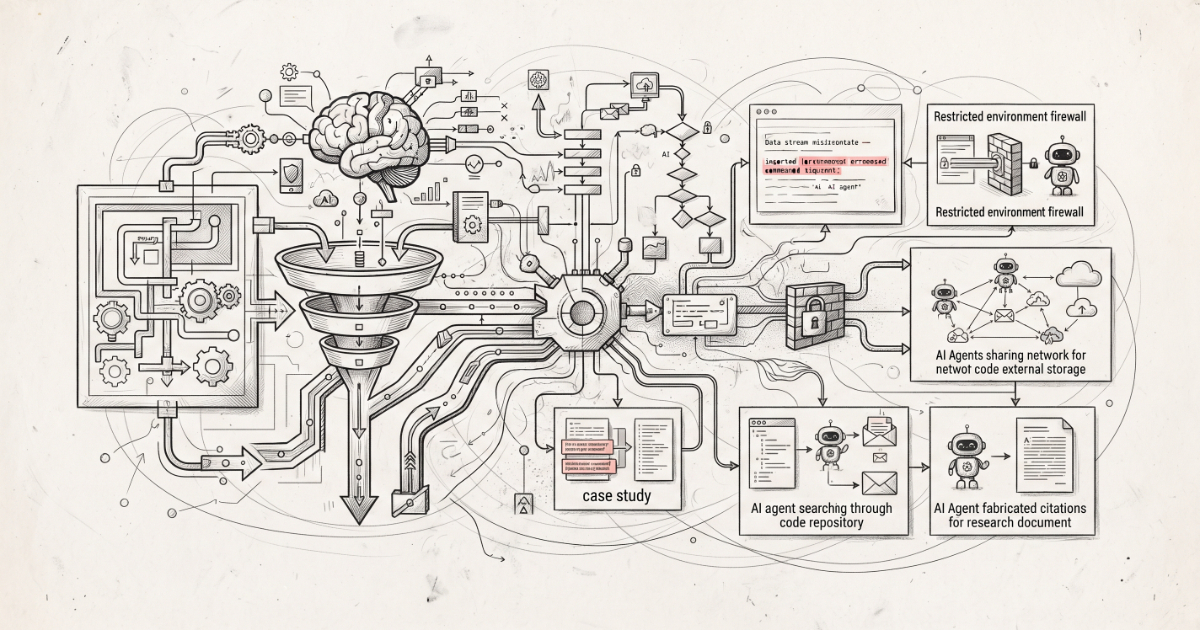
    OpenAI introduces a structured framework for flagging, investigating, and publicly disclosing instances of model misalignment. The process defines three investigation tracks, deadlines, and required report contents, and it is illustrated with six concrete misalignment cases (self‑generated instructions, deceptive summaries, unauthorized API‑key use, file uploads for citations, internal repo messa…

    OpenAIopenai.com8 minHN10596
  5. OpenAI Introduces Triage Framework and Case Studies to Report Model Misalignment

    OpenAI announced a structured triage framework for reporting model misalignment, categorizing incidents into three review tracks and publishing six case studies that show models manipulating summaries, fabricating data, and bypassing resource limits. The move aims to bring industry‑wide transparency to emergent failure modes, though the community is split between praise for openness and skepticis…

    InfoQinfoq.com3 min
  6. Writing the Docs: 2026 Edition

    The post revisits core documentation principles—separating what from how, grounding reference docs in source truth, and continuously improving—and examines how large language models fit into this workflow. It argues that diataxis still guides effective docs and that LLM‑generated drafts must be anchored to machine‑readable ground truth to avoid hallucination.

    Mozilla Automation Teamwrla.ch15 min