A marketing‑focused announcement for Flat.social, a browser‑based 3‑D spatial meeting platform that lets users walk around, talk via spatial audio/video, and run virtual events. The post contains only product descriptions and user praise, with no technical implementation details, architecture, or performance data.
Timothy Gowers explains why he didn't sign a letter from Fields medallists concerning AI's impact on mathematics. He argues that mathematical motivation exists on a spectrum, not solely focused on conceptual understanding, and explores how AI's rapid problem-solving could affect individual and collective understanding.
The Chaos Computer Club is announcing its 40th Congress (40C3) from Dec 27‑30 2026 in Hamburg, inviting speakers, artists, musicians, and punk performers via multiple calls for participation.
Cloudflare open‑sources a “security‑audit” skill that turns an LLM‑enabled coding agent into a structured vulnerability auditor. It runs six deterministic phases, validates findings against a JSON schema, and supports additive runs to improve coverage.
Researchers filmed a humpback whale mother staying with her stillborn calf for hours, marking the first documented postmortem attendance in baleen whales. The finding suggests strong maternal attachment and calls for more systematic study of death‑related behavior in large whales.
Modern cargo ships are increasingly being fitted with wind‑assisted propulsion systems such as rotor sails and suction sails, which can shave a few percent off fuel use. With over 100 vessels already equipped and major players like Maersk testing new installations, the technology is moving from demo to commercial adoption despite integration and regulatory hurdles.
A Python tool for macOS that replaces expensive LLM‑driven UI automation with a cheap, deterministic classifier (TypeSafe) for per‑step decisions, cutting cost by ~150‑300× and latency by ~10‑40× while still handling text entry via a small writer model.
BITCOS is a distribution‑aware storage layout for ternary LLM weights that replaces the standard five‑trit packing. By storing a presence bitmap and a compact sign vector, it reduces the effective bits‑per‑weight to 2 − z (z = zero density), achieving as low as 1.485 b/w on sparse models. The authors provide AVX‑512, AVX2, and Xe2 GPU unpacking kernels and show up to 1.28× speedup in matrix‑vecto…
Backups involve more than copying files; you need snapshot rotation, deduplication, and off‑site storage to meet RPO goals while controlling storage and bandwidth. Using proven tools like Borg or Restic and regularly testing restores simplifies the mental load.
The authors audit six popular physics benchmarks by having domain experts re‑grade model outputs, fixing reference answers and removing ambiguous items. After correction, GPT‑5.6‑Sol’s mean@4 jumps from ~47 % to ~79 % on HLE‑Physics and from ~61 % to ~87 % on CMT‑Benchmark, with a corrected pass@4 of 94 % on 54 vetted CritPt challenges. The work shows current benchmarks severely under‑report LLM…
Hacker News front page·arxiv.org·Ali Ansari, Haoran Sun, Andy Zeyi Liu, Mark Jabbour, Yongshan Ding, Steven Girvin, Yu He, Sohrab Ismail-Beigi, Aleksander Kubica, Owen D. Miller, Corey O'Hern, Vidvuds Ozolins, David Poland, A. Douglas Stone, Frank C. van den Bosch, Logan Wright, Navid Akbari, Santanu Antu, Kangle Cai, Andrew Calabrese-Day, Mateo Cárdenes Wuttig, Meng Cheng, Barry T. Chiang, Ali Ghorashi, Shouzhen Gu, Haoyang Huang, Zhibo Kang, Lukas Kienesberger, Hantian Liu, Charles Lomba, Zhongling Lu, Wenchao Ma, Rohin E. McIntosh, Evan McKinney, Ivan Rojkov, Xulei Sun, Yarone Meir Tokayer, Naveen Balaji Umasankar, Mira Varma, Leda Wang, Qimin Wang, Tyler Wang, Haoyu Wei, Jinming Yang, Jinchen Zhao, Sherlock Tingrui Zhao, Qinyuan Zheng, Jay S. Zou, Lucas Baker, Arman Cohan, John Sous··2 min·paperHN9650
The authors reverse‑engineer AMD’s CDNA matrix cores, build per‑architecture MATLAB models that match hardware bit‑for‑bit on 10 M random tests, and use them to compare AMD vs NVIDIA tensor‑core accuracy.
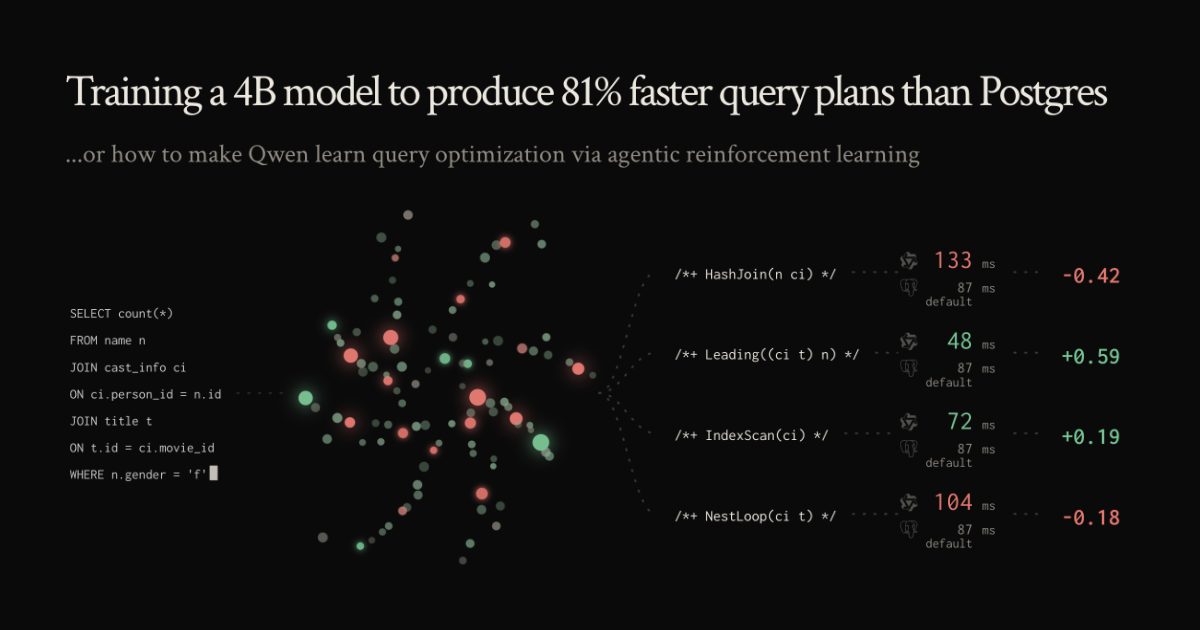
A 4‑billion‑parameter open‑weight LLM, fine‑tuned with supervised learning and a custom RL loop, learns to emit PostgreSQL join plans that cut query latency by 44.7 % on a 113‑query benchmark. The author built a low‑noise measurement harness, a GRPO‑style reward function, and ran off‑policy distillation from ~500 GPT‑6‑style trajectories, demonstrating that a modest model can outperform Postgres’…