proomt

Search

Search posts, papers, and topics

kubernetes

RSS
  1. 1

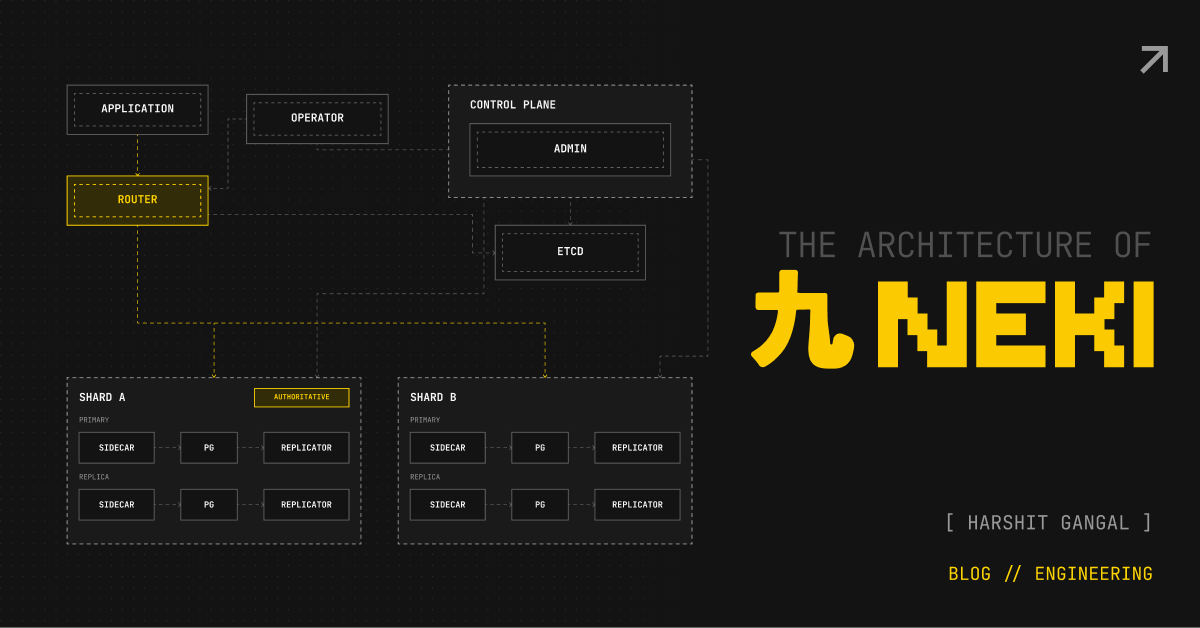
    The architecture of Neki

    Neki is PlanetScale’s sharding layer for vanilla PostgreSQL that presents a single Postgres endpoint while routing queries across a fleet of Postgres instances. It does this with a set of tightly‑coupled components—Router, Sidecar, PostgresManager, Admin, Operator, and etcd‑backed Data Topology—each handling a specific piece of the scaling, failover, and query‑planning puzzle.

    PlanetScaleplanetscale.com8 min

  2. 2

    Lyft Moves Streaming Fleet to Apache Flink Kubernetes Operator

    Lyft migrated its hundreds of production Flink jobs from a home‑grown Kubernetes operator to the Apache Flink Kubernetes Operator, gaining last‑state upgrades, in‑place autoscaling, and resource autotuning while cutting typical deployment downtime to 3–6 minutes. The switch also enabled Flink 1.19 features, saved millions in over‑provisioned capacity, and required workload‑specific scaling strate…

    InfoQinfoq.com3 min
  3. 3

    Kubernetes v1.37: Hardening Container Storage with Bind Mount Options and EmptyDir Permissions

    Kubernetes v1.37 adds two alpha‑level storage hardening knobs: per‑volume `bindMountOptions` (e.g. noexec, nosuid, nodev) that affect the bind‑mount the runtime creates, and an `emptyDir` `mode` field to set Unix permission bits (including the sticky bit). Together they let you enforce least‑privilege policies on writable volumes without init‑containers or CSI tricks.

    Kuberneteskubernetes.io8 minHN3
  4. 4

    Running OpenBao on Kubernetes with a CloudNativePG PostgreSQL backend

    Step‑by‑step recipe to run OpenBao (Vault fork) on Kubernetes using CloudNativePG as a password‑less, TLS‑authenticated PostgreSQL storage backend. Shows how to spin up a Kind cluster with the cnpg‑playground, deploy a 3‑node CNPG cluster with synchronous quorum replication, configure DatabaseRole‑based client certificates, set up pg_hba rules, and initialize OpenBao’s schema via a one‑off Job.

    CNCFcncf.io16 minHN2
  5. 5

    Introducing Filestore agent volumes: fully managed storage for agent workspaces

    Google Cloud adds Filestore agent volumes, a fully‑managed, elastic file‑system that automatically provisions isolated POSIX workspaces for GKE‑based AI agent sandboxes. Volumes attach in milliseconds, support RWX with file‑level locking, and charge only for used capacity with automatic tiering, aiming to cut cold‑start latency and storage waste for large‑scale agent fleets.

    Google Cloud Bloggoogle.com4 min
  6. 7

    Kubernetes v1.37: Pod-Level Resource Managers graduated to Beta

    Kubernetes v1.37 adds Pod‑Level Resource Managers to beta (off by default). The feature lets Kubelet’s Topology, CPU, and Memory managers consume pod‑level `.spec.resources` to reserve exclusive NUMA‑aligned CPUs/memory for primary containers while sidecars share a pod‑isolated pool. A new PodResources gRPC API now reports `cpu_ids` and `memory` per pod. Enable via the `PodLevelResourceManagers`…

    Kuberneteskubernetes.io2 min
  7. 8

    Microsoft Open-Sources TauGrid to Simplify AI Workload Management on Kubernetes

    Microsoft open‑sourced TauGrid, a Helm‑installable platform that bundles Kueue, KubeRay and other components to schedule, monitor and checkpoint AI workloads on GPU‑enabled Kubernetes clusters. Engineers define jobs in a simple `tau.yaml`, and TauGrid handles queuing, health checks, and observability, simplifying AI workload management.

    InfoQinfoq.com2 min
  8. 9

    For SeaVerse, GKE Agent Sandbox reduces infrastructure costs by 60%

    SeaVerse uses GKE Agent Sandbox (Kata Containers + Cloudhypervisor or gVisor) to run isolated AI sandboxes at scale, achieving 300 allocations / s per cluster (90% ≤ 200 ms) and cutting infrastructure spend by up to 60% via flexible VM sizing and per‑sandbox persistent storage, while gaining native Cloud observability.

    Google Cloud Bloggoogle.com5 min
  9. 10

    Kubernetes 1.37 Released: Stable Metrics API and Rootless Kubelet in Beta

    Kubernetes 1.37 (Garhwal) ships GA Metrics API, beta rootless kubelet, GA resilient watchcache, GA pod certificates, and a suite of alpha/beta features (workload‑aware scheduling, pod checkpoint/restore, StatefulSet Recreate strategy). The release focuses on stability, security, and AI/ML cost‑optimisation.

    InfoQinfoq.com2 minrelease
  10. 11

    Agent Substrate brings high-density, scalable, trusted infrastructure to GKE

    Agent Substrate is an open‑source runtime for AI agents that runs on GKE. It uses Cloud Hypervisor microVMs or gVisor sandboxes to give kernel‑level isolation, a custom control‑ and data‑plane that can suspend/resume agents in <500 ms, and a “zero‑idle” model that packs >1 000 dormant agents per host (≈10× density vs. containers). GKE integration adds custom ComputeClasses, spot/on‑demand pools,…

    Google Cloud Bloggoogle.com6 min
  11. 12

    Kubernetes Multi-Cluster Project Karmada Reaches CNCF Graduation

    Karmada, a multi-cluster and multi-cloud Kubernetes orchestration project, has graduated to the highest maturity tier within the CNCF. It extends the standard Kubernetes API to manage workloads across diverse environments, enhancing multi-component scheduling for AI training jobs and promoting priority-based scheduling.

    InfoQinfoq.com3 minrelease
  12. 13

    What I learned organizing KCD Lima 2026

    KCD Lima 2026 drew 2,244 registrations (900+ attendees), 60 speakers, and 11 sponsors, marking 75% growth over 2025. The organizer shares hard data and concrete takeaways: budgeting across currencies, vendor onboarding, venue layout, and the need for better coffee capacity, session timing, pre‑registration, and gender balance. The post also highlights the community profile (45% from finance, 15%…

    CNCFcncf.io7 minpostmortem
  13. 14

    Monitor TAS and gang scheduling for AI training in Kubernetes

    Kubernetes’ default scheduler can’t satisfy AI training’s need for low‑latency GPU interconnects and simultaneous pod start‑up. The blog explains how the open‑source Kueue job queue adds topology‑aware placement (using node labels like `topology.kubernetes.io/rack`) and how the Coscheduling plugin adds a permit phase that only binds a gang of pods when the full set is ready, preventing idle GPU r…

    Datadogdatadoghq.com19 min
  14. 15

    AWS Elastic Beanstalk introduces Cluster Mode

    AWS Elastic Beanstalk now offers a fully‑managed Cluster Mode that runs multiple applications on a shared Amazon EKS cluster, handling containerization, scaling, patching and observability automatically. It adds AI‑driven troubleshooting, OpenTelemetry support and standard deployment strategies while charging only for the underlying AWS resources.

    AWSamazon.com5 minrelease
  15. 16

    CloudBees CI Disaster Recovery(DR) proof of concept using Velero

    The post describes a proof‑of‑concept DR setup for CloudBees CI on EKS using Velero with custom patches for cross‑region EBS snapshot replication, achieving 15‑minute RPO and sub‑hour RTO. It also outlines the required backup of $JENKINS_HOME, metadata, DNS switch, and the experimental nature of the patches.

    Codeshipcloudbees.com12 min
  16. 17

    Migrating to Java 17: The Hows, Whys, and Whens

    A product‑focused overview of CloudBees CD/RO’s new integration with Argo Rollouts, describing the supported blue‑green and canary strategies, service‑mesh compatibility, and UI/analytics features. No deep technical walkthrough or performance data.

    Codeshipcloudbees.com6 min
  17. 18

    KubeCon + CloudNativeCon North America 2026: Your Week in Salt Lake City

    KubeCon + CloudNativeCon NA 2026 runs Nov 9‑12 in Salt Lake City, offering four days of keynotes, breakout sessions, maintainer tracks, and co‑located events covering Kubernetes, AI, observability, security, and platform engineering. In‑person attendance (All‑Access Pass) is needed for hands‑on ContribFests and CNCF‑hosted events; recordings will be posted later.

    CNCFcncf.io6 min