Related reading
Postgres on NVMe: performance and the convergence of transactions and analytics
Local NVMe storage cuts Postgres I/O latency from ms to µs, yielding ~9× higher TPS and 10× lower transaction latency on a 482 GiB pgbench workload. The gain comes from reduced IO wait, not more CPU work. To retain durability, combine NVMe with quorum synchronous replication and continuous WAL archiving (WAL‑G). For analytics, offload scans to ClickHouse via WAL‑based CDC (pg_clickhouse or the ne…
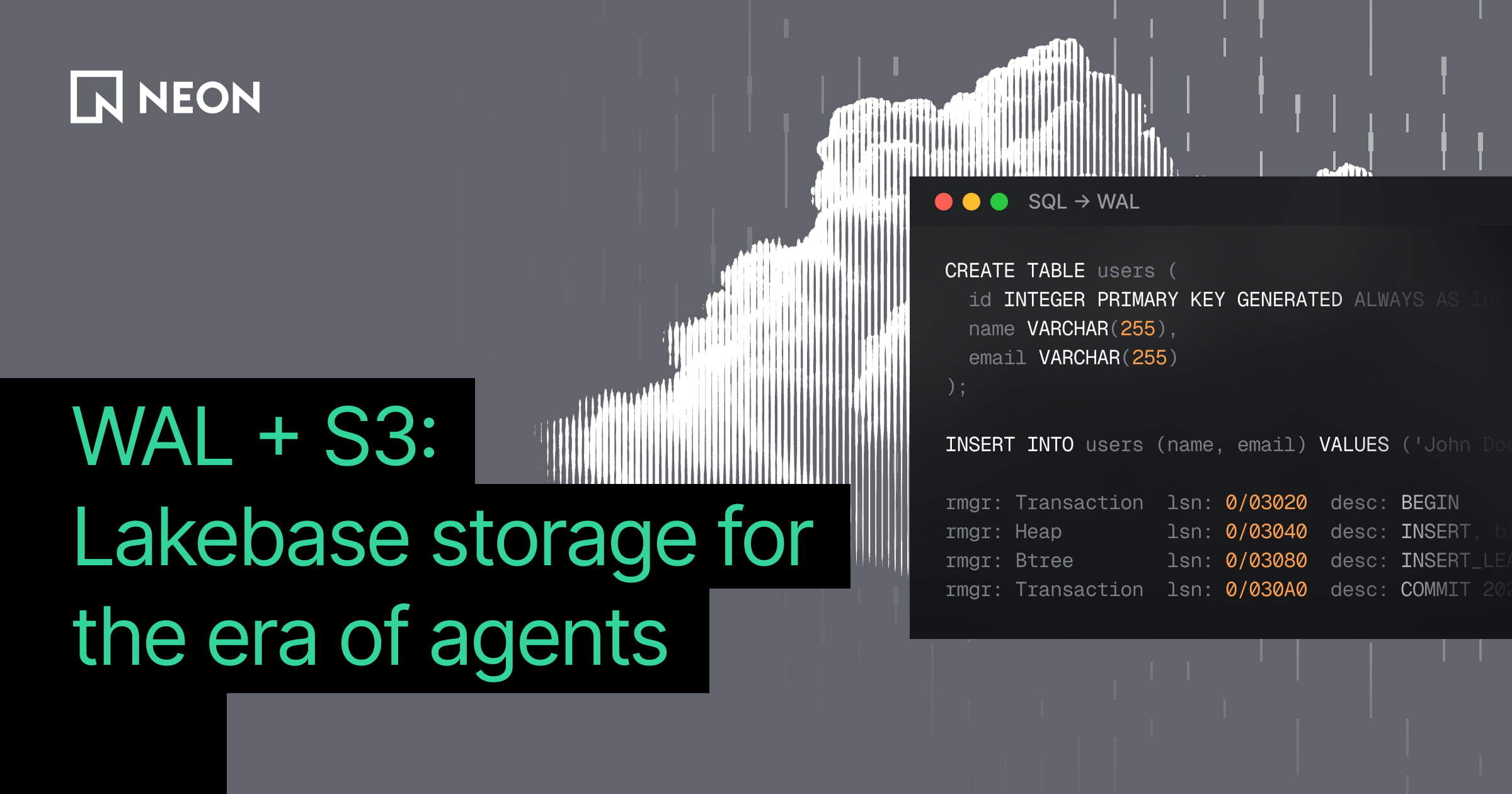
ClickHouseclickhouse.com8 minWAL + S3: Lakebase storage for the era of agents
Neon's Lakebase Postgres redefines database storage by making the WAL the source of truth, stored on S3, rather than data files. This transaction-centric approach enables instant branching, time travel, and scalable, decoupled compute and storage for Postgres.
Database Branching: A Developer's Guide to Git-Style Workflows
Database branching uses copy‑on‑write to give developers, CI jobs, and AI agents isolated database snapshots without full copies. Branches share unchanged data, store only deltas, and are disposable, enabling production‑like testing, per‑PR isolation, safe experimentation, and rapid cleanup. Safe operation requires protecting parent branches, using mock data, TTLs, and treating migrations as the…
Databricksdatabricks.com9 minAmazon Aurora: Design Considerations for High Throughput Cloud-Native Relational Databases
Amazon Aurora is a cloud-native relational database that decouples compute from storage, offloading redo log processing to a purpose-built, multi-tenant storage service. This architecture significantly reduces network I/O, enables fast crash recovery, and provides high durability and availability through a novel 6-way replication quorum model.
Hall of Famestanford.edu47 minpaperAccelerating the borderless Lakehouse: Announcing preview of cross-cloud caching
Google Cloud previewed cross‑cloud caching for its Borderless Lakehouse. The feature caches sub‑file Parquet blocks in Google Cloud, encrypts them with GMEK, isolates cache per tenant/region, and validates freshness via metadata checks. In tests it can reduce cross‑cloud data transfer to <5% of the original size, lowering query latency and cost for Iceberg tables stored in other clouds. BigQuery…
Google Cloud Bloggoogle.com3 minrelease