proomt

Search

Search posts, papers, and topics

All posts

TwilioAmanda Lange16 min readtutorialintermediate
How to Orchestrate Multi-Call Conversations with an LLM and Twilio Conversation Memory

Summary

A step‑by‑step tutorial for building a C# ASP.NET Core service that uses Twilio Conversation Memory and OpenAI’s gpt‑4o‑mini to retain caller context across multiple phone calls, with full code snippets, environment setup, and prompts for both real‑time response streaming and call summarization.

  • Twilio Conversation Memory stores per‑caller state (preferences, action history) that survives call drops and reconnections.
  • The guide shows how to create a Memory Store in the Twilio console and retrieve its ID for API use.
  • C# code demonstrates wiring OpenAI’s chat client, constructing system prompts, streaming token‑by‑token responses over a WebSocket, and summarizing the call for storage.
  • Configuration is managed via a .env file with Twilio API keys, Memory Store ID, and OpenAI API key.

Persisting conversational context across phone calls eliminates the frustration of having to repeat information, enabling more natural and efficient voice‑based AI assistants. The tutorial provides a concrete, production‑ready pattern for integrating LLMs with Twilio’s memory service, which can be…

6/10

Related reading

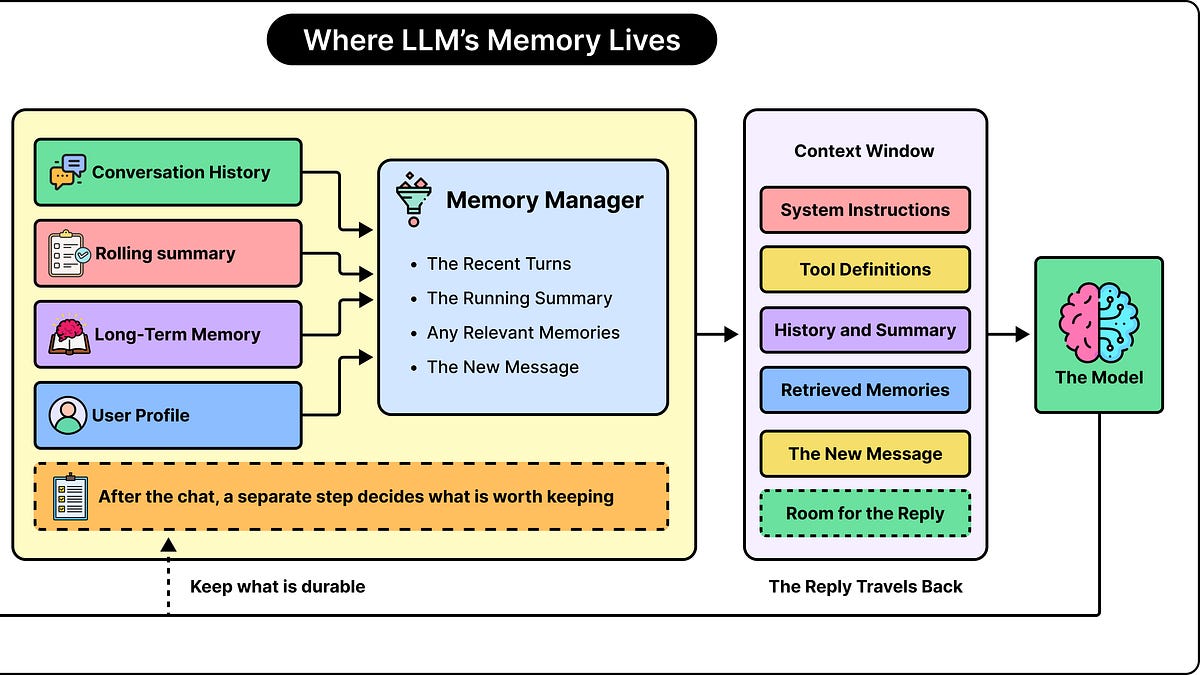
  1. Do LLMs Have the Memory of a Goldfish?

    The article explains that LLMs don’t have persistent personal memory; all “memory” is supplied by the surrounding application via the context window, summaries, or external storage. It outlines the distinction between trained weights, working‑memory (token context), and persistent application memory, shows how to construct API calls to preserve conversation state, and discusses the cost and laten…

    ByteByteGobytebytego.com12 min
  2. 9 top conversational AI platforms in 2026

    Twilio’s blog lists the nine leading conversational‑AI platforms for 2026, highlighting how the market consolidated and what capabilities matter when choosing a vendor. It details Twilio’s own infrastructure tools—ConversationRelay, Agent Connect, Orchestrator, and Memory—showing sub‑second latency and full‑stack reliability for voice and messaging.

    Twiliotwilio.com12 min
  3. On-Demand Masked Sessions with Twilio Proxy, Voice and Serverless

    A step‑by‑step tutorial showing how to build a Just‑in‑Time masked‑call workflow with Twilio Voice, Proxy, and Sync, using a two‑bounce out‑of‑session pattern to collect a tracking code via IVR, resolve the counterpart’s number, stash it in Sync, and auto‑create a Proxy session on the fly—all deployed as Twilio Serverless Functions.

    Twiliotwilio.com18 min
  4. How to Connect Your Twilio Agent to External APIs with PHP

    A step‑by‑step tutorial showing how to build a Twilio voice agent in PHP (using OpenSwoole) that calls OpenAI’s gpt‑4o‑mini model and can invoke an external REST API (Cat Facts) via tool‑calling, wiring everything together with Twilio Conversation Relay and a WebSocket server.

    Twiliotwilio.com11 min
  5. Quiz: How to Get Started With Ollama

    This is a 10‑question quiz that checks your grasp of installing Ollama, pulling models, choosing between chat and generate APIs, and managing multi‑turn conversations in Python. It reinforces the basics of running LLMs on your own hardware for privacy and offline use.

    Real Pythonrealpython.com1 min
  6. Shared Selective Persistent Memory for Agentic LLM Systems

    Apple proposes a memory architecture for agentic LLMs that selectively persists reusable context (specs, schemas, configs, constraints) across sessions and users. Shared workspaces with role‑based access and a zero‑token data‑refresh mechanism cut token usage by 97×, reduce task time by 14×, and raise task‑completion rates to 96% versus 71%‑79% for baselines.

    Apple Machine Learning Researchapple.com1 minpaper