proomt

Search

Search posts, papers, and topics

All posts

ByteByteGo12 min readintermediate
Do LLMs Have the Memory of a Goldfish?

Summary

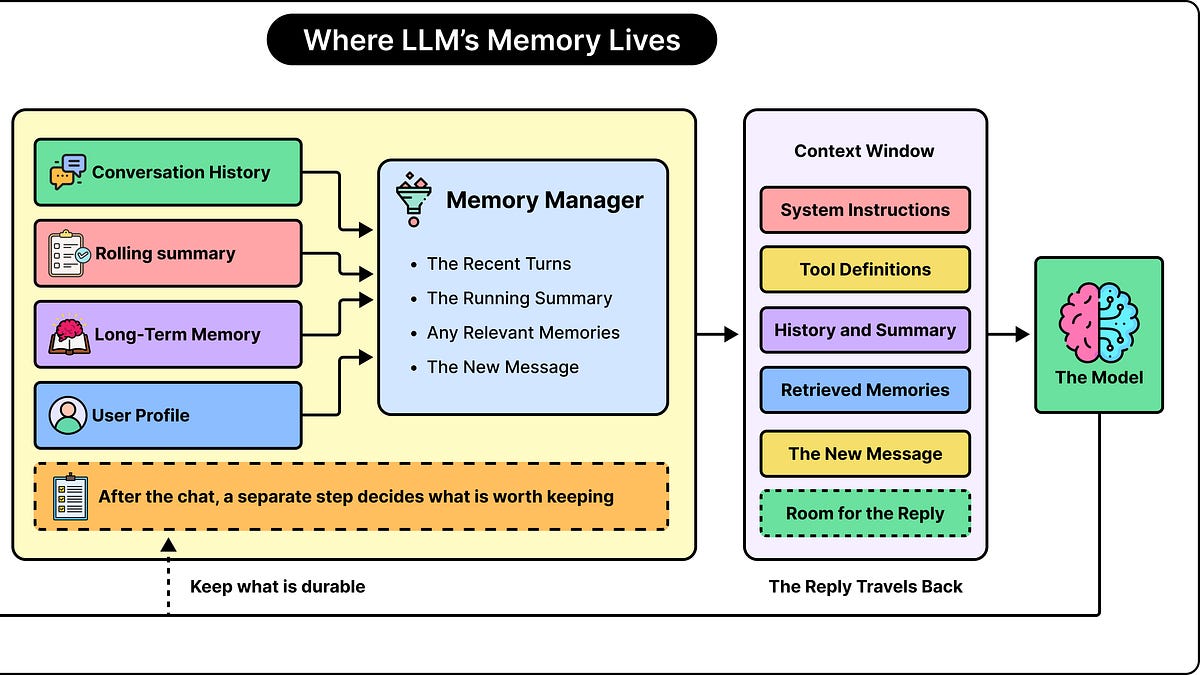
The article explains that LLMs don’t have persistent personal memory; all “memory” is supplied by the surrounding application via the context window, summaries, or external storage. It outlines the distinction between trained weights, working‑memory (token context), and persistent application memory, shows how to construct API calls to preserve conversation state, and discusses the cost and laten…

  • LLMs only retain information that is explicitly included in the prompt (the context window); they cannot remember across calls on their own.
  • Applications must manage conversation history, summaries, and external data stores to give the model the illusion of memory.
  • Context windows are a finite token budget; as conversations grow you must prune, compress, or replace older content to stay within limits.
  • Longer contexts increase both token cost and latency, and can cause “context rot” where the model struggles to surface the right facts.

Understanding the separation between model weights and application‑level memory is essential for building cost‑effective, low‑latency AI agents that can handle multi‑turn interactions without blowing up token usage.

5/10


Related reading

  1. Shared Selective Persistent Memory for Agentic LLM Systems

    Apple proposes a memory architecture for agentic LLMs that selectively persists reusable context (specs, schemas, configs, constraints) across sessions and users. Shared workspaces with role‑based access and a zero‑token data‑refresh mechanism cut token usage by 97×, reduce task time by 14×, and raise task‑completion rates to 96% versus 71%‑79% for baselines.

    Apple Machine Learning Researchapple.com1 minpaper
  2. Verifiable Social Reasoning for LLM Assistants

    The paper introduces Fuse, a multi‑agent simulation that gives LLM assistants a verifiable ground‑truth task for social reasoning by hiding a target agent’s motive and letting a user‑mediated conversation infer it. Experiments on 12 LLMs show user mediation makes reasoning harder, models are biased by user framing, need more detail than humans, and longer chats don’t always help.

    Hugging Face Daily Papersarxiv.org1 minpaper
  3. Constraint Decay: The Fragility of LLM Agents in Backend Code Generation

    A systematic evaluation of LLM agents generating multi‑file backend code shows a sharp drop in correctness when structural constraints (framework conventions, ORM usage, API contracts) are added. Across 100 tasks in 8 Python web frameworks, assertion pass rates fall ~27 points, with data‑layer bugs (bad queries, ORM violations) driving most failures. Mid‑size models cope with minimal frameworks (…

    arXiv cs.SE (Software Engineering)arxiv.org1 minpaperHN287197