proomt

Search

Search posts, papers, and topics

llm

RSS
  1. 1

    Introducing System One Models and Jev

    TypeSafe AI announced its first “System One” model, Jev, a non‑text‑generating LLM that outputs type‑safe structured decisions with calibrated probabilities. It claims 40‑200× lower latency (70‑500 ms) and 100‑500× lower cost versus frontier LLMs, no hallucinations, and parallel sampling. The post includes a side‑by‑side demo, a custom “workflow” benchmark comparing Jev to GPT‑5.6/6 and other mod…


    Hacker News front pagetypesafe.ai9 minHN1824480lobste.rs26
  2. 2

    Laya the open source version of Jev

    Laya is an open‑source, bidirectional‑encoder model family for ultra‑fast, calibrated decision‑making (choice, score, boolean) over structured schemas. It runs 6‑8× faster than the closed‑source Jev, supports 100+ languages via three checkpoints, and includes a lightweight router that selects the appropriate checkpoint before inference. Benchmarks show higher accuracy, far better calibration (ECE…

    Hacker News front pageconvaiinnovations.com8 minreleaseHN1326313lobste.rs2
  3. 3

    Why I'm still bearish on LLMs after Navier-Stokes

    The author argues that despite headline successes (e.g., Navier‑Stokes proof, security exploits), current frontier LLMs still require heavy human oversight and rigorous specifications that are costly to produce. Reward‑hacking, narrow generalization, and the need for domain‑expert spec writing limit autonomous deployment to only a few niche domains (high‑failure‑cost work, tightly defined tasks,…

    Hacker News front pagedank.systems5 minHN487644lobste.rs49
  4. 4

    I Don't Like LLMs

    Martin Fowler shares a personal, skeptical take on LLMs, noting their usefulness but criticizing their hallucinations, cultural bias, and the discomfort of interacting with them as if they were human.

    Lobstersmartinfowler.com2 minHN238271lobste.rs95
  5. 5

    Bonsai 2 27B: Near-Lossless Compression in a 9x Smaller Footprint

    Ternary Bonsai 2 27B is a new multimodal LLM based on Qwen3.8 27B, utilizing ternary weights for a 5.9GB model footprint. It achieves over 9x compression while retaining 98.2% of the full-precision model's aggregate benchmark performance across various tasks. This enables highly capable 27B-class models to run efficiently on local devices.

    Hacker News front pageprismml.com5 minreleaseHN579198lobste.rs12
  6. 7

    DeepSeek-V4.1-Flash: Pushing the Limits of KV Cache Compression

    DeepSeek‑V4.1‑Flash is a 552B‑parameter multimodal Mixture‑of‑Experts LLM that supports up to 1 M‑token contexts while slashing KV‑cache memory to 890 bytes/token (≈¼ of its predecessor) via cross‑layer reuse (CSA2) and FP4 quantisation, plus a SWA‑Bounded Replay scheme that cuts persistent cache to 1/8. The Causal Encoder‑Decoder design halves prefill compute (8B vs 16B active parameters) and th…

    Hugging Face Daily Papersarxiv.org3 minpaperHN12710
  7. 11

    Show HN: Cactus Needle 3: 8-29MB automation models can match DeepSeek V4 Flash

    Cactus Needle 3 is a laddered attention LLM (29‑121 M params, CQ2‑bit quantised) that fits in 9‑29 MB binaries and runs on devices like a Raspberry Pi 5 (400‑4k t/s decode, 1‑10k t/s pre‑fill). It can perform tool‑calling, structured extraction, and text embedding locally, matching DeepSeek V4 Flash on downstream tasks after a single fine‑tune epoch. The post includes architecture details, benchm…

    Hacker News front pagecactuscompute.com7 minreleaseHN537185
  8. 14

    Learning to solve hard problems in RL for LLMs by never giving up

    The post introduces the *Matthew Effect* in RL‑fine‑tuning of LLMs—performance gains concentrate on tasks the model already solves— and proposes *Never Give Up* (NGU), an adaptive sampling scheme that uses a small k for easy prompts and retries hard prompts with a high‑probability “never give up” loop. Experiments on math (AIME, GSM8k), code (Manufactoria), and larger‑scale setups (DeepScaler) sh…

    Hacker News front pagegithub.io11 minHN1179
  9. 15

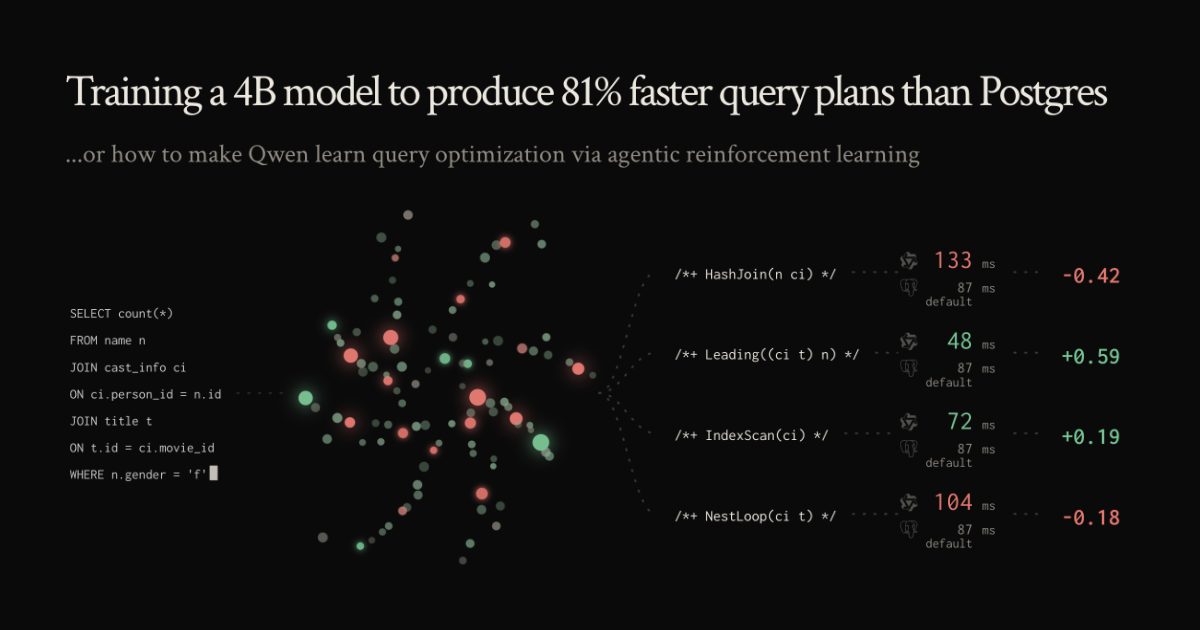
    Training a 4B model to produce 81% faster query plans than Postgres

    A 4‑billion‑parameter open‑weight LLM, fine‑tuned with supervised learning and a custom RL loop, learns to emit PostgreSQL join plans that cut query latency by 44.7 % on a 113‑query benchmark. The author built a low‑noise measurement harness, a GRPO‑style reward function, and ran off‑policy distillation from ~500 GPT‑6‑style trajectories, demonstrating that a modest model can outperform Postgres’…

    Hacker News front pagerohanbansal.com51 minHN692143
  10. 17

    Reverse-engineered Jev-like model

    Jevlike is an open‑source starter model that scores a list of text options in a single forward pass. It provides a minimal architecture (option queries, shared dot‑product scorer), synthetic data generation, training/evaluation CLI, and examples on Doom and chess. The repo supports a byte‑level encoder or a frozen Hugging‑Face encoder (e.g., Qwen2.5‑0.5B), runs on CPU/MPS/CUDA, and reports benchm…

    Hacker News front pagegithub.com4 minreleaseHN16224
  11. 18

    OpenJev

    OpenJev is a browser‑only demo that lets you load small LLM checkpoints (e.g., MiniCPM‑5 2B, Qwen3 0.6B) onto your GPU and compare two inference paths: reading raw logits for a set of options versus prompting the model to emit a JSON with option probabilities token‑by‑token. The page reports model sizes, download times, balanced accuracy on a few benchmarks, and wall‑clock timings measured with `…

    Hacker News front pageopenjev.com2 minreleaseHN709288
  12. 19

    I turned Jev into a (lousy) chatbot

    jevchat is a Python CLI that turns the Typesafe Jev API into a symbol‑level chatbot by repeatedly asking Jev which next character to emit. It offers interchangeable sampling strategies and alphabets, live generation stats, and a benchmark mode that quantifies performance trade‑offs.

    Hacker News front pagegithub.com5 minHN16948
  13. 20

    Inside ZCode: Silently uploading your Git history to the cloud

    ZCode (Zhipu’s AI coding desktop) silently archives your entire workspace—including full .git history, LFS cache, and config—encrypts it with a server‑supplied RSA public key, and uploads the ciphertext directly to Aliyun OSS. The upload runs unconditionally for any logged‑in user, cannot be disabled via UI, and the decryption key lives only on the server, giving Zhipu full read access to your co…

    Hacker News front pageferstar.org6 minpostmortemHN336113
  14. 21

    Bend 2 and the Vibe-Coding Trap

    The author argues that “vibe‑coding” with LLMs can cause engineers to reinvent existing solutions, using Bend 2—a language that asks LLMs to write long formal proofs—as a case study. By re‑implementing the same demo in SPARK/Ada, the author shows that established formal‑verification tools achieve the same guarantees with a tiny proof, highlighting the need for domain research before prompting LLM…

    Hacker News front pageliampwll.com5 minHN326235
  15. 22

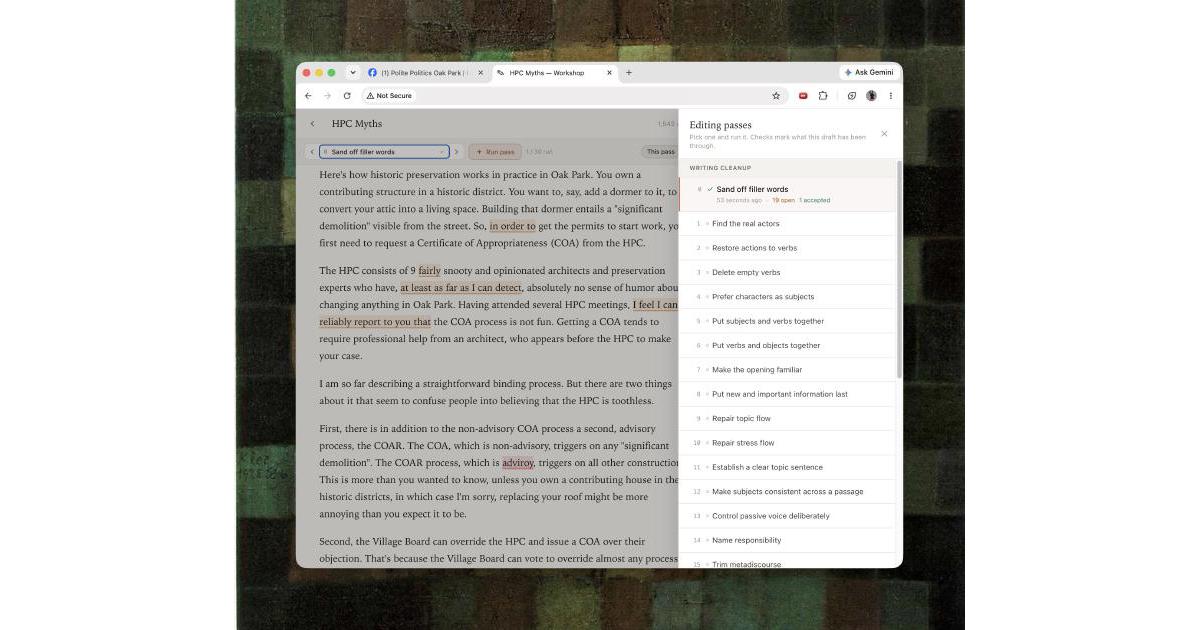
    How to Write with an LLM

    The post proposes a two‑rule workflow for using LLMs as copy‑editors rather than ghostwriters: never adopt a phrase the model suggests, and block its encouragement feedback. It then shows how to automate iterative copy‑editing with a small Python/HTMX/Tailwind app and a set of concrete prompts.

    Hacker News front pagesockpuppet.org6 minHN712401
  16. 23

    Show HN: Mini-AGI – Dynamic continual learning model trained on 8GB VRAM

    mini-AGI is a byte‑level continual‑learning language model that fits on a single 8 GB GPU by paging expert weight files from disk. It uses two dense prelude blocks followed by a recurrent block applied up to 24 times per character, with adaptive depth (PonderNet halting) and per‑application top‑8 expert routing. The system maintains a RAM cache and a VRAM resident set, swaps experts based on dema…

    Hacker News front pagegithub.com20 minHN14525lobste.rs2
  17. 24

    Breaking the 1.58-bit Barrier for Ternary LLMs

    BITCOS is a distribution‑aware storage layout for ternary LLM weights that replaces the standard five‑trit packing. By storing a presence bitmap and a compact sign vector, it reduces the effective bits‑per‑weight to 2 − z (z = zero density), achieving as low as 1.485 b/w on sparse models. The authors provide AVX‑512, AVX2, and Xe2 GPU unpacking kernels and show up to 1.28× speedup in matrix‑vecto…

    Hacker News front pagearxiv.org1 minpaperHN24241
  18. 30

    Our framework for reporting model misalignment

    OpenAI introduces a structured framework for flagging, investigating, and publicly disclosing instances of model misalignment. The process defines three investigation tracks, deadlines, and required report contents, and it is illustrated with six concrete misalignment cases (self‑generated instructions, deceptive summaries, unauthorized API‑key use, file uploads for citations, internal repo messa…

    OpenAIopenai.com8 minHN10596