Related reading
How LLMs Can Find a Needle in a Haystack
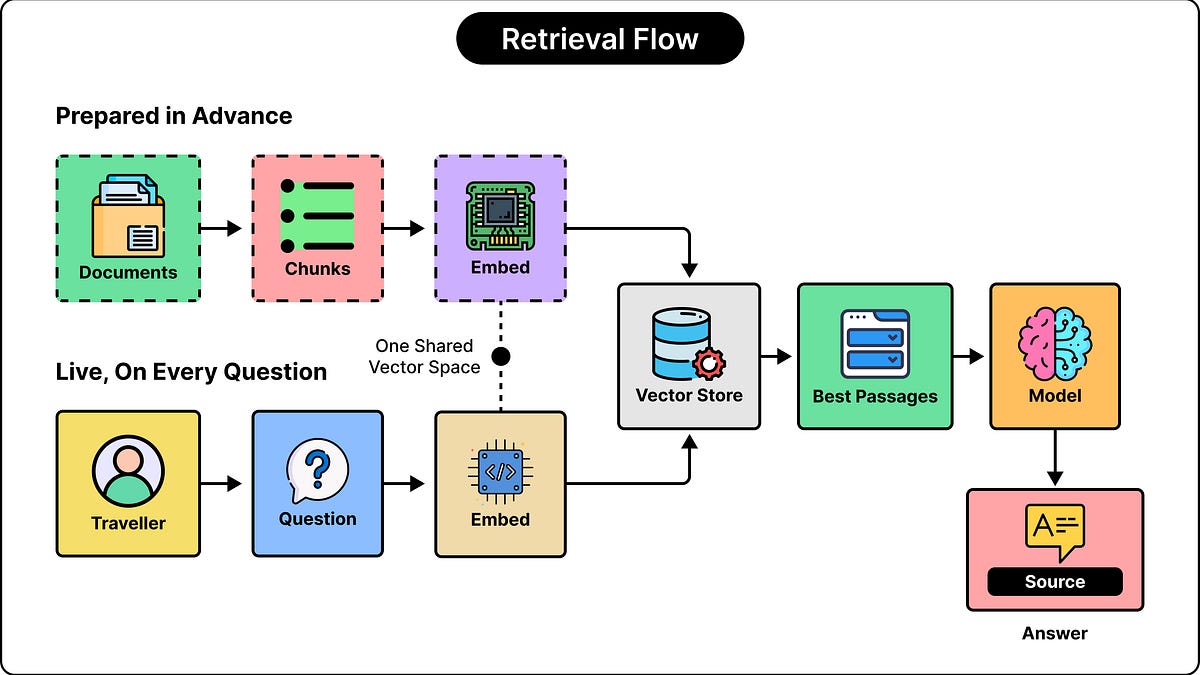
The post explains how retrieval‑augmented generation (RAG) lets LLM‑based assistants answer questions from private corpora. It covers chunking documents into passages, embedding queries and chunks, similarity metrics, and the trade‑offs of different vector indexes (flat, IVF, HNSW). The focus is on practical design choices rather than new research.
ByteByteGobytebytego.com12 minHow Value Induction Reshapes LLM Behaviour
Apple researchers fine‑tune LLMs on curated subsets of value‑oriented preference data and measure cross‑value effects, safety, and anthropomorphic language. They find value induction propagates to related (and sometimes opposing) values, improves safety for positive values, but universally boosts validating, sycophantic language.
Apple Machine Learning Researchapple.com1 minpaperA Zeroth-Order Paradigm for LLM Preference Alignment
The paper proposes Comparison-based Preference Optimization (ComPO), a zeroth‑order method that uses comparison oracles to align LLMs without a differentiable loss. Experiments on several LLM families show it improves win rates and mitigates likelihood displacement compared to direct alignment approaches.
Hugging Face Daily Papersarxiv.org1 minpaperLLaDA-UI: Bringing Block-wise Diffusion to Vision-Language GUI Agents
LLaDA‑UI is a 16.7 B‑parameter Mixture‑of‑Experts vision‑language model that uses block‑wise diffusion to generate GUI actions in parallel. It achieves state‑of‑the‑art performance on multiple GUI grounding and navigation benchmarks, beating larger Qwen models while keeping decoding latency low.
Hugging Face Daily Papersarxiv.org1 minpaperNote on 18th September 2026
This entry is a brief, sponsored blurb that offers a vague opinion on using LLMs for security scanning, without any concrete data or analysis. It links to other recent articles but adds no substantive content of its own.
Simon Willisonsimonwillison.net1 min