proomt

Search

Search posts, papers, and topics

All posts

Arduino BlogArduino Team7 min readintermediate
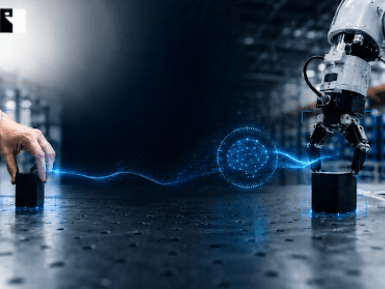
MYWAI™ VILMA™ is designed to bring human-like learning to robots via one-shot demonstration

Summary

MYWAI VILMA enables robots to learn complex manipulation tasks from a single human demonstration using AI and computer vision. This toolkit is now ported to Arduino UNO Q and VENTUNO Q boards, facilitating edge-native robotics applications.

  • VILMA uses one-shot video imitation learning to teach robots manipulation tasks like pick-and-place.
  • The AI pipeline involves hand detection (MediaPipe), object detection (YOLO), trajectory segmentation, and Dynamic Movement Primitive (DMP) generation.
  • DMPs allow learned robot skills to be adapted to new target objects and goals without re-demonstration.
  • The system employs a distributed architecture with an Edge AI Layer (Arduino boards) for intelligence and a ROS 2 Communication Layer for robot control.

Robotics developers and industrial automation engineers should care as VILMA offers a practical approach to rapidly program robots for pick-and-place tasks using human demonstrations, enhancing flexibility in dynamic settings.

6/10

Related reading

  1. Building smarter AMRs with the Arduino® VENTUNO™ Q board

    The Arduino VENTUNO Q board combines a Linux‑capable MPU with a real‑time MCU, enabling a single platform for ROS 2 navigation, sensor fusion, and low‑latency motor control in autonomous mobile robots. The post shows how LiDAR, cameras, edge‑AI and an MPU‑to‑MCU communication layer let developers prototype AMRs step by step.

    Arduino Blogarduino.cc7 min
  2. HuRo: Robotizing Human Videos for Scalable VLA Pretraining

    The paper introduces a pipeline that converts heterogeneous human videos into robot‑aligned observations and actions, creating the 630K‑episode HuRo dataset. Pretraining vision‑language‑action (VLA) policies on this data boosts real‑world manipulation success from ~51% to ~80% and improves out‑of‑distribution robustness.

    Hugging Face Daily Papersarxiv.org1 minpaper
  3. Transferring the Intelligence of VLMs to Robotic Control

    RoboDawn lets a vision‑language model (VLM) drive a robot via a tiny discrete command set (translate/rotate/gripper). Using a few in‑context demos, the VLM learns the interface and task strategy, then runs closed‑loop: observe image → reason → act → re‑observe. On the RoboTwin 2.0 C2R benchmark RoboDawn hits 53.2 % success zero‑shot, 73.6 % with one demo (vs. 46 % baseline). On RoboDojo it goes f…

    Hugging Face Daily Papersarxiv.org1 minpaper
  4. Breaking the Vision-Action Shortcut: Latent Interface Training for Generalizable Robotics Foundation Models

    Latent Interface Training (LIT) first learns a goal‑conditioned action prior without visual input, then adds a pose‑supervised latent interface as the only visual conditioning path. Applied to several vision‑language‑action models, LIT cuts vision‑action shortcuts and lifts LIBERO‑Plus success by 3.9–10.7 points and real‑world task success by 13.3–16.7 points under distribution shifts.

    Hugging Face Daily Papersarxiv.org1 minpaper
  5. Redesigning a popular robotic arm

    Arduino’s blog spotlights a community‑built robotic arm that’s been mechanically redesigned for cheaper parts, easier 3‑D printing, and better performance. The arm uses a Nano ESP32 to read potentiometer‑based puppet‑style input and drive servos via a driver board, with belt‑driven wrist and rack‑and‑pinion gripper upgrades.

    Arduino Blogarduino.cc1 min