proomt

Search

Search posts, papers, and topics

All posts

RedisMirko Ortensi2 min readintro
RDI support for federated caches, sharded data sources and multiple pipelines

Summary

Redis Data Integration (RDI) now supports multi‑source pipelines, allowing data from multiple databases to be streamed into a single Redis target for real‑time use. A forthcoming multi‑pipeline feature will let one RDI instance host multiple independent pipelines, further easing deployment complexity.

  • RDI can now connect multiple source databases (Snowflake, MongoDB, MySQL, PostgreSQL, etc.) to a single pipeline that writes to one Redis target.
  • Multi‑source pipelines enable real‑time consolidation for fraud detection, tenant‑specific views, and federated‑cache scenarios.
  • Upcoming multi‑pipeline support will let a single RDI installation run several independent pipelines, simplifying deployment scaling.
  • Using RDI reduces custom stitching code and the number of separate integration services needed.

Engineers building real‑time data pipelines across heterogeneous stores should know RDI can now consolidate sources and will soon support multiple pipelines in a single deployment.

4/10

Related reading

  1. How Fountain rebuilt its data plane on ClickHouse Cloud to power Cue, the Frontline Superintelligence

    Fountain replaced a multi‑vendor batch pipeline (Postgres + MongoDB → replication → S3/Iceberg → BigQuery/ClickHouse) with a single‑hop real‑time data plane built on ClickPipes and ClickHouse Cloud. CDC streams 13 Postgres and 4 MongoDB sources directly into ClickHouse, where native JSON, incremental materialized views, and role‑based access control provide sub‑second query latency, 66 % cost red…

    ClickHouseclickhouse.com9 min
  2. Integrating AI Across Industries: A Developer’s Guide to Practical Frameworks

    The article surveys common AI integration patterns—high‑throughput streaming with Kafka/Kinesis, edge object detection on Jetson, CI/CD for full‑stack freelance apps, and security/bias safeguards—but offers only high‑level guidance. It outlines the technologies and best‑practice checkpoints developers should consider when building scalable, secure AI services.

    SitePointsitepoint.com1 min
  3. How Data 360 Builds Trusted Context: The Enduring Layer for Enterprise AI

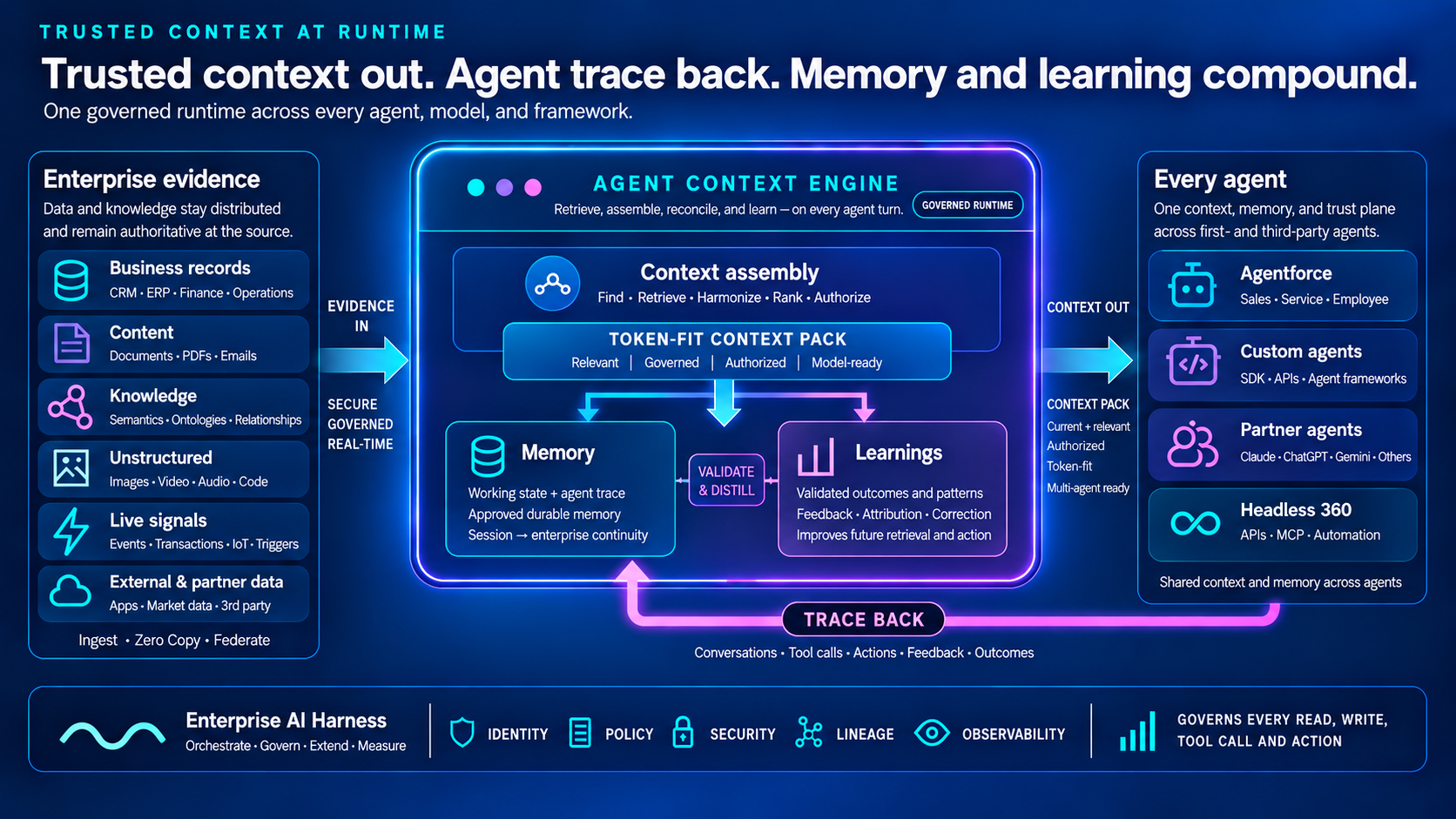
    Salesforce’s Data 360 provides a shared runtime that assembles the minimal, authorized slice of enterprise data (“Trusted Context”) for each AI‑agent turn. A six‑stage Agent Context Engine (Resolve, Plan, Reconcile, Govern, Compile, Learn) pulls data from structured, unstructured, and streaming sources across Salesforce, Snowflake, Databricks, etc., applies fine‑grained policy, and returns a toke…

    Salesforce Engineeringsalesforce.com11 min