proomt

Search

Search posts, papers, and topics

All posts

Salesforce EngineeringScott Nyberg11 min readintermediate
How Data 360 Builds Trusted Context: The Enduring Layer for Enterprise AI

Summary

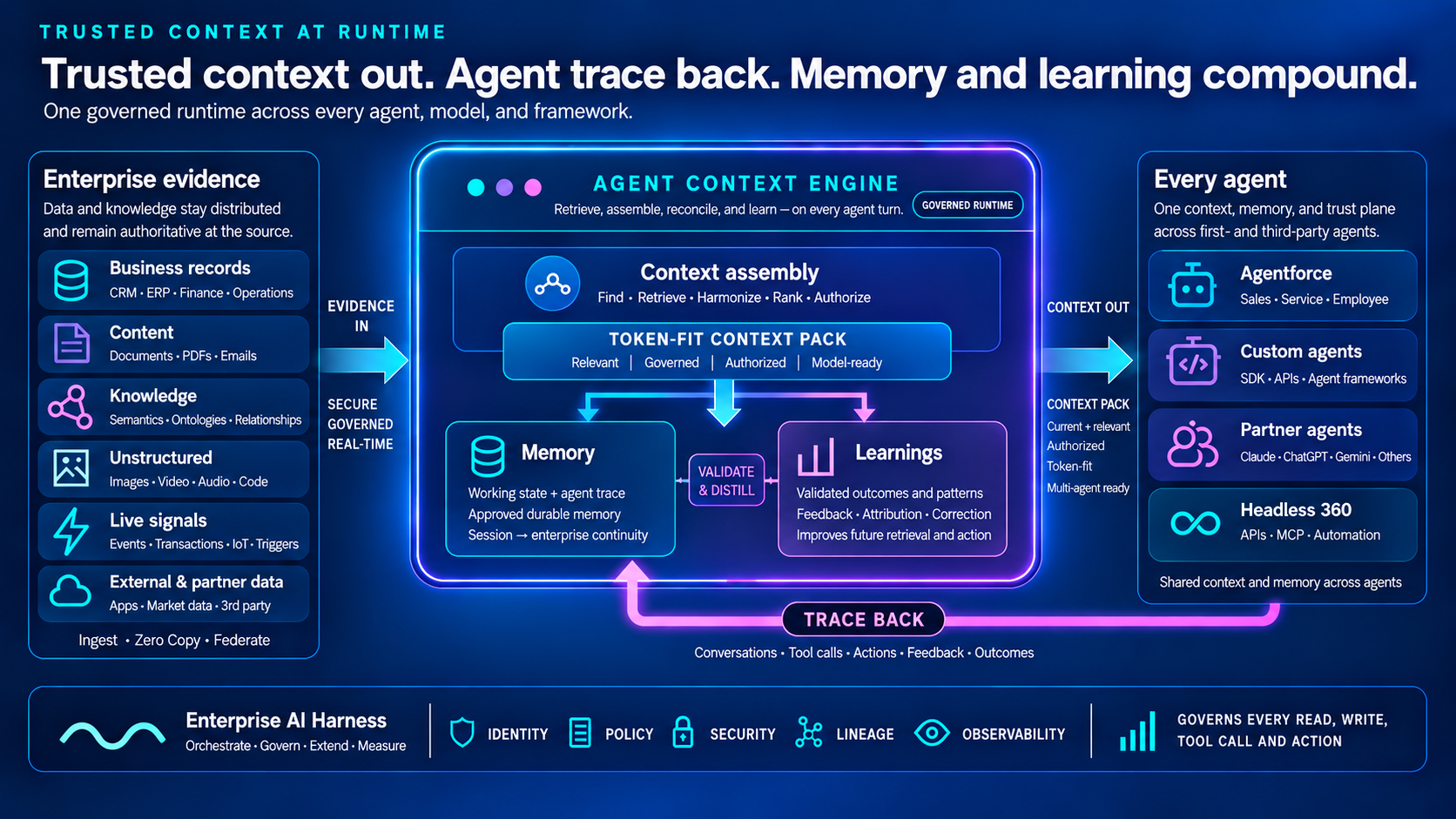
Salesforce’s Data 360 provides a shared runtime that assembles the minimal, authorized slice of enterprise data (“Trusted Context”) for each AI‑agent turn. A six‑stage Agent Context Engine (Resolve, Plan, Reconcile, Govern, Compile, Learn) pulls data from structured, unstructured, and streaming sources across Salesforce, Snowflake, Databricks, etc., applies fine‑grained policy, and returns a toke…

  • Trusted Context isolates the data needed for a prompt, reducing token usage, latency, cost, and exposure of sensitive data.
  • The Agent Context Engine’s six runtime stages enforce identity, purpose, freshness, relevance, and policy before compiling a Context Pack.
  • Data 360’s architecture supports unified query, profile unification, graph traversal, vector search, RAG, and streaming across a distributed data estate without centralizing data.
  • Memory is split into working context, short‑term, long‑term, and learnings, allowing governed continuity across models and agents.

Enterprise AI must balance the need for up‑to‑date, relevant evidence with strict governance and cost constraints. By providing a runtime that assembles only the authorized subset of data per request, Data 360 makes large‑scale LLM‑driven applications feasible in regulated environments and enables…

6/10

Related reading

  1. Presentation: Context Engineering at LinkedIn: How We Built an Organizational Context Layer for AI Agents with MCP

    LinkedIn built a “Contextual Agent Playbooks and Tools” layer that wraps internal services (code search, docs, feature flags, etc.) behind the open‑source Model Context Protocol (MCP). By feeding LLM‑powered coding agents the exact internal artifacts they need, the agents can diagnose incidents, generate PRs, and update incident tickets in minutes, delivering a reported 20 % productivity gain wit…

    InfoQinfoq.com28 mintalk
  2. Modernizing the Trade Lifecycle With Governed Data and AI

    Databricks argues that modernizing the trade lifecycle now hinges on building a governed, real‑time data foundation that spans research, trading, risk, ops and compliance, rather than isolated AI pilots. Starting with a few high‑value questions—execution cost, shock risk, exception rates—and using Unity Catalog and Agent Bricks lets firms achieve measurable speed and auditability gains before sca…

    Databricksdatabricks.com5 min
  3. How to upskill enterprise AI builders by using daily micro habits

    Google Cloud Consulting proposes a four‑pillar micro‑learning framework for enterprise AI upskilling: 5‑minute browser‑based exercises, pre‑configured sandboxes, daily streaks, and delivering runnable code each session. A pilot (Advent of Agents) showed >150k participants, 859k code runs, and a 31% daily return rate, suggesting short, frictionless tasks improve engagement versus traditional bootc…

    Google Cloud Bloggoogle.com3 min
  4. Trying the Software Factory Pattern

    The post describes an experiment implementing the software‑factory pattern: an AI‑driven loop that audits a Linear project, syncs goals from Notion, metrics from Datadog/Snowflake, creates and updates issues, and executes non‑blocked tasks. It shows how tying together a unified task tracker, observability data, and an orchestrated agent harness can keep projects aligned without manual state hoard…

    Hacker News front pagelethain.com3 minHN8745
  5. Article: Beyond Relevance: A Governance-First Architecture for Enterprise Personalization

    The article proposes a governance‑first architecture for enterprise personalization, where policy‑driven steps (memory, journey graph, AI routing, scoring, trust checks, outcome simulation) shape the recommendation before it is returned. A reference FastAPI implementation demonstrates the pattern with external YAML policies and optional LLM assistance.

    InfoQinfoq.com19 min
  6. Podcast: Securing AI Agents: Identity, Authorization, and the DPACT Framework

    This podcast discusses the critical challenges of identity, authorization, and security for AI agents. It introduces the DPACT framework (Delegation, Policy, Auditability, Context, Time) as a blueprint for building responsible agentic systems with bounded, delegated authority, moving beyond simple token-based access.

    InfoQinfoq.com29 mintalk