proomt

Search

Search posts, papers, and topics

All posts

SitePointM Anees Siyal1 min readintermediate
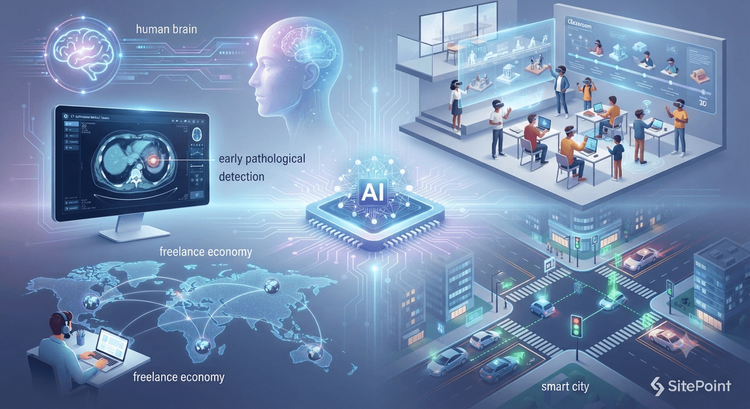
Integrating AI Across Industries: A Developer’s Guide to Practical Frameworks

Summary

The article surveys common AI integration patterns—high‑throughput streaming with Kafka/Kinesis, edge object detection on Jetson, CI/CD for full‑stack freelance apps, and security/bias safeguards—but offers only high‑level guidance. It outlines the technologies and best‑practice checkpoints developers should consider when building scalable, secure AI services.

  • Use Kafka or Kinesis for high‑throughput vehicle telemetry streams.
  • Deploy YOLO models on low‑power edge devices like NVIDIA Jetson for real‑time detection.
  • Implement CI/CD pipelines to support distributed freelance development teams.
  • Apply AES‑256 encryption and regular bias audits to secure and responsibly operate ML models.

Engineers designing AI‑enabled products need a checklist of infrastructure, deployment, and governance concerns to avoid hidden pitfalls.

4/10

Related reading

  1. AI Security Is an Engineering Problem — How to Solve It at Every Layer of the Agent Stack

    Nvidia frames AI security as an engineering discipline, outlining required controls across the AI agent stack (model, harness, runtime) and advocating for enforceable boundaries, traceable identities, and evidence‑based testing. It highlights OpenShell as a sandboxed runtime, the Open Secure AI Alliance, and several vendor tools for testing and red‑team exercises.

    Nvidianvidia.com4 min
  2. Why Deploying Physical AI at Scale Demands Safety at Every Layer

    NVIDIA’s Halos platform is a full‑stack safety system for physical AI (autonomous vehicles and industrial robots). It bundles safety‑engineered hardware (DRIVE AGX Thor, IGX Thor), an ASIL‑D certified OS (Halos OS), middleware for isolation and monitoring, AI models for explainability (Alpamayo), and simulation/validation tools (Isaac Lab, Omniverse). The blog argues that scaling physical AI requ…

    Nvidianvidia.com5 min
  3. From Individual Experiments to a Shared AI Practice: How Avant Scaled AI-Assisted Engineering

    Avant replaced many personal AI‑assistant setups with a single, organization‑wide Claude Code configuration that embeds the company’s coding standards, project‑tracking links, and documentation. Treated as an internal product, the setup is versioned, owned by delivery engineers, and iteratively improved. The shared tool speeds routine tasks (scaffolding, tests, migrations, docs) and enforces cons…

    Moove-itqubika.com2 min
  4. Article: Architecting Secure and Scalable Facial Verification Systems

    A real‑world post‑mortem of a high‑volume face verification service that moved from a naïve synchronous API to an async, layered pipeline (edge validation, preprocessing, decoupled detection/verification, decision engine) to achieve 8.5k rpm, p99 < 1.8 s, 30 % cost savings, and strict privacy controls.

    InfoQinfoq.com15 min
  5. Introducing AI First Responder: The Next Step in CloudBees’ AI Journey

    CloudBees announced AI First Responder (AIFR), an AI‑powered incident‑triage assistant that lives in Slack and leverages the CloudBees Unify control plane and its knowledge graph. AIFR claims to summarize logs, suggest root causes, and optionally trigger GitOps remediation, all while logging actions for governance. The feature is in limited preview and available to a design‑partner program.

    Codeshipcloudbees.com2 minrelease
  6. Trying the Software Factory Pattern

    The post describes an experiment implementing the software‑factory pattern: an AI‑driven loop that audits a Linear project, syncs goals from Notion, metrics from Datadog/Snowflake, creates and updates issues, and executes non‑blocked tasks. It shows how tying together a unified task tracker, observability data, and an orchestrated agent harness can keep projects aligned without manual state hoard…

    Hacker News front pagelethain.com3 minHN8745