proomt

Search

Search posts, papers, and topics

All posts

Jonathan Snook2 min readintro

Reminder of Things

Summary

The author reflects on moving from the Things to‑do app to Apple Reminders, citing Siri/HomePod integration and collaborative lists as the main reasons, while criticizing Reminders’ UI clutter. He notes the fragmentation of his task data across multiple apps and hopes a third‑party front‑end like Unforgetful could combine the simplicity of Things with Reminders’ data.

  • Things offers a clean UI but lacks strong Siri/HomePod integration.
  • Apple Reminders provides collaborative lists and voice entry, but its design feels cluttered to the author.
  • Fragmented task storage (Notes, Reminders, Things) creates mental overhead.
  • Third‑party front‑ends (e.g., Unforgetful) could offer a better view of Reminders data.

For engineers who rely on personal task management, the trade‑off between UI simplicity and ecosystem integration (Siri, HomePod) can affect productivity, especially when juggling multiple tools.

2/10
Related reading

  1. Shared Selective Persistent Memory for Agentic LLM Systems

    Apple proposes a memory architecture for agentic LLMs that selectively persists reusable context (specs, schemas, configs, constraints) across sessions and users. Shared workspaces with role‑based access and a zero‑token data‑refresh mechanism cut token usage by 97×, reduce task time by 14×, and raise task‑completion rates to 96% versus 71%‑79% for baselines.

    Apple Machine Learning Researchapple.com1 minpaper
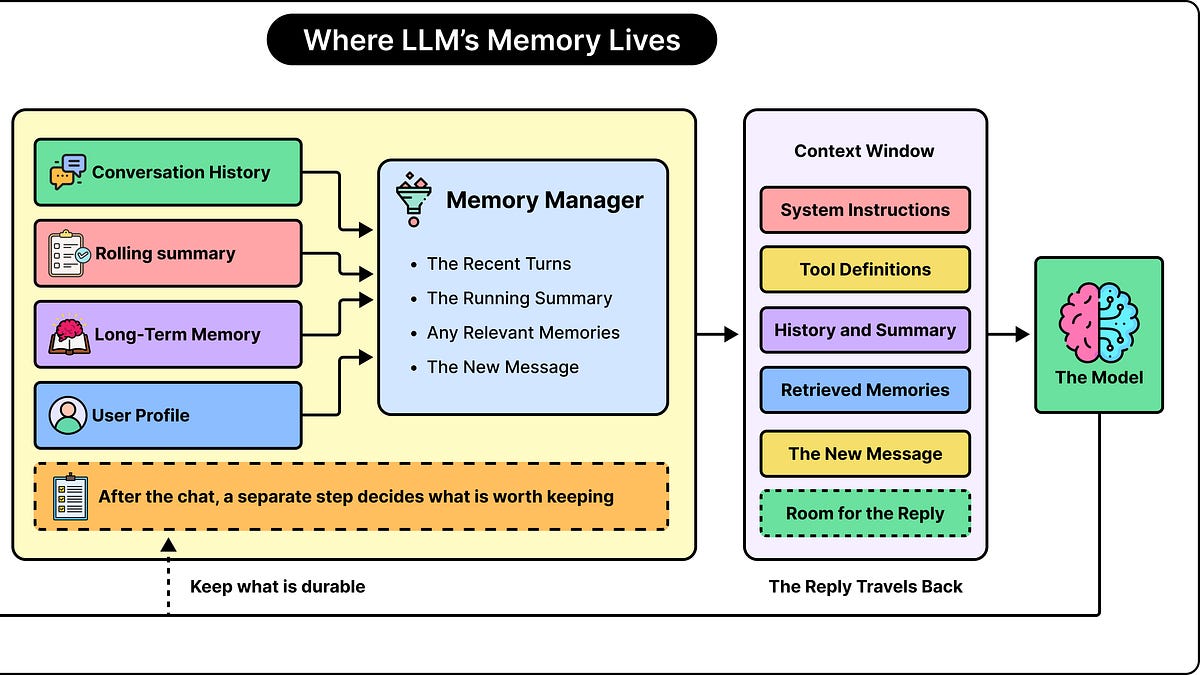
  2. Do LLMs Have the Memory of a Goldfish?

    The article explains that LLMs don’t have persistent personal memory; all “memory” is supplied by the surrounding application via the context window, summaries, or external storage. It outlines the distinction between trained weights, working‑memory (token context), and persistent application memory, shows how to construct API calls to preserve conversation state, and discusses the cost and laten…

    ByteByteGobytebytego.com12 min
  3. App Intents: One Java Declaration for Siri, Spotlight, and Shortcuts

    Codename One adds @AppIntent annotations that let a static Java method be exposed as a Siri, Spotlight, or Android shortcut. The build‑time processor generates native declarations, a reflection‑free dispatch table, and validates the intent metadata. Handlers can be headless, accept typed parameters, return results, and be invoked internally via Intents.invoke(). Entities enable system‑driven disa…

    CodeName Onecodenameone.com5 min
  4. We Stopped Waiting for Platform Changes to Find Us

    Codename One added a daily automated scan of Apple and Google deprecation notices, linking each notice to concrete builder artifacts before work is created. The system caught the Android 16 back‑gesture change and enabled a permission‑free ContactPicker, turning policy shifts into repeatable, evidence‑backed patches.

    CodeName Onecodenameone.com3 min
  5. Seeing Double with the iPhone Duo [FREE]

    A speculative preview of Apple’s upcoming iPhone Duo, summarizing hinted‑away SwiftUI/UIKit APIs (size classes, split view, tab‑bar placement, toolbar axis, badge, overflow) and advising developers to target iOS 27 SDK now while waiting for Xcode 27.1.

    Ray Wenderlichkodeco.com5 min
  6. Native Drag and Drop Meets Cross-Device Continuity

    Codename One 8.0 adds two user‑experience primitives: **Cross‑Device Continuity** (state checkpointing + Apple Handoff + custom HTTP relay) and **Native Drag‑and‑Drop** (OS‑level drag using the same ClipboardContent model). The post shows the API (StateProvider, Continuity.checkpoint, NativeDragOperation), platform support tables, and practical advice on payload size, security, thread handling, a…

    CodeName Onecodenameone.com7 min