proomt

Search

Search posts, papers, and topics

All posts

Eli Bendersky4 min readintro

Summary of reading: July - September 2026

Summary

The article is a personal reading roundup covering a dozen books from fiction to nonfiction, offering brief impressions of each. It contains no engineering content or actionable insights for software developers.

  • A list of books with short personal comments, ranging from classic literature to nonfiction histories.
  • The author notes strengths and weaknesses of each work but provides no technical analysis.
  • Overall the piece is a literary digest, not a technical article.
  • No code, design patterns, or performance data are discussed.
2/10

Related reading

  1. Notes from September 2026

    Evan Hahn shares a brief September roundup, noting massive feedback on his short post about programmers disliking the reduce function, and lists a few interesting links. The piece highlights community interest in low‑level programming details.

    Evan Hahnevanhahn.com1 min
  2. No Silver Bullet: Essence and Accidents of Software Engineering

    Brooks argues that software development’s fundamental difficulty lies in essential complexity—conceptual design, conformity, changeability, and invisibility—rather than accidental implementation issues. Consequently, no single technology or management trick will yield an order‑of‑magnitude productivity boost; progress must come from disciplined, incremental improvements.

    Hall of Fameunc.edu34 minpaperHN11731
  3. Article: Your Next DSL Author Is a Language Model

    Typed Domain Grounding (TDG) embeds a DSL inside a mainstream language the LLM already knows (e.g., Kotlin) and uses the host compiler as an oracle. The author describes five building blocks—embedding, choosing a host language with high training‑data frequency, compiler‑driven type safety, a generate‑compile‑repair loop, and an on‑demand teaching tool—and shows measured results from kUML, a Kotli…

    InfoQinfoq.com18 min
  4. I don't want to read what you didn't write

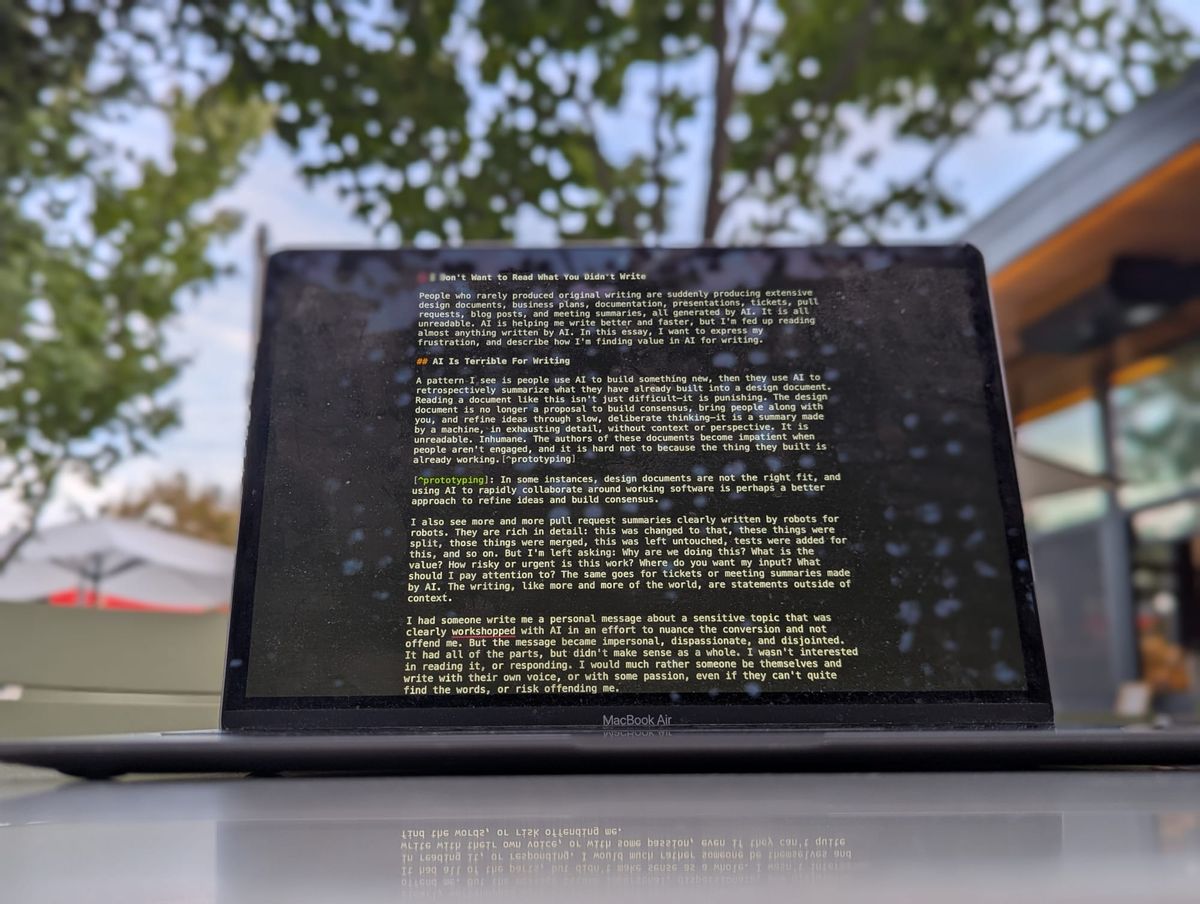
    The essay laments the unreadability of AI‑generated design docs, PR summaries, and other engineering writing, citing a survey where 78% of readers quit when they suspect AI involvement. The author finds AI useful only when they control the prompt and context—e.g., for grammar checks, citation generation, and diagram creation while writing a paper—but not for producing the core narrative. He highl…

    Hacker News front pagecolinbreck.com13 minHN1041450
  5. The top AI text generators in 2026

    Zapier’s 2026 roundup treats AI text generation as a ubiquitous feature rather than a standalone product. It explains that modern LLMs with long context windows have pushed dedicated generators into niche roles (marketing, SEO, agents) and then surveys the most useful built‑in generators across email (Gmail Gemini, Outlook Copilot), document suites (Google Docs, Microsoft Word, Notion), chatbots…

    Zapier Engineeringzapier.com9 min