proomt

Search

Search posts, papers, and topics

All posts

InfoQIrakli Betchvaia18 min readintermediate

Article: Your Next DSL Author Is a Language Model

Summary

Typed Domain Grounding (TDG) embeds a DSL inside a mainstream language the LLM already knows (e.g., Kotlin) and uses the host compiler as an oracle. The author describes five building blocks—embedding, choosing a host language with high training‑data frequency, compiler‑driven type safety, a generate‑compile‑repair loop, and an on‑demand teaching tool—and shows measured results from kUML, a Kotli…

  • LLMs hallucinate DSL syntax because the language has zero training‑data frequency; they interpolate from similar grammars.
  • Embedding the DSL in a host language with abundant LLM exposure (Kotlin, TypeScript, Python) eliminates the syntax‑hallucination problem.
  • Typed APIs (named parameters, enums, sealed hierarchies) turn domain errors into compile‑time type errors that the model can see and repair.
  • A Generate‑Compile‑Repair (GCR) loop feeds compiler diagnostics back to the model, limiting regeneration to three attempts; failures after that indicate missing concepts.

If engineers rely on LLMs to author DSLs for modeling, infrastructure, or config, silent syntax hallucinations can propagate incorrect artifacts. TDG provides a pragmatic, tool‑leveraging path to safe LLM‑generated code without building new parsers or sacrificing expressiveness.

7/10


Related reading

  1. Article: Beyond Relevance: A Governance-First Architecture for Enterprise Personalization

    The article proposes a governance‑first architecture for enterprise personalization, where policy‑driven steps (memory, journey graph, AI routing, scoring, trust checks, outcome simulation) shape the recommendation before it is returned. A reference FastAPI implementation demonstrates the pattern with external YAML policies and optional LLM assistance.

    InfoQinfoq.com19 min
  2. Article: Architecting Secure and Scalable Facial Verification Systems

    A real‑world post‑mortem of a high‑volume face verification service that moved from a naïve synchronous API to an async, layered pipeline (edge validation, preprocessing, decoupled detection/verification, decision engine) to achieve 8.5k rpm, p99 < 1.8 s, 30 % cost savings, and strict privacy controls.

    InfoQinfoq.com15 min
  3. System Design Interviews for Data Roles: What to Actually Practice

    The piece shows that data‑role system design interviews evaluate how you turn vague requirements into a defensible architecture, not which tools you name, and it gives a concrete prep framework: clarify scope, quantify load, pick batch vs streaming with trade‑offs, and address failure handling. Candidates should rehearse explaining these decisions aloud with numbers rather than just drawing diagr…

    SitePointsitepoint.com6 min
  4. Bend 2 and the Vibe-Coding Trap

    The author argues that “vibe‑coding” with LLMs can cause engineers to reinvent existing solutions, using Bend 2—a language that asks LLMs to write long formal proofs—as a case study. By re‑implementing the same demo in SPARK/Ada, the author shows that established formal‑verification tools achieve the same guarantees with a tiny proof, highlighting the need for domain research before prompting LLM…

    Hacker News front pageliampwll.com5 minHN326235
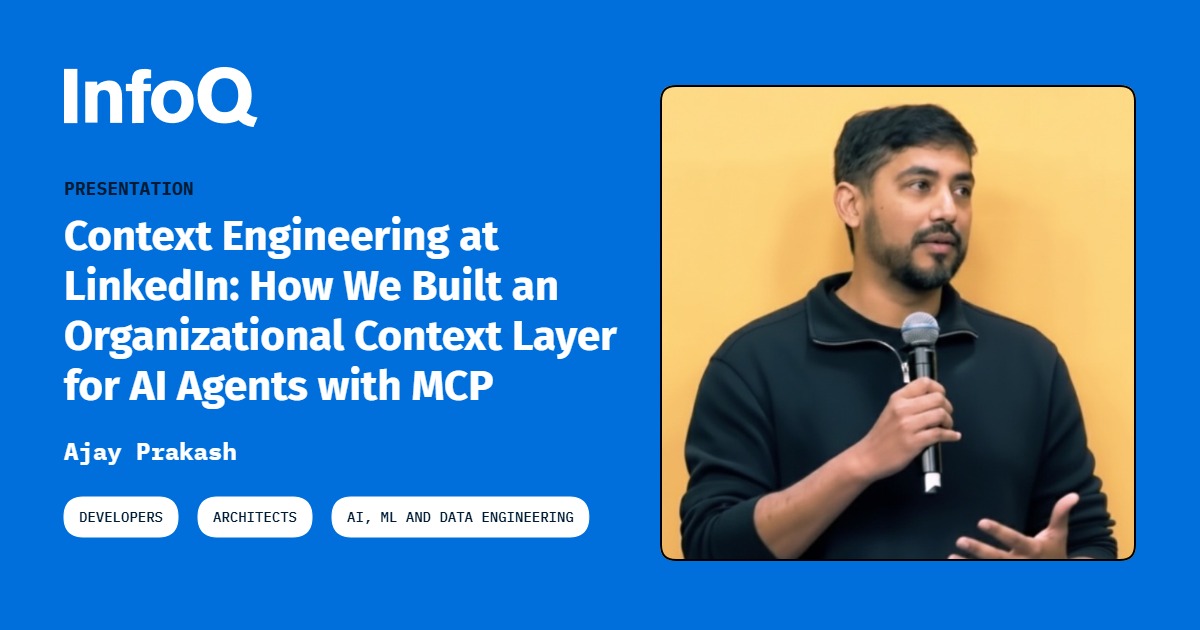
  5. Presentation: Context Engineering at LinkedIn: How We Built an Organizational Context Layer for AI Agents with MCP

    LinkedIn built a “Contextual Agent Playbooks and Tools” layer that wraps internal services (code search, docs, feature flags, etc.) behind the open‑source Model Context Protocol (MCP). By feeding LLM‑powered coding agents the exact internal artifacts they need, the agents can diagnose incidents, generate PRs, and update incident tickets in minutes, delivering a reported 20 % productivity gain wit…

    InfoQinfoq.com28 mintalk
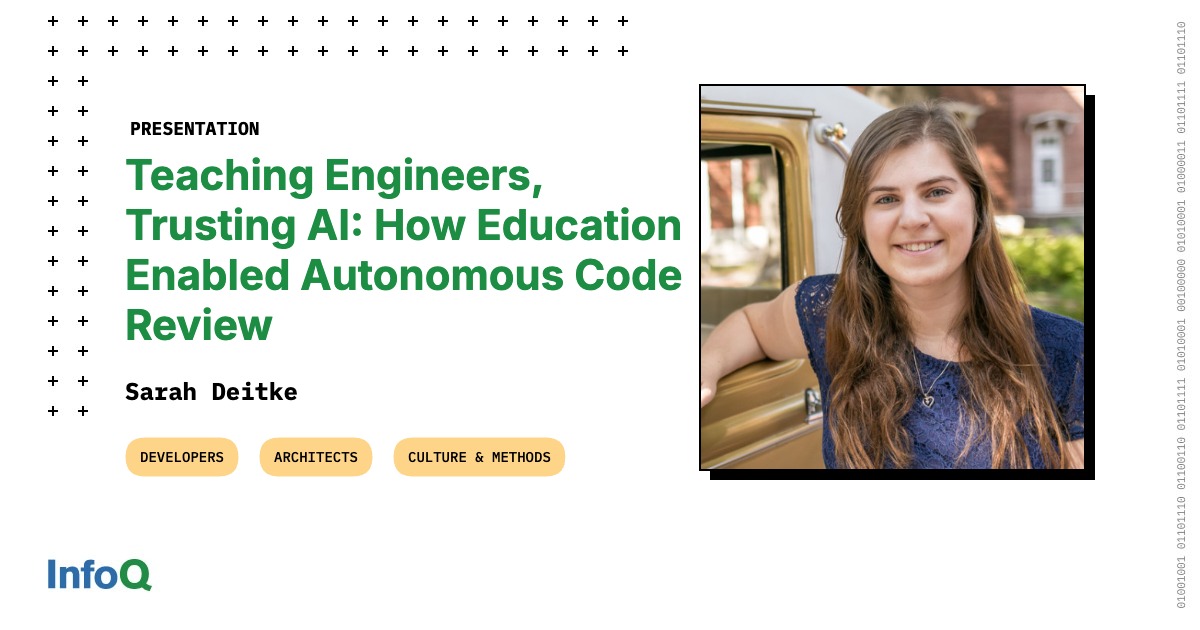
  6. Presentation: Teaching Engineers, Trusting AI: How Education Enabled Autonomous Code Review

    Duolingo’s DevEx AI team built a program of AI‑literacy workshops, observability dashboards, office‑hours, and vendor partnerships to get engineers comfortable with LLM‑based tools. With that foundation they launched a PR‑risk‑assessment bot that auto‑approves low‑risk pull requests, cutting review bottlenecks while keeping defect rates flat.

    InfoQinfoq.com24 mintalk