proomt

Search

Search posts, papers, and topics

All posts

Hacker News front pageColin Breck13 min readintermediate
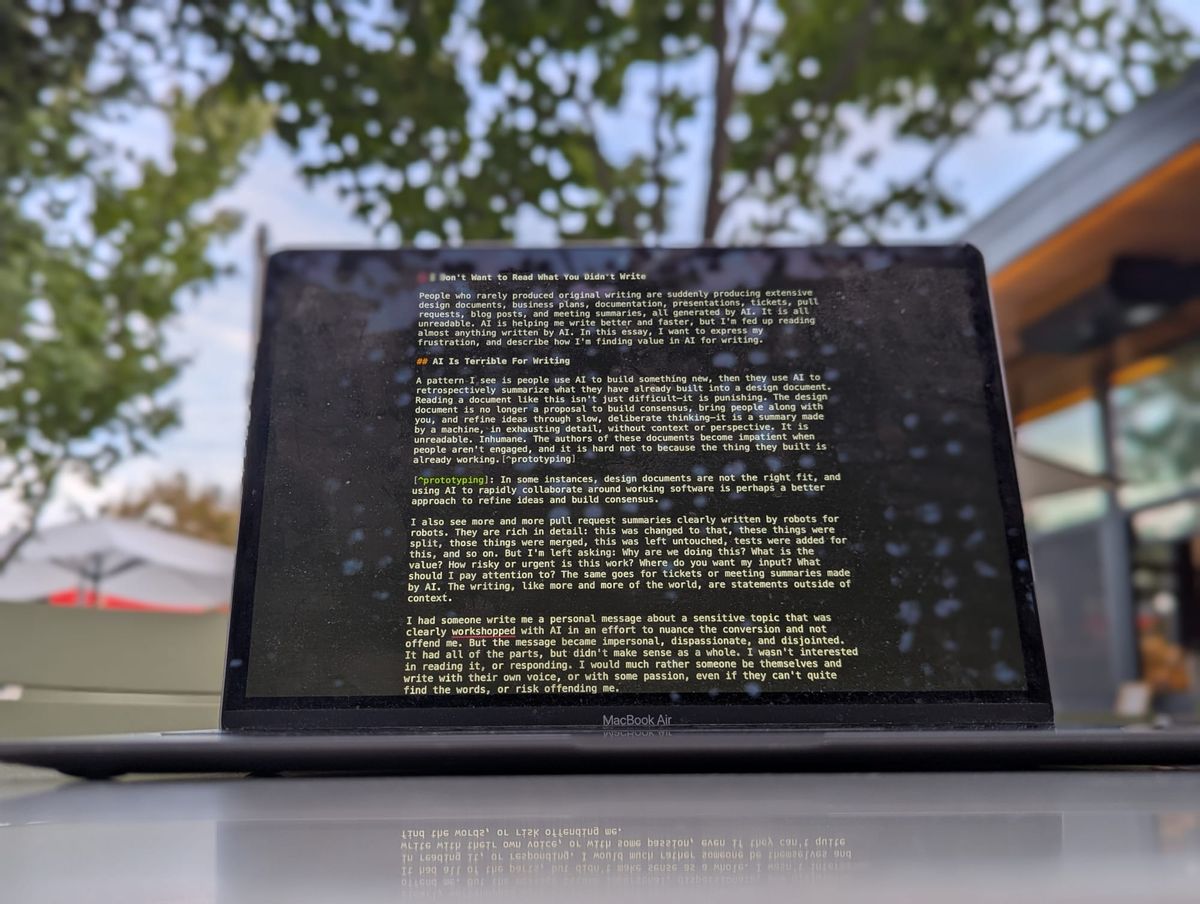
I don't want to read what you didn't write

Summary

The essay laments the unreadability of AI‑generated design docs, PR summaries, and other engineering writing, citing a survey where 78% of readers quit when they suspect AI involvement. The author finds AI useful only when they control the prompt and context—e.g., for grammar checks, citation generation, and diagram creation while writing a paper—but not for producing the core narrative. He highl…

  • AI‑generated engineering prose often lacks context, making it hard for reviewers to extract relevance or risk, leading to disengagement.
  • A developer survey shows 78% stop reading AI‑scented articles and 71% avoid the author; 98% prefer the author's original voice.
  • When the writer is in the loop (prompting, providing source code, logs, metrics), AI can accelerate tasks: grammar fixes, citation formatting, TikZ diagram generation, and abstract drafting.
  • AI struggles to produce accurate, context‑rich summaries of complex systems; human‑written narratives remain superior for conveying intent and nuance.

Engineering communication is a bottleneck; unreadable AI‑generated artifacts waste reviewer time and erode trust. Understanding when AI adds value (editing, verification) versus when it harms (uncontextualized summaries) helps teams maintain effective knowledge transfer.

5/10
Related reading

  1. Should you read the code, is RAG dead, and did Skills kill MCP?

    The article debunks five common AI‑tool hot takes, arguing you still must read AI‑generated code, AI fluency matters in hiring, MCP and Skills serve different purposes, RAG remains useful, and needing fine‑tuning signals a messy codebase. It offers concrete rules for reviewing generated code and integrating AI components responsibly.

    GitHub Oldgithub.blog5 minHN3
  2. Use Curiosity, Craft, and Care to Decide What AI Should Write

    The post proposes a three‑principle framework—Curiosity, Craft, and Care—to decide how much AI should author each artifact in a software development workflow. It argues that AI can be used aggressively for exploratory, disposable outputs (Curiosity) but should be limited for artifacts that commit the team to decisions (Craft) and for communications that require personal ownership (Care). The auth…

    Atomic Objectatomicobject.com4 min
  3. The 6 best AI writing generators in 2026

    Zapier’s blog post reviews six AI‑writing generators (Jasper, Anyword, Writer, Writesonic, Rytr, Sudowrite), explains how they work on top of LLMs, and outlines the author’s evaluation criteria (dedicated writing focus, control over output, ease of use, price, anti‑spam stance). The write‑up is a high‑level overview with no code, benchmarks, or deep technical analysis.

    Zapier Engineeringzapier.com19 min