proomt

Search

Search posts, papers, and topics

All posts

Hacker News front pageThe Twelve Problems7 min readintermediate
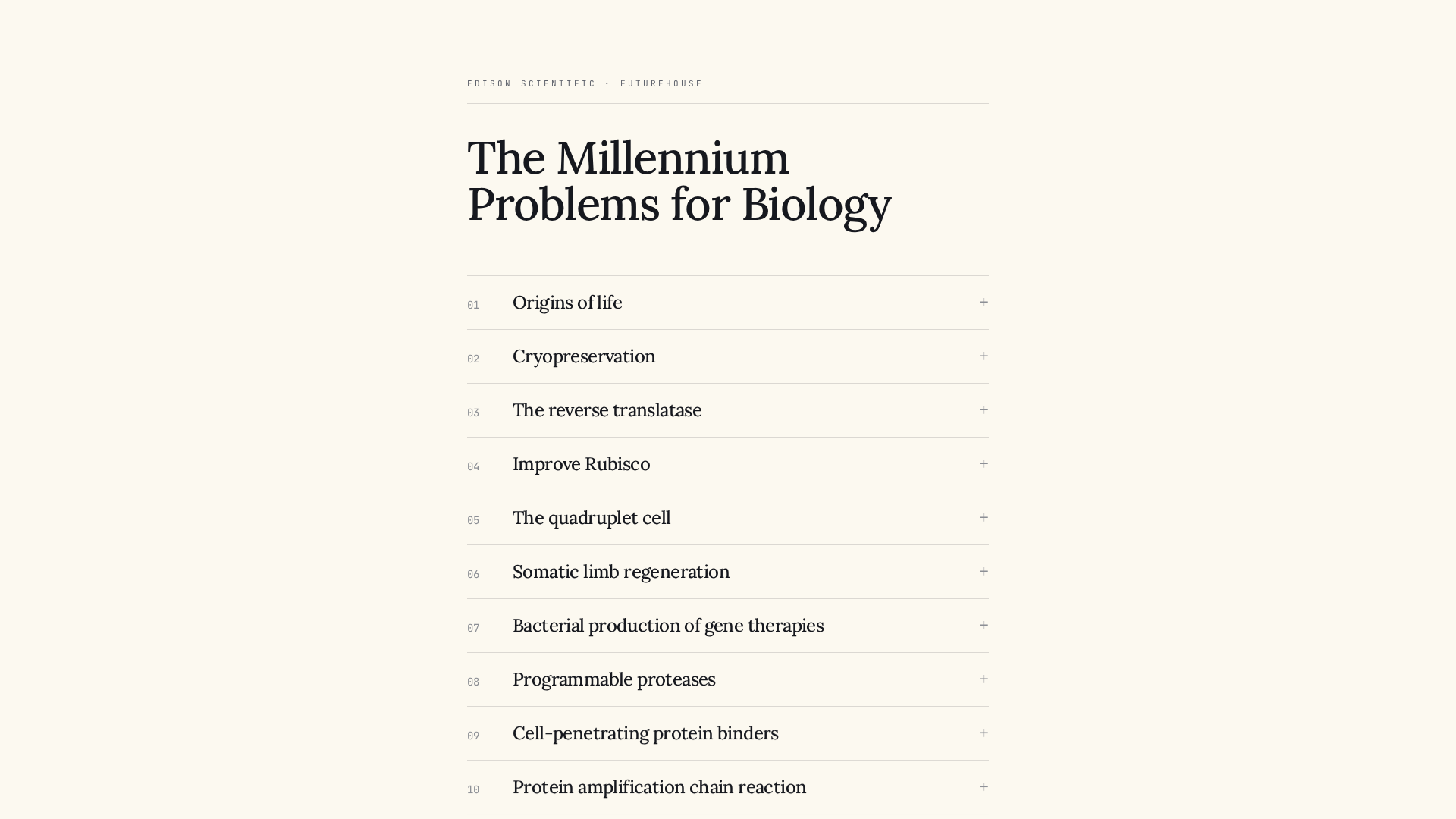
The Millennium Problems for Biology

Summary

A speculative list of twelve grand challenges for biology, each with detailed success criteria ranging from abiogenesis to engineered enzymes and regenerative medicine.

  • The article is a high‑level enumeration of ambitious biological problems, not a technical deep‑dive.
  • Each problem includes precise quantitative targets, but no experimental data, methods, or code are presented.
  • Useful as a thought‑leadership piece, but offers little concrete insight for practicing engineers.

The list outlines aspirational goals that could shape long‑term research agendas in synthetic biology, protein engineering, and regenerative medicine, helping teams prioritize high‑impact projects.

3/10

Related reading

  1. HypoEvolve: Genetic Algorithms Enable Multi-Agent LLMs to Discover Scientific Hypotheses

    The paper presents HypoEvolve, a generational genetic algorithm that coordinates specialized LLM agents to iteratively propose, critique, and refine scientific hypotheses. On a drug‑repurposing benchmark across 34 cancer types, it outperforms six baselines, achieving a DepMap selectivity of 0.171 versus 0.115.

    Hugging Face Daily Papersarxiv.org1 minpaper
  2. Advancing AI for biology: Teaching models to design and characterize antibodies

    Amazon Bio Discovery developed three AI models: MochiBind for fast, sequence-based antibody binding ranking, CA-MAP for context-aware developability prediction robust to batch effects, and an agent-guided system for de novo antibody design. These advancements aim to accelerate and improve the accuracy of antibody drug discovery, with experimental validation for a novel cancer target.

    Amazon Scienceamazon.science10 min
  3. Article: Architecting Secure and Scalable Facial Verification Systems

    A real‑world post‑mortem of a high‑volume face verification service that moved from a naïve synchronous API to an async, layered pipeline (edge validation, preprocessing, decoupled detection/verification, decision engine) to achieve 8.5k rpm, p99 < 1.8 s, 30 % cost savings, and strict privacy controls.

    InfoQinfoq.com15 min
  4. ScienceBuddy: Recursive-in-Recursive Self-Improvement for Interactive Scientific Agents

    ScienceBuddy is an interactive workspace that converts researcher prompts, feedback, and execution traces into continual‑learning tasks for AI agents. It introduces a "recursive‑in‑recursive" self‑improvement loop that alternates harness refinement and model training, and showcases case studies across four scientific task families.

    Hugging Face Daily Papersarxiv.org1 minpaperHN2