proomt

Search

Search posts, papers, and topics

All posts

TailscaleRoss Kukulinski3 min readintro
The TailscaleUp-date

Summary

Tailscale announced new features at its upcoming TailscaleUp event, including AI gateway Aperture enhancements, time‑bound privileged access, DNS‑level protection, and richer programmable APIs. These aim to give teams finer identity‑based control over access to internal and cloud resources.

  • Aperture AI gateway now supports model/agent governance with logging for better AI access control.
  • Teams can grant time‑bound, approved access to production resources without permanent credentials.
  • New DNS‑level controls let organizations block malicious or unwanted internet destinations.
  • Expanded APIs and SDKs make it easier to embed Tailscale networking into applications.

Security, devops, and platform engineers should care because the features provide finer, auditable control over access to internal services and AI tools.

4/10
Related reading

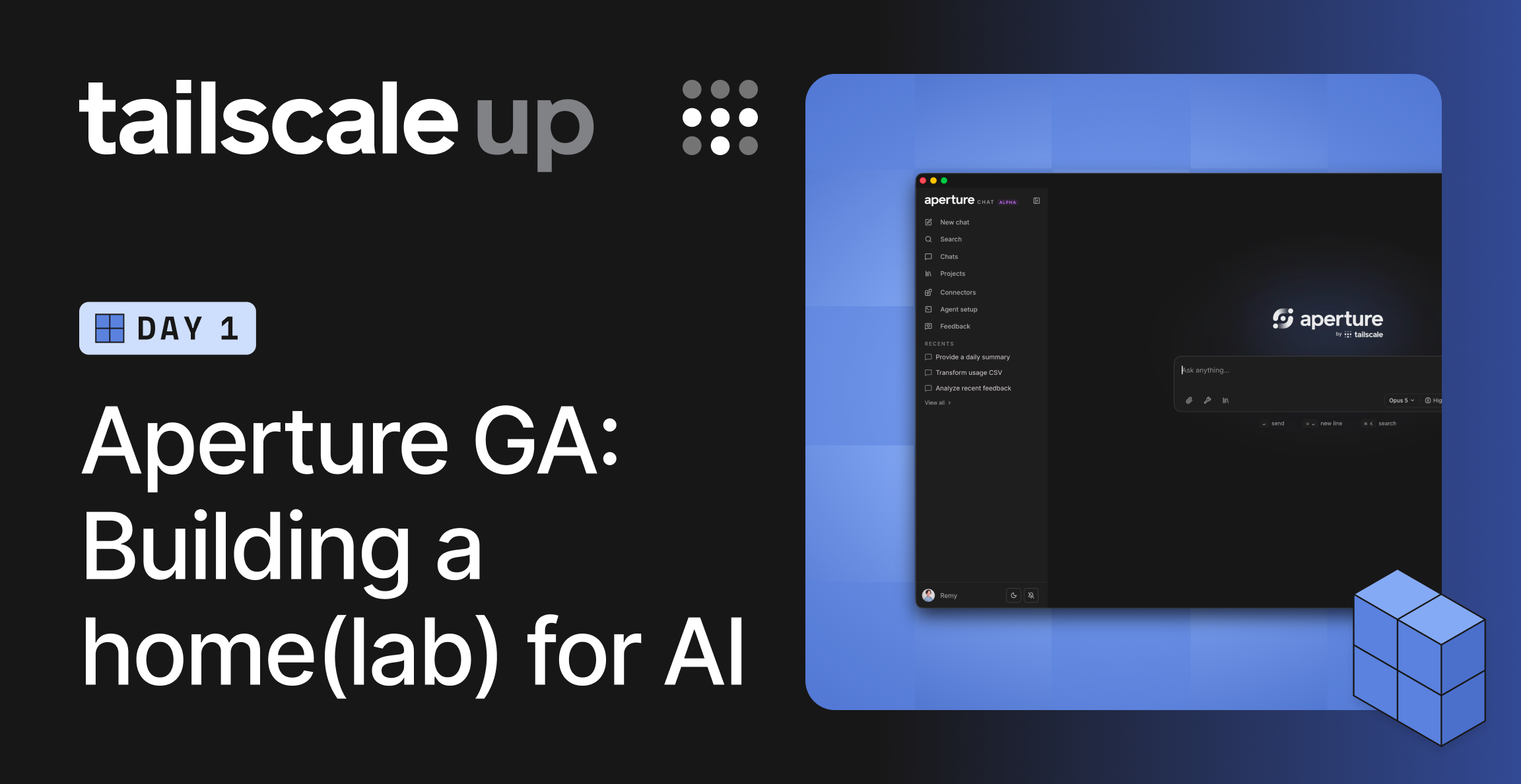
  1. Aperture GA: Building a home(lab) for agentic AI

    Aperture, Tailscale’s AI gateway, is now generally available. It ships with starter tokens, in‑app token purchases, new Model Context Protocol (MCP) endpoints for adding Tailnet nodes and invoking Tailscale SSH, and an upgraded chat UI that supports Projects (shared context, tool access, node groups) and configurable default tool permissions. All agent actions respect Tailscale’s unidirectional A…

    Tailscaletailscale.com4 minreleaseHN41
  2. We're making Tailscale faster

    Tailscale is cutting memory overhead for small packets, adding a multi‑queue pipeline for routers and exit nodes, using Linux’s writev, and introducing netmap caching to speed up startup. These changes give ~5 % throughput gains now and larger gains in upcoming releases.

    Tailscaletailscale.com7 minHN3
  3. The Tail at Scale

    The paper defines “tail‑tolerant” systems that keep interactive latency (≤100 ms) low even as services scale to thousands of servers, and surveys the main causes of latency outliers. It shows that techniques such as request replication, hedged requests, and resource isolation can dramatically shrink the latency tail with modest overhead, enabling higher utilization without over‑provisioning.

    Hall of Fameresearch.google1 minpaper
  4. How we tracked down a 16-year-old SQLite bug

    Tailscale experienced 19 SQLite database corruptions over six months due to a 16‑year‑old bug in SQLite’s WAL checkpoint logic. The single‑writer, Go‑driven shard architecture forced them to add forensic telemetry, a transaction‑logging replay pipeline, and work directly with SQLite core developers to isolate and fix the issue, dramatically reducing downtime.

    Tailscaletailscale.com14 minpostmortemHN1223239
  5. Durable Digest: August highlights

    Temporal’s August digest rolls out a suite of new features: Serverless Workers for AWS Lambda (public preview), Projects for organizing Cloud resources, Standalone Nexus Operations, Google GenAI and Deep Agents integrations, Activity Operations and Workflow Pause controls, poller autoscaling GA, and .NET/TypeScript Nexus SDKs. It also adds a Web UI news feed, new tutorials, validated patterns, an…

    Temporaltemporal.io5 min
  6. Podcast: Securing AI Agents: Identity, Authorization, and the DPACT Framework

    This podcast discusses the critical challenges of identity, authorization, and security for AI agents. It introduces the DPACT framework (Delegation, Policy, Auditability, Context, Time) as a blueprint for building responsible agentic systems with bounded, delegated authority, moving beyond simple token-based access.

    InfoQinfoq.com29 mintalk