proomt

Search

Search posts, papers, and topics

All posts

TailscaleRemy Guercio4 min readrelease notesintermediate
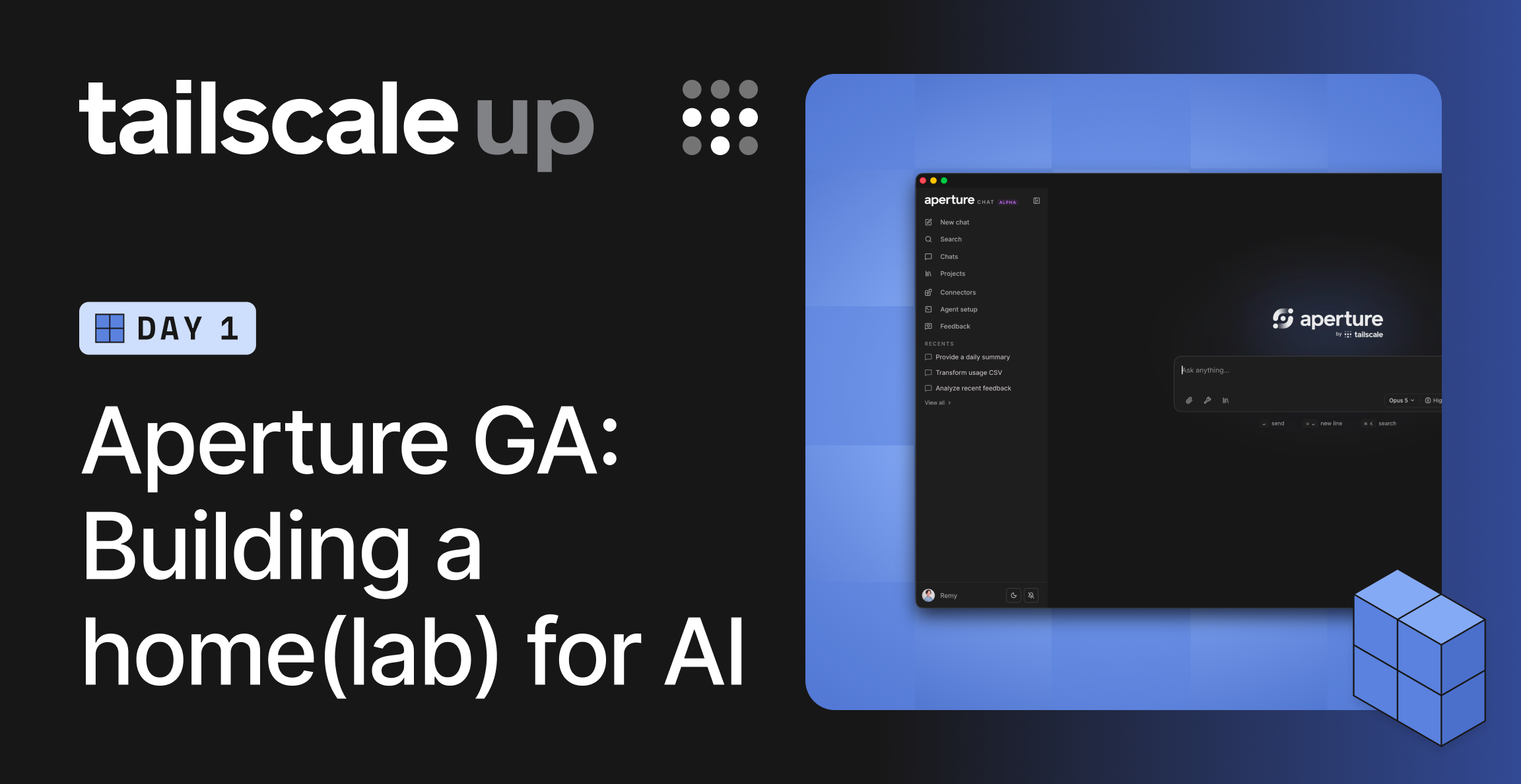
Aperture GA: Building a home(lab) for agentic AI

Summary

Aperture, Tailscale’s AI gateway, is now generally available. It ships with starter tokens, in‑app token purchases, new Model Context Protocol (MCP) endpoints for adding Tailnet nodes and invoking Tailscale SSH, and an upgraded chat UI that supports Projects (shared context, tool access, node groups) and configurable default tool permissions. All agent actions respect Tailscale’s unidirectional A…

  • Each new Aperture instance includes a bundle of usage tokens; additional tokens for any major LLM (open‑weight or closed) can be bought directly in the UI.
  • Two new MCP endpoints (Tailnet, Tailnet SSH) let agents add devices to a Tailnet and run commands via Tailscale SSH, with user approval and audit logging.
  • Chat UI now has Projects to group chats, share initial prompts, tool access, and Tailnet nodes, reducing per‑chat setup.
  • Default tool permission profiles let you pre‑approve or block specific connector actions (e.g., list_machines, run_command) across all chats.

Aperture demonstrates a practical way to embed LLM agents into a zero‑trust network without scattering API keys, while giving homelab users fine‑grained control over what agents can do on their devices. The token model lowers entry cost, and the MCP extensions make it possible to automate device pr…

5/10

Related reading

  1. Cloudflare Introduces the Agent Development Lifecycle to Replace Traditional SDLC

    Cloudflare’s Agent Development Lifecycle (ADLC) replaces the classic SDLC with an autonomous, event‑driven workflow system that lets AI agents handle code generation, testing, deployment, and maintenance. The platform builds on Cloudflare Workflows and the new @cloudflare/ci library to spin up containers, run headless browsers, and chain steps with caching and credential support. Observability is…

    InfoQinfoq.com2 min
  2. Agentic AI: Beyond the Hype

    The article is a marketing overview of CloudBees' agentic AI push, highlighting a webinar, the “Three H’s” governance framework, and the new MCP Server AI integration now on AWS Marketplace. It contains no technical deep‑dive or implementation specifics for engineers.

    Codeshipcloudbees.com2 min
  3. Auth0 Agent Gateway: The Identity Control Plane for Customer-Facing AI

    Auth0 Agent Gateway is a beta CIAM control plane that lets SaaS teams govern product‑native, customer‑facing AI agents. It adds organization‑aware identity, token‑exchange‑based credential delegation, real‑time policy checks, audit logging and a kill‑switch, aiming to prevent cross‑tenant data leaks and unauthorized tool use.

    Auth0auth0.com6 min
  4. Agent Substrate brings high-density, scalable, trusted infrastructure to GKE

    Agent Substrate is an open‑source runtime for AI agents that runs on GKE. It uses Cloud Hypervisor microVMs or gVisor sandboxes to give kernel‑level isolation, a custom control‑ and data‑plane that can suspend/resume agents in <500 ms, and a “zero‑idle” model that packs >1 000 dormant agents per host (≈10× density vs. containers). GKE integration adds custom ComputeClasses, spot/on‑demand pools,…

    Google Cloud Bloggoogle.com6 min
  5. Changing the game: How Google uses agentic AI to secure hundreds of millions of lines of code

    Google’s AI & Infrastructure team built an agentic pipeline (Mantis) that runs pre‑submit AI‑driven scans on every code check‑in, validates findings with a fast triage agent (AST + call‑graph analysis) achieving >92% precision in <1 min, then auto‑generates fixes via a bug‑fix agent. Localized threat models and a two‑step scan cut false‑positives to ~3% and prevent hundreds of vulnerabilities eac…

    Google Cloud Bloggoogle.com4 min