Related reading
Introducing System One Models and Jev
TypeSafe AI announced its first “System One” model, Jev, a non‑text‑generating LLM that outputs type‑safe structured decisions with calibrated probabilities. It claims 40‑200× lower latency (70‑500 ms) and 100‑500× lower cost versus frontier LLMs, no hallucinations, and parallel sampling. The post includes a side‑by‑side demo, a custom “workflow” benchmark comparing Jev to GPT‑5.6/6 and other mod…
Article: Your Next DSL Author Is a Language Model
Typed Domain Grounding (TDG) embeds a DSL inside a mainstream language the LLM already knows (e.g., Kotlin) and uses the host compiler as an oracle. The author describes five building blocks—embedding, choosing a host language with high training‑data frequency, compiler‑driven type safety, a generate‑compile‑repair loop, and an on‑demand teaching tool—and shows measured results from kUML, a Kotli…
InfoQinfoq.com18 minQuiz: Python's Mutable vs Immutable Types: What's the Difference?
The page offers a 12‑question interactive quiz that checks knowledge of Python’s mutable vs immutable types, covering built‑in type categories, aliasing pitfalls, mutable default arguments, and shallow copy behavior.
Real Pythonrealpython.com1 minPodcast: Signals and Levers: Building Thriving Engineering Organizations
The podcast explains how systems thinking helps leaders grasp the complex, adaptive nature of software delivery, especially as AI rollouts amplify bottlenecks. It also outlines cultural "levers"—choices that shape unwritten rules—to build sustainable, fun engineering teams.
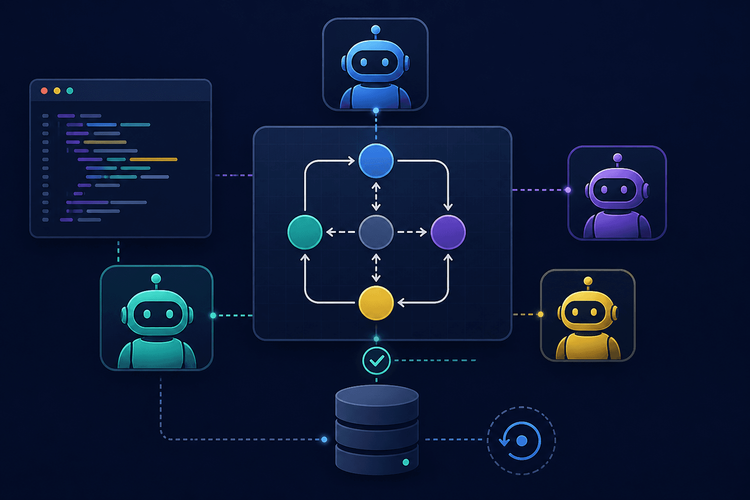
InfoQinfoq.com31 mintalkBuilding Deterministic Multi-Agent State Machines in TypeScript
The article shows how to build a deterministic, checkpoint‑backed finite state machine engine in TypeScript for orchestrating multi‑agent AI workflows. It uses Zod for schema validation, better‑sqlite3 for atomic persistence, and a pure transition function to make workflows traceable and recoverable in serverless environments.
SitePointsitepoint.com18 min