Related reading
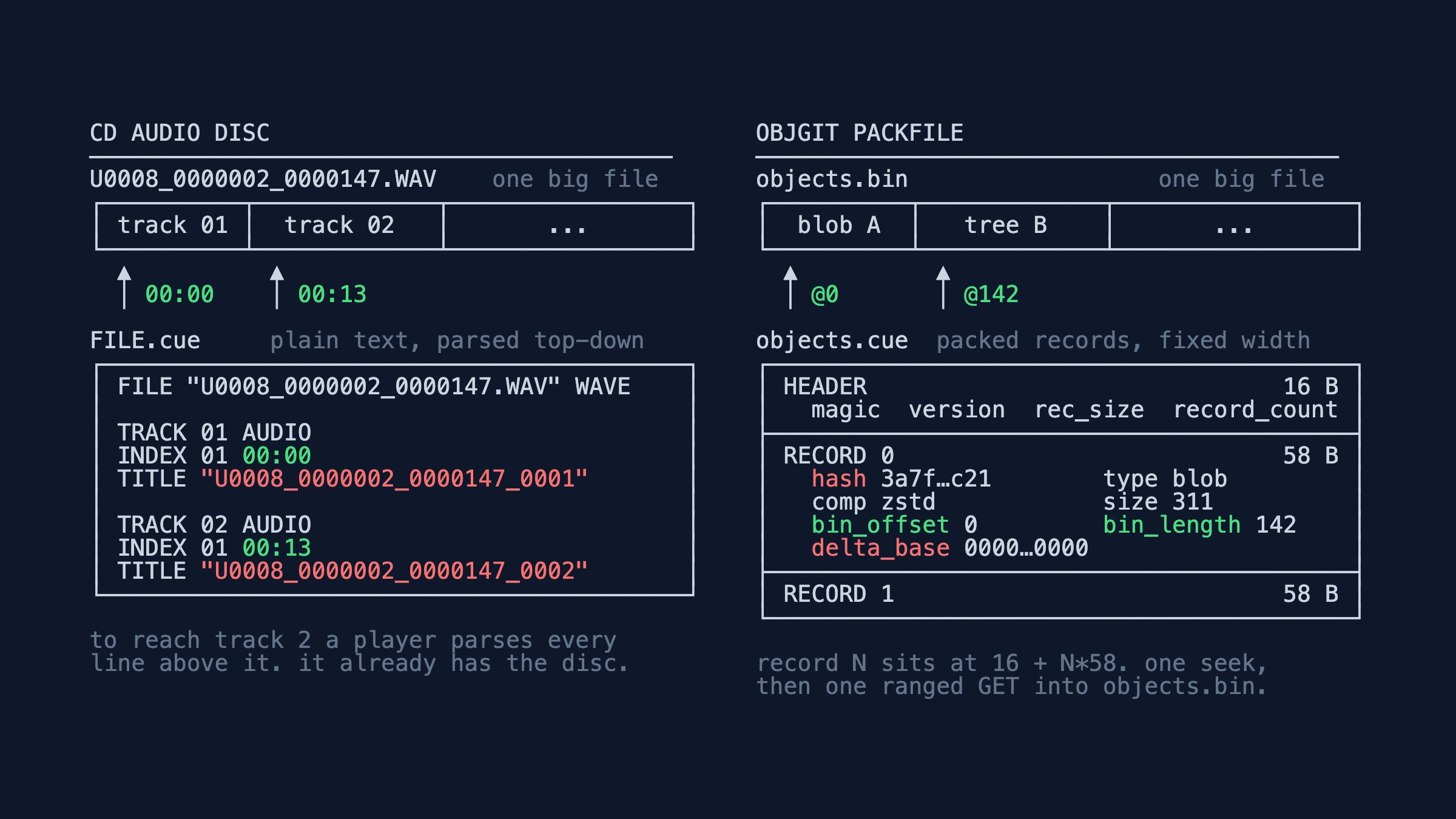
You can run Git on object storage if you re-make packfiles
The author built a Git server on object storage (objgit) and found standard Git packfiles inefficient due to random‑access and round‑trip latency. By designing a columnar, object‑storage‑native packfile format that can be accessed via HTTP range requests, they achieved acceptable performance for large repositories without client‑side changes.
Hacker News front pagetigrisdata.com18 minHN14635Reinventing issue tracking: Local-first and Git-native
A devlog describing how Manganin’s issue tracker stores issues in a dedicated Git repo as plain files, after rejecting earlier approaches that tried to embed issue data in the code tree or Git refs. The author explains the pitfalls of using refs for issue storage, shows the low‑level Git commands needed for that approach, and then outlines the final design: a hidden sister repository where each i…
Migrating Repositories to Git 3.0: Moving to SHA-256 and Reftables
The article outlines a step‑by‑step workflow for migrating existing Git repositories to the new SHA‑256 object format and reftable reference backend, including an audit script, conversion commands, and rollback guidance. Following the guide lets teams modernize their repos, improve scalability and address SHA‑1 security concerns.
SitePointsitepoint.com17 minDatabase Branching: A Developer's Guide to Git-Style Workflows
Database branching uses copy‑on‑write to give developers, CI jobs, and AI agents isolated database snapshots without full copies. Branches share unchanged data, store only deltas, and are disposable, enabling production‑like testing, per‑PR isolation, safe experimentation, and rapid cleanup. Safe operation requires protecting parent branches, using mock data, TTLs, and treating migrations as the…
Databricksdatabricks.com9 minAgora: Git as Shared Memory for Collective AutoResearch
Agora treats a Git repository as a shared, append‑only memory for autonomous research agents, recording each claim as an immutable commit in a DAG. In a 12‑day run with 13 language‑model workers it generated 1,703 reproducible contributions and closed 62 % of the gap to a trained GPT‑2‑124M, demonstrating that shared research state can accelerate discovery.
Hugging Face Daily Papersarxiv.org2 minpaper