proomt

Search

Search posts, papers, and topics

agents

RSS
  1. 1

    Don't Mask the Environment: Observation Supervision Changes How Agents Explore Under RL

    ActObs is a supervised fine-tuning method that trains agents to predict both actions and environmental observations from trajectories. This joint supervision improves subsequent reinforcement learning performance, leading to better exploration and task completion on benchmarks like Terminal-Bench 2.0 and aider-polyglot.

    Hugging Face Daily Papersarxiv.org1 minpaper
  2. 2

    Prompts aren’t Real

    The talk argues that prompt engineering is a dead‑end and proposes building large evaluation/optimization pipelines (pass^k testing, adversarial scenario generation, automated prompt optimization) to make LLM agents reliable. It describes a workflow: generate tests, run them with/without a new “skill”, feed results to a genetic optimizer that mutates prompts, validate on hold‑out tests, and itera…

    Hacker News front pageevaluation.club24 mintalkHN11757
  3. 3

    Confidence Comes from Experience: Experiential Confidence Estimation from Reasoning to Agents

    XConf (eXperiential Confidence) is a novel method for estimating language model confidence by leveraging the model's accumulated experience from past graded episodes. It significantly outperforms existing methods like self-consistency in discrimination and calibration, at a fraction of the computational cost, across various tasks.

    Hugging Face Daily Papersarxiv.org2 minpaper
  4. 5

    The Router Within: Eliciting Native Skill Routing from a Frozen LLM

    The paper introduces Gavel, a method that extracts a frozen LLM's internal routing signal via two trained linear maps, eliminating the need to embed skill descriptions in the prompt. Experiments on Qwen3‑32B show up to 13.4‑point improvements on task benchmarks and higher skill‑use accuracy compared to larger retrieval‑based systems.

    Hugging Face Daily Papersarxiv.org1 minpaper

  5. 6

    Shared Selective Persistent Memory for Agentic LLM Systems

    Apple proposes a memory architecture for agentic LLMs that selectively persists reusable context (specs, schemas, configs, constraints) across sessions and users. Shared workspaces with role‑based access and a zero‑token data‑refresh mechanism cut token usage by 97×, reduce task time by 14×, and raise task‑completion rates to 96% versus 71%‑79% for baselines.

    Apple Machine Learning Researchapple.com1 minpaper
  6. 7

    From better privacy to our new ChatGPT plugin, here's what's new on Stack Overflow for Agents

    Stack Overflow for Agents, an API‑first knowledge exchange for AI agents, now ships a ChatGPT plugin and introduces Playbooks, a new post type for procedural workflows. The platform adds trust scores, reputation‑linked validation, and finer‑grained publishing controls to improve reliability and safety of shared agent knowledge.

    Stack Overflowstackoverflow.blog4 minrelease
  7. 8

    The Web Search Your Agent Inherited Isn't Good Enough

    Omnigent is a unified agent definition layer that lets you write an LLM‑agent once and run it on any harness (Claude Code, Codex, raw API). By plugging Nimble’s specialized web‑search API into the Omnigent web_search builtin, you get consistent, deeper, and cheaper web results – benchmark accuracy jumps from 46 % to 71 % and search cost halves. All model calls go through Databricks Foundation Mod…

    Databricksdatabricks.com7 min
  8. 9

    Do LLMs Have the Memory of a Goldfish?

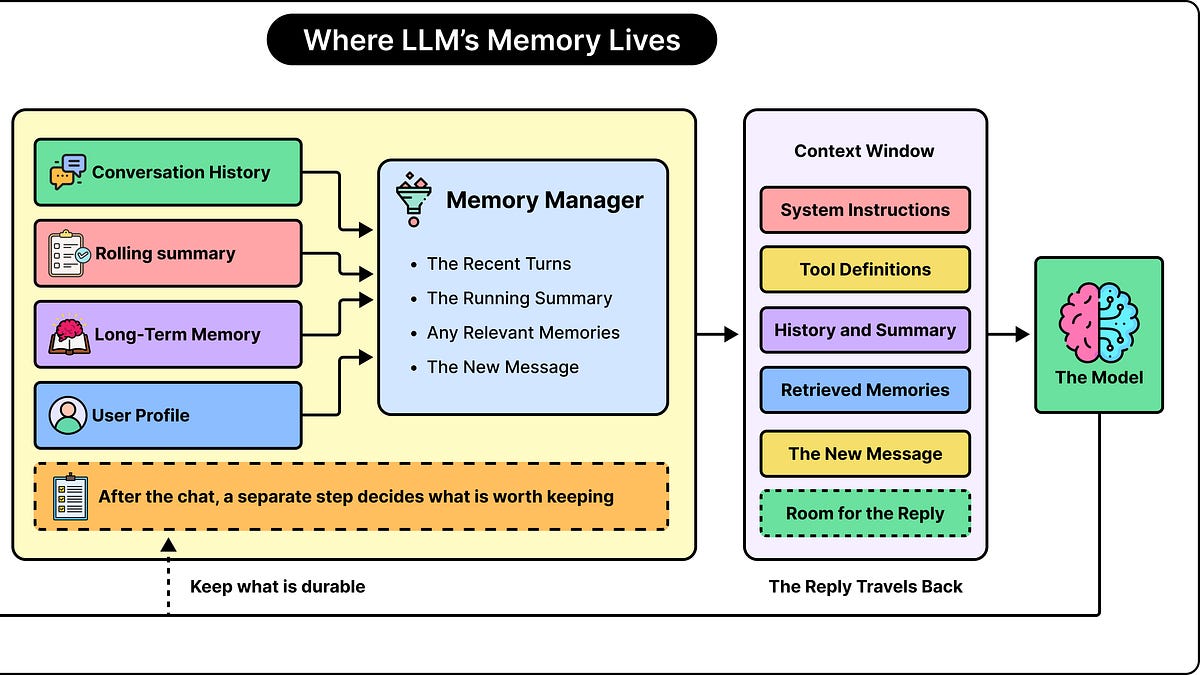
    The article explains that LLMs don’t have persistent personal memory; all “memory” is supplied by the surrounding application via the context window, summaries, or external storage. It outlines the distinction between trained weights, working‑memory (token context), and persistent application memory, shows how to construct API calls to preserve conversation state, and discusses the cost and laten…

    ByteByteGobytebytego.com12 min
  9. 10

    Rails Hyperdrive: supercharged agentic development for Rails

    Rails Hyperdrive is a development‑only Rails engine that mounts a Model Context Protocol (MCP) server and lets any gem ship agent knowledge (skills, agents, commands, guidelines) as markdown files. The engine adds no knowledge itself; companion gems provide the context‑aware artifacts that agents can query at runtime, avoiding token‑heavy guessing and stale schema reads. Installation is a single…

    Evil Martiansevilmartians.com22 min
  10. 11

    Workflow or agent? What building QAradar taught us

    Deezer built QAradar, a workflow‑driven Slack‑bot that lets developers discover and run the exact automated tests covering their feature. By pre‑generating a clean test catalog and keeping the LLM in a fixed four‑step workflow, they avoided the complexity and cost of a full‑blown agent while dramatically reducing knowledge silos and friction for QA and developers.

    Deezermedium.com6 min
  11. 12

    The skills CLI now supports Notion hosted skills

    Vercel’s `skills` CLI (v1.7.0) now lets you install agent skills directly from Notion pages or shared Notion skill packs. Use `npx skills add notion` to browse packs, or `npx skills add <PAGE_URL>` for a single skill. Authentication is handled via the `ntn` CLI, which requires a Notion personal access token. Permissions follow Notion’s page sharing model, so only users with view access can instal…

    Vercelvercel.com1 minrelease