proomt

Search

Search posts, papers, and topics

reinforcement learning

RSS
  1. 1

    Laya the open source version of Jev

    Laya is an open‑source, bidirectional‑encoder model family for ultra‑fast, calibrated decision‑making (choice, score, boolean) over structured schemas. It runs 6‑8× faster than the closed‑source Jev, supports 100+ languages via three checkpoints, and includes a lightweight router that selects the appropriate checkpoint before inference. Benchmarks show higher accuracy, far better calibration (ECE…
    Hacker News front pageconvaiinnovations.com8 minreleaseHN1326313lobste.rs2
  2. 2

    Learning to solve hard problems in RL for LLMs by never giving up

    The post introduces the *Matthew Effect* in RL‑fine‑tuning of LLMs—performance gains concentrate on tasks the model already solves— and proposes *Never Give Up* (NGU), an adaptive sampling scheme that uses a small k for easy prompts and retries hard prompts with a high‑probability “never give up” loop. Experiments on math (AIME, GSM8k), code (Manufactoria), and larger‑scale setups (DeepScaler) sh…

    Hacker News front pagegithub.io11 minHN1179
  3. 3

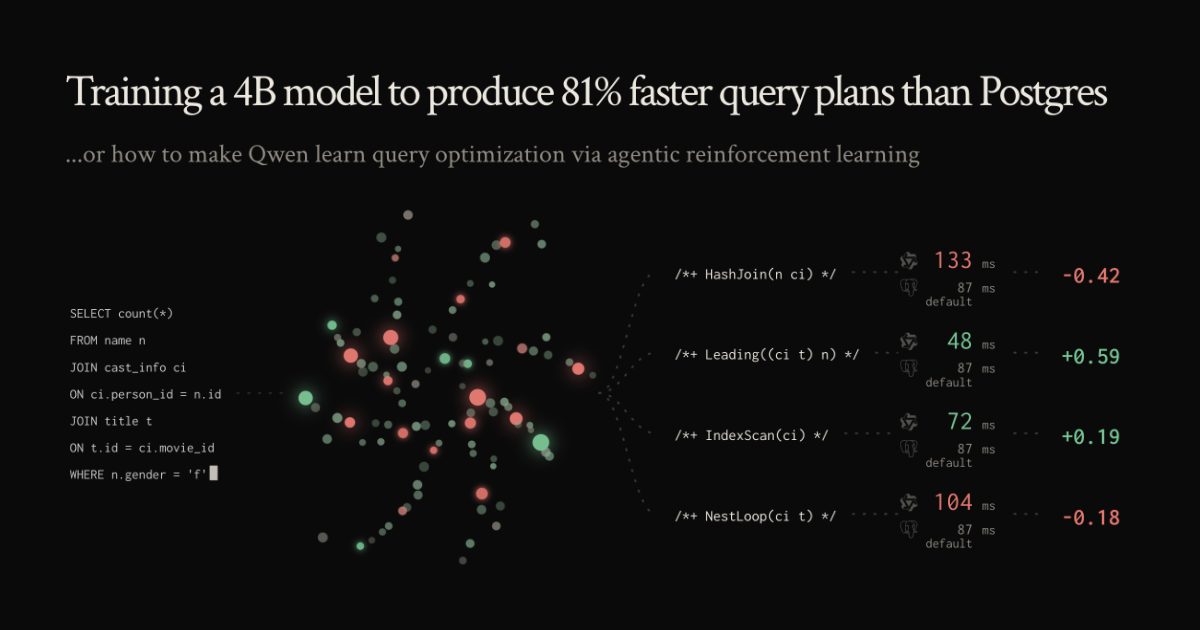
    Training a 4B model to produce 81% faster query plans than Postgres

    A 4‑billion‑parameter open‑weight LLM, fine‑tuned with supervised learning and a custom RL loop, learns to emit PostgreSQL join plans that cut query latency by 44.7 % on a 113‑query benchmark. The author built a low‑noise measurement harness, a GRPO‑style reward function, and ran off‑policy distillation from ~500 GPT‑6‑style trajectories, demonstrating that a modest model can outperform Postgres’…

    Hacker News front pagerohanbansal.com51 minHN692143
  4. 4

    CodeMidas: Scaling Agentic Coding RL Environments from Code Itself

    CodeMidas builds RL environments directly from open‑source code: agents explore a repo, infer a spec, generate tests from the original implementation, and filter tasks via execution checks. The pipeline yields 5,545 high‑quality coding tasks across 23 languages and 15 domains. Training the MiMo‑V2.5 agent with GRPO on this dataset improves benchmark scores by 8‑18% (e.g., DeepSWE +11.7%, ProgramB…

    Hugging Face Daily Papersarxiv.org1 minpaper
  5. 5

    Don't Mask the Environment: Observation Supervision Changes How Agents Explore Under RL

    ActObs is a supervised fine-tuning method that trains agents to predict both actions and environmental observations from trajectories. This joint supervision improves subsequent reinforcement learning performance, leading to better exploration and task completion on benchmarks like Terminal-Bench 2.0 and aider-polyglot.

    Hugging Face Daily Papersarxiv.org1 minpaper
  6. 6

    Rethinking Critic Learning in PPO: Understanding and Mitigating Value Flattening

    PPO critics in reinforcement learning for LLMs suffer from "Value Flattening," where predicted state values are too flat compared to actual values. This paper identifies the causes as an implicit variance penalty and redundant updates, and proposes SParse Proximal Policy Optimization (SP3O) to mitigate it by supervising only a few well-separated states.

    Hugging Face Daily Papersarxiv.org1 minpaper
  7. 7

    RetireOPD: Self-Retiring On-Policy Distillation for Agentic Reinforcement Learning

    RetireOPD introduces a self‑retiring on‑policy distillation framework for multi‑turn RL agents. A skill‑conditioned teacher is first trained with environment rewards, then a skill‑free student learns jointly via RL and token‑level distillation. The student automatically drops the teacher once its performance gap stops shrinking and it reaches a target success‑rate fraction, after which training c…

    Hugging Face Daily Papersarxiv.org1 minpaper
  8. 8

    ActionPiece: Rethinking Action Tokenization for Autoregressive Vision-Language-Action Models

    Action tokenizers for autoregressive VLA models often fail to preserve subtle action adjustments, despite good pointwise reconstruction. This paper introduces Physical Rank Consistency (PRC) to measure relational fidelity and ActionPiece, a new tokenizer that uses joint supervision to preserve these physical relationships, significantly improving policy success on robotics benchmarks.

    Hugging Face Daily Papersarxiv.org1 minpaper
  9. 9

    A Zeroth-Order Paradigm for LLM Preference Alignment

    The paper proposes Comparison-based Preference Optimization (ComPO), a zeroth‑order method that uses comparison oracles to align LLMs without a differentiable loss. Experiments on several LLM families show it improves win rates and mitigates likelihood displacement compared to direct alignment approaches.

    Hugging Face Daily Papersarxiv.org1 minpaper
  10. 10

    BI-Agent and BI-Bench: Towards Automating End-to-End Business Intelligence

    The paper introduces BI‑Bench, a new benchmark of real‑world BI questions derived from public dashboards, and BI‑Agent, a tool‑augmented LLM system that breaks BI workflows into search, join, and transform subtasks. Baseline LLMs hit <50 % accuracy on BI‑Bench. By orchestrating specialized data‑management tools and post‑training the model with supervised fine‑tuning and reinforcement learning on…

    Hugging Face Daily Papersarxiv.org2 minpaper
  11. 11

    MintAct: A Unified Visual Agent for Digital Environments

    MintAct is a family of vision-language models (2B-8B) that unifies UI grounding, multi-step navigation, and visual tool use across mobile, desktop, and web environments. It achieves state-of-the-art performance by leveraging a scalable environment and an asynchronous reinforcement learning infrastructure.

    Hugging Face Daily Papersarxiv.org1 minpaper
  12. 12

    OmniVChat: Synthesizing, Benchmarking, and Training for Native Audio-Visual Dialogue

    OmniVChat defines native audio‑visual dialogue where a model consumes raw audio and video streams and replies in text. The authors build OmniVChat‑Studio, a multi‑agent simulator that generates single‑ and multi‑turn audio‑visual conversations, and use it to create OmniVChat‑Bench, a benchmark covering five dialogue abilities. They also propose OmniVChat‑RL, a reinforcement‑learning reward that b…

    Hugging Face Daily Papersarxiv.org2 minpaper
  13. 13

    Region-Level Policy Optimization for Fine-grained MLLM Perception

    Vision‑RL2 trains a lightweight proposal network via region‑level reinforcement learning to select high‑resolution evidence for multimodal LLMs, allowing coarse‑resolution localization and fine‑resolution recognition. Across six fine‑grained vision benchmarks it reduces visual token count by ~4× while matching or surpassing full‑resolution accuracy.

    Hugging Face Daily Papersarxiv.org1 minpaper
  14. 14

    Generalized Agent Iteration: One Formal Framework for Iterative Policy Improvement and Recursive Self-Improvement

    The paper introduces Generalized Agent Iteration (GAI), a formal framework that unifies classical iterative policy improvement (GPI) and recursive self‑improvement (RSI). GAI treats an agent as a set of modifiable components and models learning as a loop of evaluation and improvement. Two binary “dials”—whether the improvement mechanism is internal to the agent and whether the evaluation standard…

    Hugging Face Daily Papersarxiv.org1 minpaper
  15. 16

    Zing-0.5: Toward Playable Worlds with Real-Time Joint Action and Text Control

    Zing‑0.5 is a 5 B autoregressive world model that lets users control generated environments in real time using both keyboard actions and text prompts. The paper introduces unified action‑text conditioning, segment‑level teacher distillation, and a low‑cost streaming inference pipeline that runs at 24 FPS (832×480) for about $0.009 per minute, achieving 81 % overall and 88.5 % consistency on a nav…

    Hugging Face Daily Papersarxiv.org1 minpaper
  16. 17

    From Pretraining to Proficiency: Real-World Subtask RL for Long-Horizon Manipulation with Minimal Human Intervention

    The paper presents PARTS, a framework that augments a frozen pretrained robot policy with RL‑learned residuals on selected bottleneck subtasks, using local success rewards and minimal human resets. In real‑world bimanual and single‑arm tasks, PARTS more than doubles success rates with only minutes of robot rollouts, outperforming prior fine‑tuning methods.

    Hugging Face Daily Papersarxiv.org1 minpaper
  17. 19

    Modality-Autoregressive World-Action Models

    ModAR is a world‑action model that autoregressively denoises multiple future modalities (depth, DINO features, point tracks) before predicting actions, letting each prediction condition on earlier outputs. It outperforms prior WAMs, achieving higher success rates with ~20× fewer training FLOPs and no pretraining.

    Hugging Face Daily Papersarxiv.org1 minpaper
  18. 20

    Register Tokens for Bounded-State Reasoning in Diffusion Language Models

    Register tokens are fixed‑position embeddings that store a compact hidden state across diffusion‑based language model generation chunks, enabling bounded‑state reasoning without retaining all prior text. Post‑training on LLaDA and Dream shows up to +8.5 math and +19.5 code benchmark points versus plain text carry, and RL fine‑tuning further improves long‑horizon tasks.

    Hugging Face Daily Papersarxiv.org1 minpaper
  19. 21

    ScienceBuddy: Recursive-in-Recursive Self-Improvement for Interactive Scientific Agents

    ScienceBuddy is an interactive workspace that converts researcher prompts, feedback, and execution traces into continual‑learning tasks for AI agents. It introduces a "recursive‑in‑recursive" self‑improvement loop that alternates harness refinement and model training, and showcases case studies across four scientific task families.

    Hugging Face Daily Papersarxiv.org1 minpaperHN2
  20. 22

    Learning Foresight without Explicit Trajectories for 3D Diffusion Policies

    This paper introduces Movement Trend Guidance (MTG), a method to provide foresight to 3D diffusion policies for robotic manipulation without explicit trajectory planning. MTG learns a compact latent representation of interaction evolution, significantly improving performance on various benchmarks with minimal parameter overhead.

    Hugging Face Daily Papersarxiv.org1 minpaper
  21. 23

    CERA-MoA: Co-Evolving Routing Mechanisms with Continually Learning LLM Agents

    CERA-MoA proposes a reinforcement‑learning loop where a router and a set of LLM agents are trained together. A “familiarity” estimator reads mid‑layer hidden states to predict each agent’s competence on a query, letting the router activate only a minimal subset of agents that meet a cumulative confidence threshold. The system also feeds targeted training examples to agents based on their evolving…

    Hugging Face Daily Papersarxiv.org1 minpaper
  22. 24

    DACA-GRPO: Denoising-Aware Credit Assignment for Reinforcement Learning in Diffusion Language Models

    DACA‑GRPO adds denoising‑aware credit assignment to GRPO‑style RL trainers for diffusion LLMs. It computes per‑token importance scores from intermediate denoising steps and uses stratified masking to reduce mean‑field bias in likelihood estimates. Plug‑and‑play on three existing GRPO methods, it yields consistent gains on seven downstream tasks (up to +5.6 pp math, +7.4 pp code, +36.3 pp constrai…

    Apple Machine Learning Researchapple.com1 minpaper
  23. 25

    REVERSAL-BENCH: A Reversibility Axis and Reset Oracle for Measuring the Reset-Free RL Cliff

    The paper presents REVERSAL‑BENCH, a benchmark that varies environment reversibility with a parameter ρ and provides a ground‑truth reset oracle for eight manipulation tasks. Using it, the authors show that reset‑free RL agents hit a sharp reversibility cliff and become permanently trapped, while episodic agents remain robust.

    Apple Machine Learning Researchapple.com1 minpaper
  24. 26

    ImpossibleRubrics: Stress-Testing Generated Rubrics as Reward Signals

    ImpossibleRubrics introduces a 169‑task benchmark of “impossible” prompts, each with a formal oracle certificate defining what an honest answer can claim. The authors generate rubrics downstream and test them adversarially, finding that many rubric generators are exploitable (8‑36% of the time) and that a single generic rubric (“be decisive, penalize hedging”) is exploited 64% of the time, while…

    Hugging Face Daily Papersarxiv.org1 minpaper
  25. 27

    Online Learning with LLM Experts from Limited Feedback

    The paper models prompt routing to multiple LLM experts as a bandit problem with limited feedback and proposes algorithms that achieve sublinear regret in both full‑information and bandit settings. Experiments demonstrate that the methods learn effective routing strategies across diverse LLMs using only a small feedback budget.

    Hugging Face Daily Papersarxiv.org2 minpaper
  26. 28

    Fingers as Legs: Learning Self-Supported Locomotion and Manipulation with an Anthropomorphic Hand

    The authors train an anthropomorphic robotic hand to crawl, steer, and recover from falls using its fingers for both support and manipulation, via a reinforcement‑learning reward formulation tuned to the hand's asymmetry. Sim‑to‑real experiments show faster locomotion than quadruped‑style rewards and successful untethered tasks without onboard vision.

    Hugging Face Daily Papersarxiv.org1 minpaper
