proomt

Search

Search posts, papers, and topics

All posts

Hugging Face Daily PapersKailin Jiang, Lei Liu, Jian Xi2 min readpaperadvanced

AdaTutoRank: Learning to Rerank Document Sets via Adaptive Tutoring Optimization for RAG and Deep Research

Summary

AdaTutoRank is a setwise document reranker for retrieval‑augmented generation that trains via Adaptive Tutoring Optimization, providing quality‑matched hints from a frozen policy snapshot. Across ten benchmarks it achieves state‑of‑the‑art performance with fewer retrieval calls.

  • AdaTutoRank trains a setwise reranker using Adaptive Tutoring Optimization, supplying three hint forms (rubrics, sibling set, reflection) matched to rollout quality.
  • It combines silver‑label supervision, RL rewards, and distillation into a token‑level advantage that captures both group‑relative and hint‑conditioned signals.
  • Evaluation on ten RAG/deep‑research benchmarks shows AdaTutoRank outperforms prior setwise rerankers while reducing retrieval calls.
  • A nine‑dimensional hierarchical rubric enables finer‑grained credit assignment among documents in a set.

Researchers and engineers building RAG pipelines or deep‑research systems should care because it offers a more effective way to compose complementary document sets with less retrieval overhead.

8/10

Related reading

  1. RenderRank: Learning to Rerank Text with Compressed Visual Tokens

    RenderRank renders documents as images and uses a vision‑language model to produce compressed visual tokens for reranking, cutting input length by up to 35% while achieving higher NDCG@10 than text‑only baselines. It shows especially strong gains on long‑document datasets with half the token count and 1.7× throughput.

    Hugging Face Daily Papersarxiv.org1 minpaper
  2. Beyond Top-k Skill Retrieval: Diversity-Aware Skill Routing for LLM Agents

    Beyond Top‑k Skill Retrieval: Diversity‑Aware Skill Routing (DSR) applies a Determinantal Point Process with a query‑residual diversity kernel to rerank skill candidates, balancing relevance and redundancy. On the SkillRouter benchmark it raises recall and full‑coverage, especially for multi‑skill queries, showing that skill routing benefits from set‑selection rather than independent ranking.

    Hugging Face Daily Papersarxiv.org1 minpaper
  3. How LLMs Can Find a Needle in a Haystack

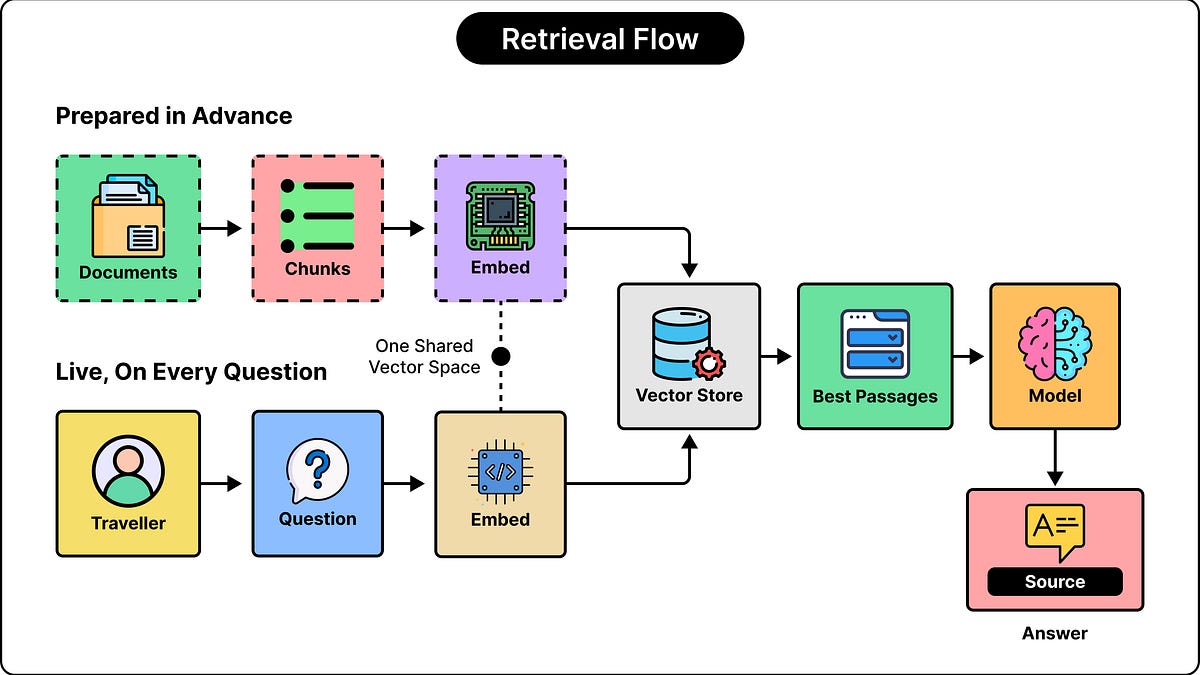
    The post explains how retrieval‑augmented generation (RAG) lets LLM‑based assistants answer questions from private corpora. It covers chunking documents into passages, embedding queries and chunks, similarity metrics, and the trade‑offs of different vector indexes (flat, IVF, HNSW). The focus is on practical design choices rather than new research.

    ByteByteGobytebytego.com12 min
  4. ML based ranking using Nrtsearch

    Yelp added an Inference Plugin to Nrtsearch that runs XGBoost and neural‑network models inside the search engine, eliminating a separate scoring service. The plugin extracts features from index documents, loads MLeap bundles from MLflow, and serves predictions on replica nodes with millisecond latency.

    Yelp Engineeringyelp.com7 min
  5. When AI Reviews Train AI Reviewers: Scientific-Judgment Collapse and Mitigation

    The authors show that training LLM reviewers on synthetic reviews leads to a compression of rating distributions and loss of semantic diversity, a phenomenon they call scientific-judgment collapse. They mitigate it with TrustReviewer, which uses curated training data and activation steering to preserve judgment diversity.

    Hugging Face Daily Papersarxiv.org1 minpaper