proomt

Search

Search posts, papers, and topics

All posts

InfoQJerald Selvaraj19 min readintermediate

Article: Beyond Relevance: A Governance-First Architecture for Enterprise Personalization

Summary

The article proposes a governance‑first architecture for enterprise personalization, where policy‑driven steps (memory, journey graph, AI routing, scoring, trust checks, outcome simulation) shape the recommendation before it is returned. A reference FastAPI implementation demonstrates the pattern with external YAML policies and optional LLM assistance.

  • Separate relevance, consent, journey memory, AI routing, and outcome estimation into distinct, inspectable pipeline stages.
  • Use an Experience Memory Layer (SQLite) and Temporal Knowledge Graph to retain cross‑session context for each customer.
  • Hybrid AI Orchestration Engine selects the cheapest reliable inference tier (rules, SLM, ML, or LLM) based on policy.
  • Trust‑Aware Personalization Layer applies YAML‑defined governance (consent, fatigue, channel sensitivity) to modify scores or suppress offers.

Teams building regulated recommendation systems need a reproducible, auditable way to enforce consent, fatigue, and channel policies without sacrificing relevance.

6/10


Related reading

  1. Article: Architecting Secure and Scalable Facial Verification Systems

    A real‑world post‑mortem of a high‑volume face verification service that moved from a naïve synchronous API to an async, layered pipeline (edge validation, preprocessing, decoupled detection/verification, decision engine) to achieve 8.5k rpm, p99 < 1.8 s, 30 % cost savings, and strict privacy controls.

    InfoQinfoq.com15 min
  2. Article: Your Next DSL Author Is a Language Model

    Typed Domain Grounding (TDG) embeds a DSL inside a mainstream language the LLM already knows (e.g., Kotlin) and uses the host compiler as an oracle. The author describes five building blocks—embedding, choosing a host language with high training‑data frequency, compiler‑driven type safety, a generate‑compile‑repair loop, and an on‑demand teaching tool—and shows measured results from kUML, a Kotli…

    InfoQinfoq.com18 min
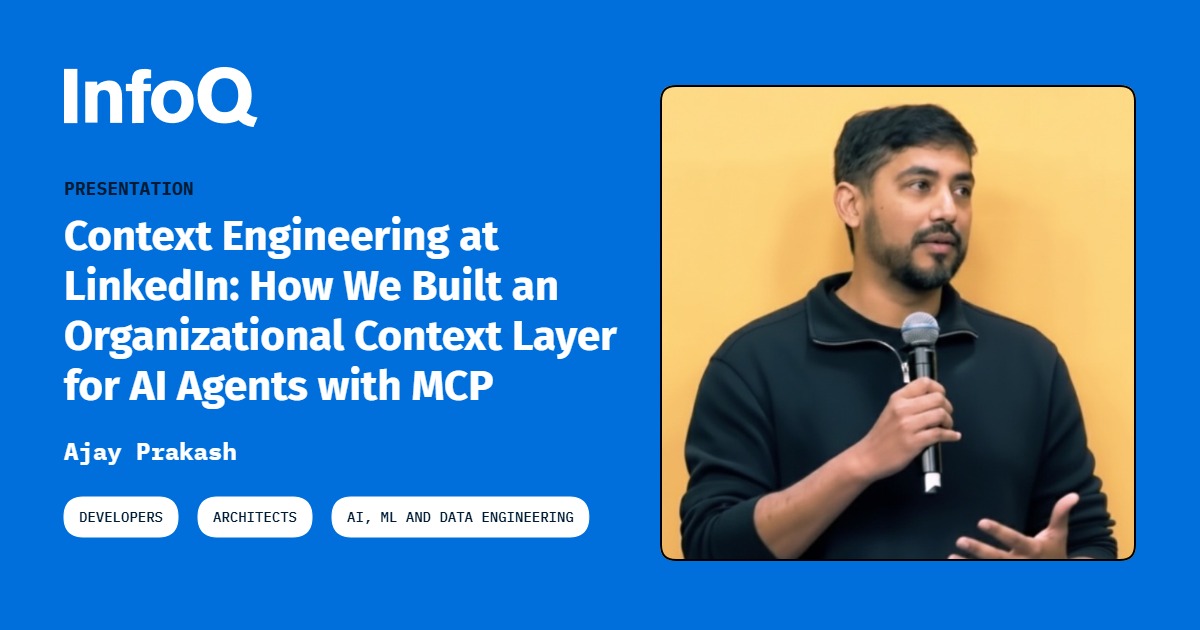
  3. Presentation: Context Engineering at LinkedIn: How We Built an Organizational Context Layer for AI Agents with MCP

    LinkedIn built a “Contextual Agent Playbooks and Tools” layer that wraps internal services (code search, docs, feature flags, etc.) behind the open‑source Model Context Protocol (MCP). By feeding LLM‑powered coding agents the exact internal artifacts they need, the agents can diagnose incidents, generate PRs, and update incident tickets in minutes, delivering a reported 20 % productivity gain wit…

    InfoQinfoq.com28 mintalk
  4. Use Curiosity, Craft, and Care to Decide What AI Should Write

    The post proposes a three‑principle framework—Curiosity, Craft, and Care—to decide how much AI should author each artifact in a software development workflow. It argues that AI can be used aggressively for exploratory, disposable outputs (Curiosity) but should be limited for artifacts that commit the team to decisions (Craft) and for communications that require personal ownership (Care). The auth…

    Atomic Objectatomicobject.com4 min
  5. How to upskill enterprise AI builders by using daily micro habits

    Google Cloud Consulting proposes a four‑pillar micro‑learning framework for enterprise AI upskilling: 5‑minute browser‑based exercises, pre‑configured sandboxes, daily streaks, and delivering runnable code each session. A pilot (Advent of Agents) showed >150k participants, 859k code runs, and a 31% daily return rate, suggesting short, frictionless tasks improve engagement versus traditional bootc…

    Google Cloud Bloggoogle.com3 min