proomt

Search

Search posts, papers, and topics

All posts

CodeshipShafiq Shivji10 min readintermediate

Blog: How to Build a DevOps Agent

Summary

This blog walks through the open‑source DevOps Agent Kit, which lets Claude Code or Cursor act as a DevOps assistant by connecting to CloudBees Unify, Jira, and Slack via MCP servers and to GitHub via the CLI. It provides a repeatable setup (Docker, Node, env file) and seven slash commands for pipeline overview, triage, security, release readiness, flag management, CI health scoring, and Jira tic…

  • The DevOps Agent Kit uses Model Context Protocol (MCP) servers to bridge an LLM (Claude Code/Cursor) with CloudBees Unify, Jira, Slack, while using the GitHub CLI for GitHub actions.
  • Setup consists of cloning the repo, populating a .env with CloudBees, Slack, and optional Jira credentials, then validating with demo/setup.sh before launching with `claude .` or `cursor .`.
  • Seven slash commands expose unified pipeline status, automated failure triage, security posture, release readiness, feature‑flag control, CI health score, and Jira ticket creation.
  • The agent classifies build failures into CONFIG, CODE, SECURITY, ENVIRONMENT, or KNOWN categories and can automatically post summaries to Slack or create Jira tickets after confirmation.

Engineers building AI‑augmented DevOps tooling can quickly prototype a unified assistant without writing custom integration code, saving time and reducing context‑switching across CI/CD systems.

6/10
Related reading

  1. Introducing the DevOps Agent Kit

    The DevOps Agent Kit is an Apache‑2.0 open‑source starter kit that lets you plug an LLM‑based coding assistant into your existing CI/CD, security, and feature‑flag tooling via CloudBees Unify. It ships with seven read‑only example skills, enforces RBAC and audit trails, and normalises data from up to 63 tools so the agent can answer a single “are we good to ship?” question with verifiable evidenc…

    Codeshipcloudbees.com5 min
  2. The DevFest Community Workshop Experience: Building Real Agents Together

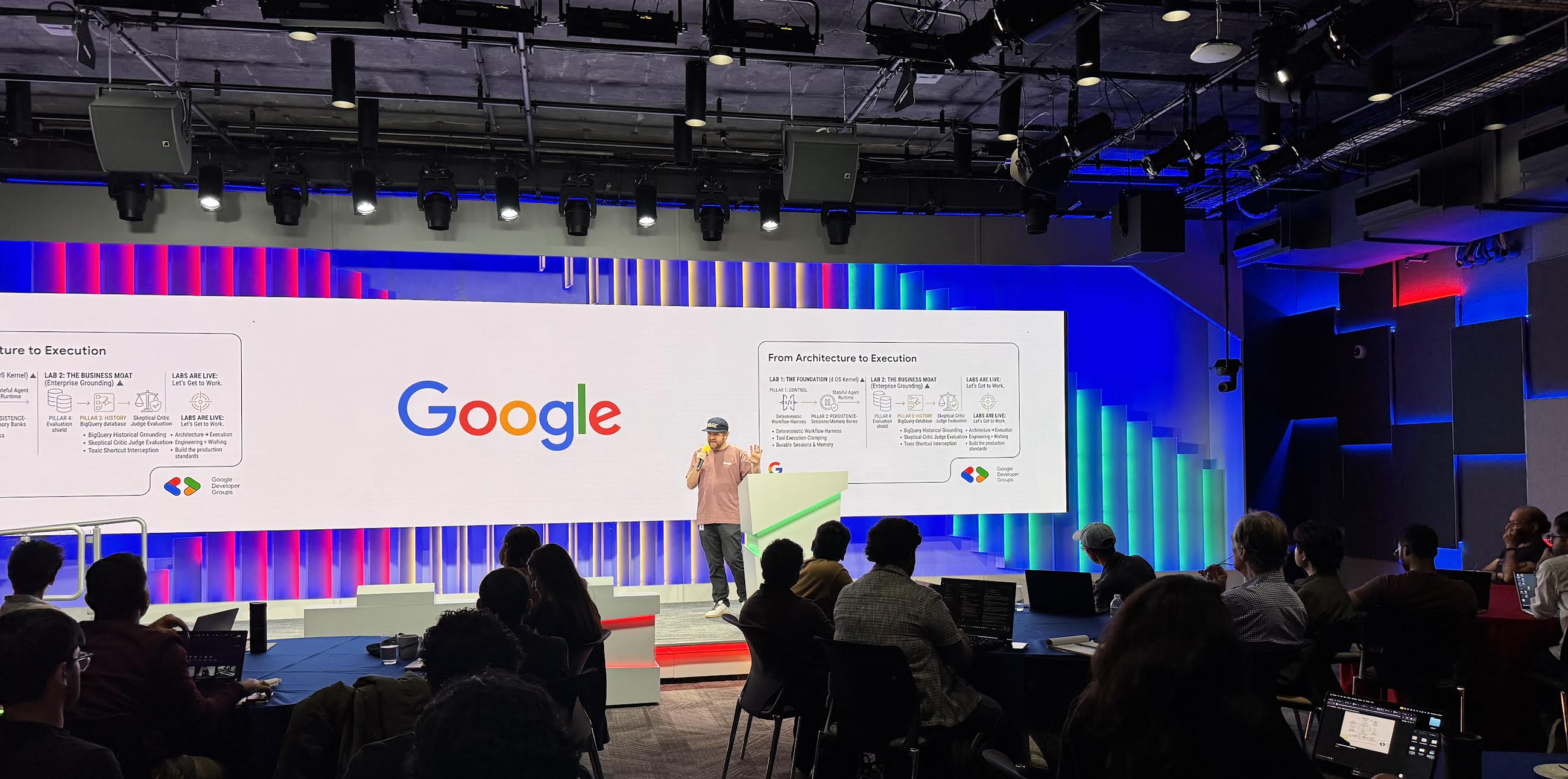
    Google’s DevFest Community Workshop introduced a “Workbench” format that emphasizes architectural mental models over copy‑paste code, guiding engineers to build long‑running, self‑evolving multi‑agent systems with the Agent Development Kit and Gemini Enterprise platforms. Attendees learned state‑separation, workflow pausing, and self‑patching pipelines, and the series will continue in five more c…

    Google Cloud Bloggoogle.com2 min
  3. Cloudflare Introduces the Agent Development Lifecycle to Replace Traditional SDLC

    Cloudflare’s Agent Development Lifecycle (ADLC) replaces the classic SDLC with an autonomous, event‑driven workflow system that lets AI agents handle code generation, testing, deployment, and maintenance. The platform builds on Cloudflare Workflows and the new @cloudflare/ci library to spin up containers, run headless browsers, and chain steps with caching and credential support. Observability is…

    InfoQinfoq.com2 min
  4. Why Every Enterprise Needs a DevSecOps Control Plane

    The article argues that enterprises need a DevSecOps control plane to unify fragmented CI/CD tools, enforce security policies, and provide AI‑aware context. CloudBees Unify is presented as a solution that claims large reductions in release prep time and outages without requiring tool migration.

    Codeshipcloudbees.com6 min
  5. Five CI Tools, One Control Plane: Finally Answer “What’s Going On?”

    CloudBees Unify is a control‑plane overlay that connects existing CI tools (GitHub Actions, Jenkins, GitLab, Bitbucket, CloudBees CI) to provide a single dashboard, centralized policy enforcement, audit trails, and artifact lineage without requiring migration of pipelines. The post outlines a 30‑60‑90‑day rollout plan and the expected benefits for platform teams.

    Codeshipcloudbees.com3 min