proomt

Search

Search posts, papers, and topics

devops

RSS
  1. 1

    Everybody's Lost Their Minds

    The author argues that the AI hype wave is draining engineering resources without improving security, and that basic practices like inventory and automated patching are far more valuable. He warns that over‑reliance on AI‑generated code erodes understanding and makes debugging harder.

    Lobstersnetmeister.org6 minHN368338lobste.rs193
  2. 2

    Cloudflare Quick Tunnels

    Cloudflare Quick Tunnels let you expose a local service via an outbound‑only connection to Cloudflare’s edge network. The service gets a public URL (anycast across 335+ cities) with automatic TLS, DDoS protection, and no inbound ports. It’s positioned for short‑lived agents, webhooks, and testing loops, with JSON health output and no config files.

    Hacker News front pagecloudflare.com1 minreleaseHN831316
  3. 3

    Inside ZCode: Silently uploading your Git history to the cloud

    ZCode (Zhipu’s AI coding desktop) silently archives your entire workspace—including full .git history, LFS cache, and config—encrypts it with a server‑supplied RSA public key, and uploads the ciphertext directly to Aliyun OSS. The upload runs unconditionally for any logged‑in user, cannot be disabled via UI, and the decryption key lives only on the server, giving Zhipu full read access to your co…

    Hacker News front pageferstar.org6 minpostmortemHN336113
  4. 5

    Cloudflare/Security-Audit-Skill

    Cloudflare open‑sources a “security‑audit” skill that turns an LLM‑enabled coding agent into a structured vulnerability auditor. It runs six deterministic phases, validates findings against a JSON schema, and supports additive runs to improve coverage.

    Hacker News front pagegithub.com3 minreleaseHN20938
  5. 6

    Backups Aren't Simple

    Backups involve more than copying files; you need snapshot rotation, deduplication, and off‑site storage to meet RPO goals while controlling storage and bandwidth. Using proven tools like Borg or Restic and regularly testing restores simplifies the mental load.

    Hacker News front pagefilipovski.net8 minHN353222
  6. 7

    Reinventing issue tracking: Local-first and Git-native

    A devlog describing how Manganin’s issue tracker stores issues in a dedicated Git repo as plain files, after rejecting earlier approaches that tried to embed issue data in the code tree or Git refs. The author explains the pitfalls of using refs for issue storage, shows the low‑level Git commands needed for that approach, and then outlines the final design: a hidden sister repository where each i…

    Lobstersmanganin.dev6 minHN1lobste.rs27
  7. 8

    Beyond jj: config & tools ecosystem

    A talk‑style overview of the growing jj ecosystem, covering new built‑ins (bookmark‑advance, bisect‑run, run, fix, tag, arrange, converge), clever alias tricks (subcommand aliases, git‑push‑like publish alias), the community‑maintained alias directory, and current forge integrations (GitHub stacked PRs, JJHub, Radicle, Tangled).

    Lobstersarko.net16 mintalklobste.rs89
  8. 10

    Show HN: Pizza Bot – An inbox for AI agents that work in the background

    Pizza Bot is an open‑source inbox for long‑running LLM‑based agents. It runs a stateful DeepAgents/LangGraph runtime behind an HTTP/SSE API server, with Electron, web, and CLI front‑ends. The tool supports multiple model providers (Bedrock, Anthropic, Gemini, OpenAI, OpenRouter, Ollama), checkpointed runs, human‑in‑the‑loop approvals, and a plugin/skill system. The repo includes a clear monorepo…

    Hacker News front pagegithub.com4 minreleaseHN5933
  9. 11

    Trying the Software Factory Pattern

    The post describes an experiment implementing the software‑factory pattern: an AI‑driven loop that audits a Linear project, syncs goals from Notion, metrics from Datadog/Snowflake, creates and updates issues, and executes non‑blocked tasks. It shows how tying together a unified task tracker, observability data, and an orchestrated agent harness can keep projects aligned without manual state hoard…

    Hacker News front pagelethain.com3 minHN8745
  10. 13

    Rate limits on GitLab.com are changing

    GitLab.com will tie API rate limits to subscription tiers: free users (and unauthenticated IPs) get 60 req/hr, while Premium/Ultimate get higher per‑user and per‑group caps starting Oct 19 2026 (free) and Jan 2027 (paid). Authenticated requests use the plan’s limits; hitting a limit returns 429 with Retry‑After. Preview “brownout” windows on Oct 7 and 14 let you test the new caps. If you need mor…

    Hacker News front pagegitlab.com4 minHN174127
  11. 14

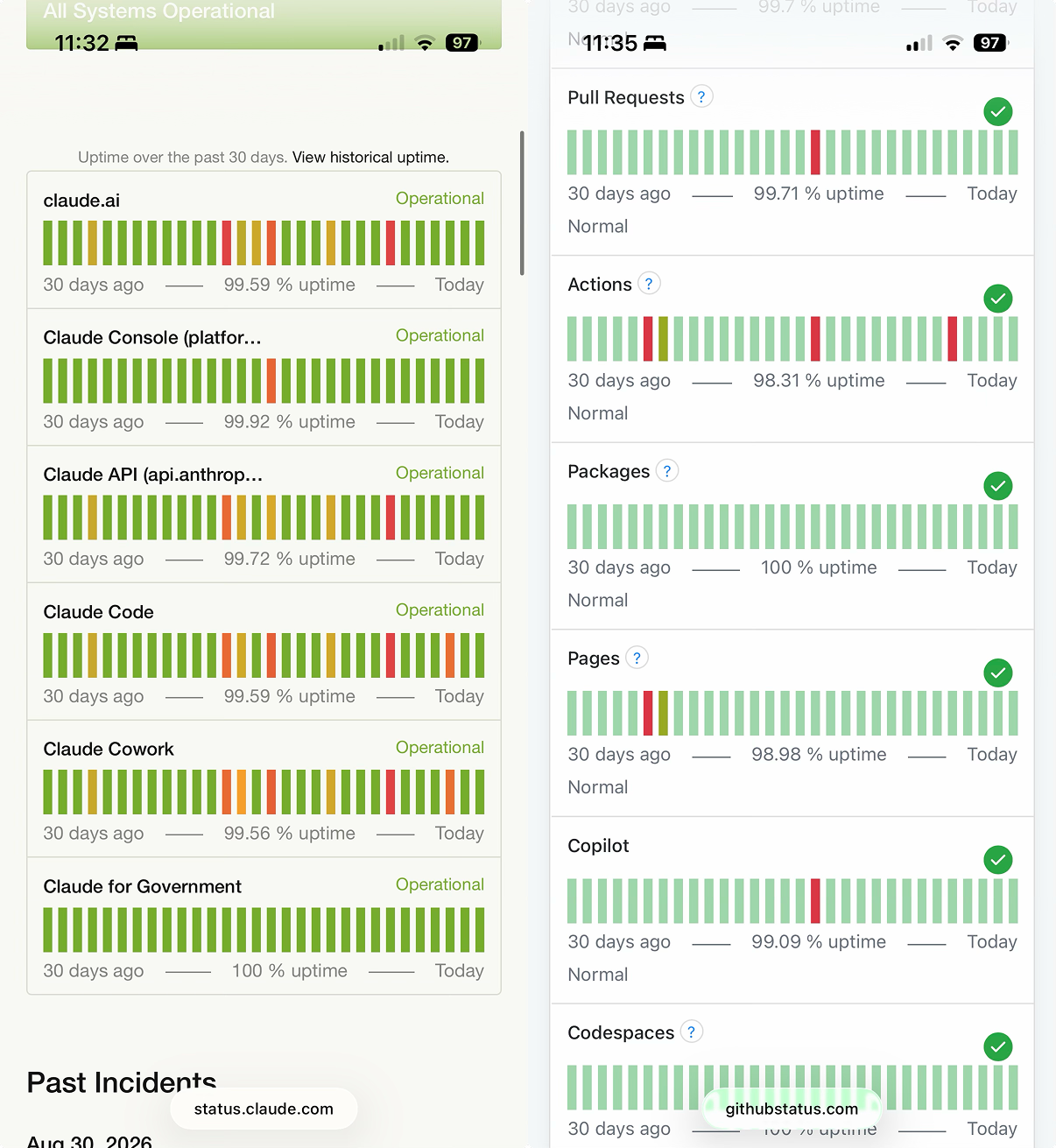
    Can we stop with the uptime percentages?

    This article argues that uptime percentages are a poor public interface for communicating service reliability because their non-linear nature is not intuitive to non-infrastructure people. It proposes showing absolute downtime (e.g., hours affected) alongside percentages for better clarity for a general audience.

    Hacker News front pagejim-nielsen.com2 minHN144112
  12. 15

    Prompts aren’t Real

    The talk argues that prompt engineering is a dead‑end and proposes building large evaluation/optimization pipelines (pass^k testing, adversarial scenario generation, automated prompt optimization) to make LLM agents reliable. It describes a workflow: generate tests, run them with/without a new “skill”, feed results to a genetic optimizer that mutates prompts, validate on hold‑out tests, and itera…

    Hacker News front pageevaluation.club24 mintalkHN11757
  13. 16

    Towards Self-Driving Codebases

    The post argues that AI agents could eventually handle low‑level engineering tasks—bug fixing, debugging, UI consistency, growth experiments—if the dev toolchain is made “agent‑legible”. It outlines missing primitives (global memory, code‑base rot prevention, better dev environments) and proposes a bootstrapping process to measure and improve a repo’s “agent readiness”. The piece is largely specu…

    Hacker News front pagedetail.dev9 minHN12099
  14. 18

    Telling a Computer to Do Things

    The author explains how learning shell scripting unlocked the ability to automate and stitch together tools, emphasizing that proficiency is more about a rich CLI toolbox than syntax. He provides concrete tips, tool suggestions, and examples for writing maintainable scripts.

    Hacker News front pagewill-keleher.com7 minHN8736
  15. 19

    Back to the future: modules for Guix packages (2022)

    Guix-Modules is a new tool that generates Environment Modules files from Guix packages, allowing HPC users to leverage Guix's reproducible software environments with their familiar `module` command interface. This bridges the gap between traditional HPC environment management and Guix's declarative, reproducible approach.

    Hacker News front pageguix.info7 minHN671
  16. 20

    AI Changed How Spotify Builds. What We Learned (and Fixed) About Quality at Higher Velocity

    Spotify’s AI‑assisted development doubled change volume, exposing gaps in alerting, capacity planning, fleet‑update safety, and mobile quality signals. The team added end‑to‑end monitoring, priority‑based tiering, stronger rollback/observability, and expanded edge capacity. Data shows AI‑generated code isn’t a direct incident cause, but verification pipelines must scale with velocity.

    Spotifyatspotify.com7 minpostmortemHN52
  17. 22

    OpenTelemetry everywhere: Migrating a metrics platform at scale

    Atlassian replaced its decade‑old gostatsd‑based metrics pipeline with a fully OpenTelemetry‑based stack by keeping the StatsD‑UDP contract on the client side and swapping in purpose‑built OTel Collector distributions for collection, ingest, aggregation, and forwarding. The migration was done incrementally, saved ~3.9% CPU per service, cut sidecar cost ~30% fleet‑wide, halved aggregation CPU, and…

    CNCFcncf.io6 minHN1
  18. 23

    Squalk: an old-school forum engine built on Nostr (NIP-29 groups, NIP-7D threads)

    Squalk is a SvelteKit‑based forum built on the Nostr protocol, implementing NIP‑29 groups and NIP‑7D threads. It can run in a single‑forum “simple” mode or a multi‑forum “full” mode, with chat sidebars, markdown resources, and optional server‑side rendering for SEO. Configuration is done entirely via `PUBLIC_` environment variables, and deployment scripts support both static hosting and Node SSR,…

    Lobstersgithub.com5 minlobste.rs12
  19. 24

    Changing the game: How Google uses agentic AI to secure hundreds of millions of lines of code

    Google’s AI & Infrastructure team built an agentic pipeline (Mantis) that runs pre‑submit AI‑driven scans on every code check‑in, validates findings with a fast triage agent (AST + call‑graph analysis) achieving >92% precision in <1 min, then auto‑generates fixes via a bug‑fix agent. Localized threat models and a two‑step scan cut false‑positives to ~3% and prevent hundreds of vulnerabilities eac…

    Google Cloud Bloggoogle.com4 min
  20. 25

    Android 17 Without the Last-Minute Scramble

    CodeName One prepared for Android 17 (API 37) by addressing platform changes proactively, including fixing version number parsing and implementing the new system-rendered location button. They also added robust PEM key parsing and explicit task removal to simplify common security operations for app developers.

    CodeName Onecodenameone.com8 min
  21. 27

    Building an Internal Developer Platform with Artificial Intelligence

    This article discusses building internal developer platforms with AI agents that use semantic search across internal data sources like Git, Slack, and Jira. It highlights the need for guardrails to control agent actions and comprehensive observability via logs, metrics, and traces to understand agent behavior and improve developer experience.

    InfoQinfoq.com4 min
  22. 28

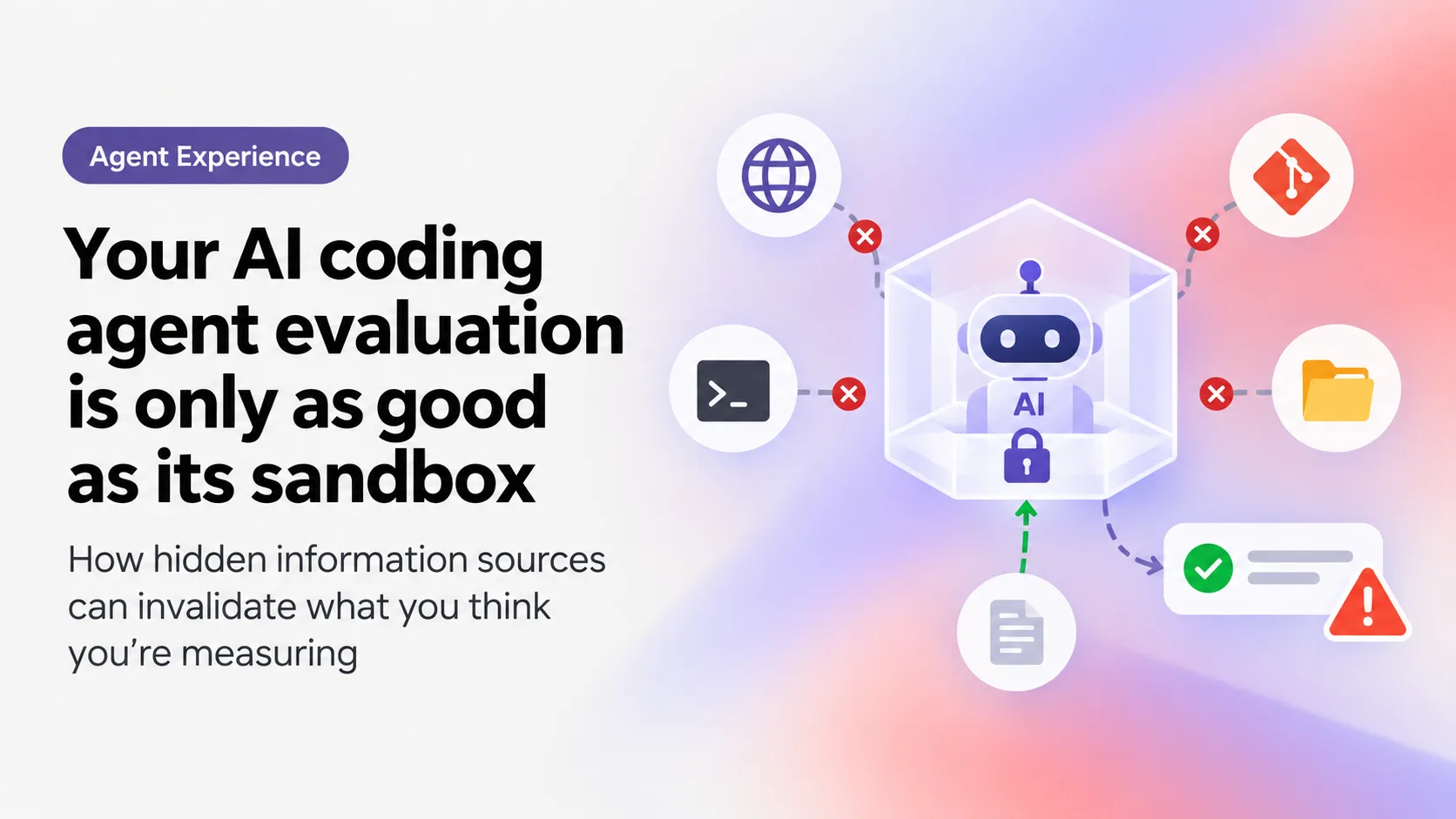
    Your AI coding agent evaluation is only as good as its sandbox

    Evaluating AI coding agents requires a robust sandbox to prevent agents from retrieving answers from the environment, which can invalidate tests of internal knowledge. A correct answer doesn't guarantee a valid measurement if the agent accessed information it shouldn't have, highlighting the need to define sandboxes by information boundaries rather than just tool restrictions. Always review agent…

    Microsoft for Developersmicrosoft.com5 min
  23. 29

    Presentation: Context Engineering at LinkedIn: How We Built an Organizational Context Layer for AI Agents with MCP

    LinkedIn built a “Contextual Agent Playbooks and Tools” layer that wraps internal services (code search, docs, feature flags, etc.) behind the open‑source Model Context Protocol (MCP). By feeding LLM‑powered coding agents the exact internal artifacts they need, the agents can diagnose incidents, generate PRs, and update incident tickets in minutes, delivering a reported 20 % productivity gain wit…

    InfoQinfoq.com28 mintalk
  24. 30

    Kubernetes v1.37: Hardening Container Storage with Bind Mount Options and EmptyDir Permissions

    Kubernetes v1.37 adds two alpha‑level storage hardening knobs: per‑volume `bindMountOptions` (e.g. noexec, nosuid, nodev) that affect the bind‑mount the runtime creates, and an `emptyDir` `mode` field to set Unix permission bits (including the sticky bit). Together they let you enforce least‑privilege policies on writable volumes without init‑containers or CSI tricks.

    Kuberneteskubernetes.io8 minHN3