proomt

Search

Search posts, papers, and topics

All posts

InfoQOlimpiu Pop2 min readintermediate
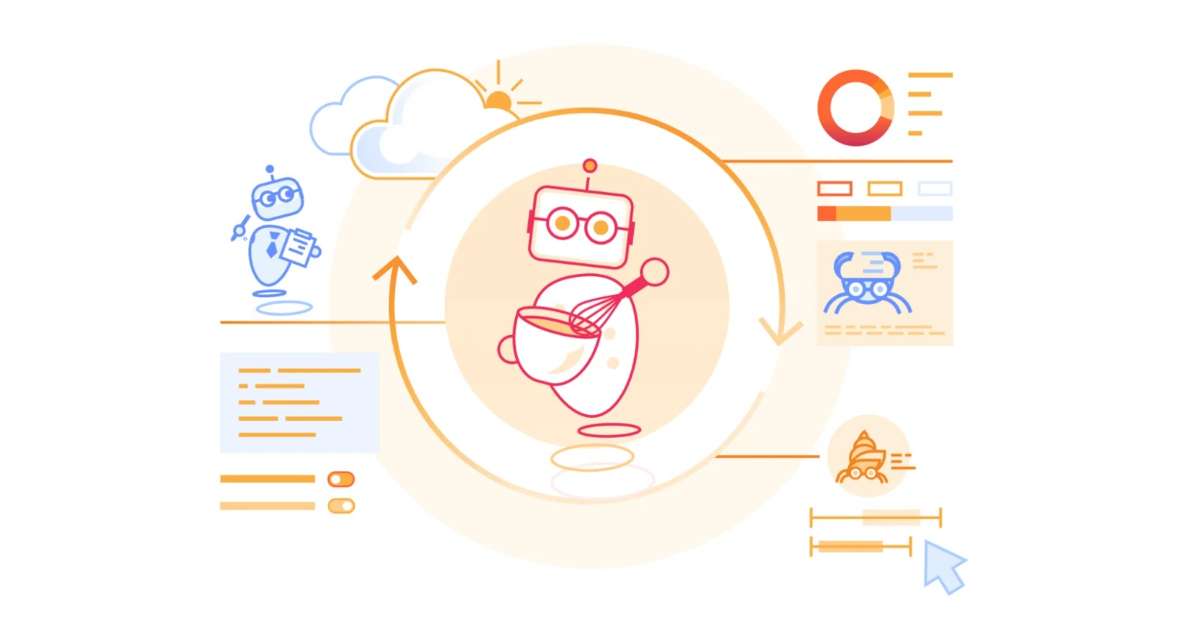
Cloudflare Introduces the Agent Development Lifecycle to Replace Traditional SDLC

Summary

Cloudflare’s Agent Development Lifecycle (ADLC) replaces the classic SDLC with an autonomous, event‑driven workflow system that lets AI agents handle code generation, testing, deployment, and maintenance. The platform builds on Cloudflare Workflows and the new @cloudflare/ci library to spin up containers, run headless browsers, and chain steps with caching and credential support. Observability is…

  • ADLC treats the CI/CD pipeline as a generic, programmable workflow that agents can extend with dynamic sub‑agents and container spawns.
  • The @cloudflare/ci library lets agents orchestrate steps, cache dependencies, and handle failures without human intervention, as shown in the NightlyReview example.
  • Observability is upgraded from infrastructure metrics to fine‑grained tracing of AI model invocations and tool usage, integrated with OpenTelemetry and Cloudflare’s Think/Flue frameworks.
  • Security is addressed via short‑lived, task‑scoped credentials and a Trust Ratchet that automatically lowers an agent’s capabilities after it touches protected resources.

If AI agents can reliably manage the full software lifecycle, engineering teams could dramatically reduce manual bottlenecks in testing and deployment, especially at scale. However, the shift also raises new challenges around observability and least‑privilege security, which Cloudflare attempts to…

5/10
Related reading

  1. Introducing the DevOps Agent Kit

    The DevOps Agent Kit is an Apache‑2.0 open‑source starter kit that lets you plug an LLM‑based coding assistant into your existing CI/CD, security, and feature‑flag tooling via CloudBees Unify. It ships with seven read‑only example skills, enforces RBAC and audit trails, and normalises data from up to 63 tools so the agent can answer a single “are we good to ship?” question with verifiable evidenc…

    Codeshipcloudbees.com5 min
  2. The DevFest Community Workshop Experience: Building Real Agents Together

    Google’s DevFest Community Workshop introduced a “Workbench” format that emphasizes architectural mental models over copy‑paste code, guiding engineers to build long‑running, self‑evolving multi‑agent systems with the Agent Development Kit and Gemini Enterprise platforms. Attendees learned state‑separation, workflow pausing, and self‑patching pipelines, and the series will continue in five more c…

    Google Cloud Bloggoogle.com2 min
  3. How to upskill enterprise AI builders by using daily micro habits

    Google Cloud Consulting proposes a four‑pillar micro‑learning framework for enterprise AI upskilling: 5‑minute browser‑based exercises, pre‑configured sandboxes, daily streaks, and delivering runnable code each session. A pilot (Advent of Agents) showed >150k participants, 859k code runs, and a 31% daily return rate, suggesting short, frictionless tasks improve engagement versus traditional bootc…

    Google Cloud Bloggoogle.com3 min
  4. Blog: How to Build a DevOps Agent

    This blog walks through the open‑source DevOps Agent Kit, which lets Claude Code or Cursor act as a DevOps assistant by connecting to CloudBees Unify, Jira, and Slack via MCP servers and to GitHub via the CLI. It provides a repeatable setup (Docker, Node, env file) and seven slash commands for pipeline overview, triage, security, release readiness, flag management, CI health scoring, and Jira tic…

    Codeshipcloudbees.com10 min
  5. Changing the game: How Google uses agentic AI to secure hundreds of millions of lines of code

    Google’s AI & Infrastructure team built an agentic pipeline (Mantis) that runs pre‑submit AI‑driven scans on every code check‑in, validates findings with a fast triage agent (AST + call‑graph analysis) achieving >92% precision in <1 min, then auto‑generates fixes via a bug‑fix agent. Localized threat models and a two‑step scan cut false‑positives to ~3% and prevent hundreds of vulnerabilities eac…

    Google Cloud Bloggoogle.com4 min