proomt

Search

Search posts, papers, and topics

All posts

TemporalHouman Kargaran5 min readintermediate

Chaining Activities — from text to vectors

Summary

This post details how Temporal Activities orchestrate an RAG pipeline, from text embedding to vector storage, ensuring PII compliance and idempotency. It covers using an on-premise embedding model, caching vectors in Redis, and upserting to Pinecone with robust retry mechanisms.

  • Temporal Activities orchestrate multi-step RAG pipelines, ensuring durability and retries for each operation.
  • PII is protected by passing only `file_id` and cache keys between Activities, not raw data.
  • Idempotency is achieved via `case_id` for upserts and an `embedded` flag for reconciliation in Postgres.
  • On-premise embedding models are integrated using a provider pattern for easier swapping and testing.

Engineers building durable, PII-compliant RAG pipelines or complex data workflows with Temporal will find practical patterns for orchestration, data handling, and error recovery.

7/10
Related reading

  1. How LlamaIndex uses Temporal to scale reliable document orchestration

    LlamaIndex migrated from RabbitMQ to Temporal for orchestrating complex, multi-stage document processing workflows, scaling to tens of millions of pages daily. This shift enabled them to replace ad-hoc state management and concurrency controls with Temporal's durable execution and workflow primitives, improving reliability and resource efficiency.

    Temporaltemporal.io7 min
  2. How LLMs Can Find a Needle in a Haystack

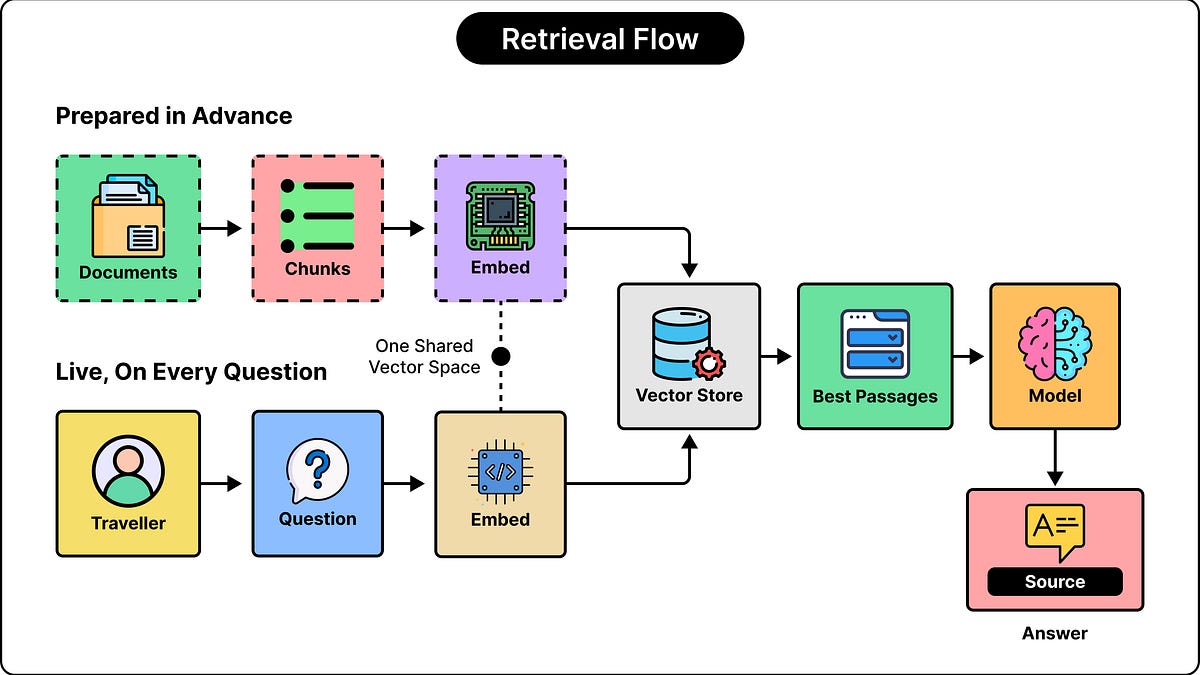
    The post explains how retrieval‑augmented generation (RAG) lets LLM‑based assistants answer questions from private corpora. It covers chunking documents into passages, embedding queries and chunks, similarity metrics, and the trade‑offs of different vector indexes (flat, IVF, HNSW). The focus is on practical design choices rather than new research.

    ByteByteGobytebytego.com12 min
  3. Building a Reliable Script-to-Video Pipeline for Modern Web Applications

    A practical guide to building a reliable, observable script‑to‑video pipeline. It advocates a staged architecture (scene manifest → asset generation → voice → rendering → encoding), validates AI‑generated JSON with Zod, persists project and scene state, uses explicit workflow states, runs heavy work in background queues, limits concurrency, and stores voice, captions, and assets separately to ena…

    SitePointsitepoint.com11 min
  4. Label your agent steps

    This post demonstrates how to use Temporal's `summary` fields for Activities, Timers, and Workflows to enhance observability. These labels make it significantly easier to debug and understand the execution flow of complex, especially agentic, workflows directly in the Temporal UI without needing to inspect full payloads.

    Temporaltemporal.io4 min