proomt

Search

Search posts, papers, and topics

All posts

Hacker News front page1 min readrelease notesintermediate

Cloudflare Quick Tunnels

Summary

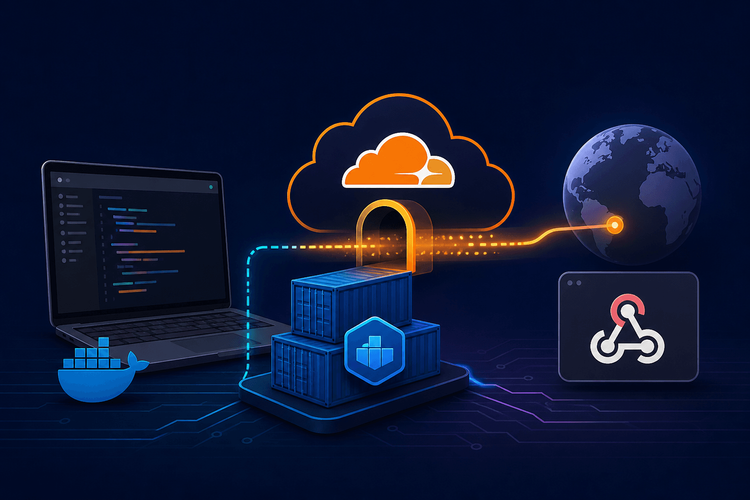
Cloudflare Quick Tunnels let you expose a local service via an outbound‑only connection to Cloudflare’s edge network. The service gets a public URL (anycast across 335+ cities) with automatic TLS, DDoS protection, and no inbound ports. It’s positioned for short‑lived agents, webhooks, and testing loops, with JSON health output and no config files.

  • Uses an outbound‑only tunnel (cloudflared) to avoid opening inbound ports on the host.
  • Provides a public URL backed by Cloudflare’s Anycast edge (335+ cities) with automatic HTTPS and DDoS filtering.
  • Designed for ephemeral use: the tunnel ends when the process exits; no manual revocation needed.
  • Outputs hostname, edge location, and health as JSON on stdout, simplifying integration with agents.

Quick, secure exposure of local services is a common pain point for developers building CI agents, webhook integrations, or demo services. By eliminating inbound ports and handling TLS/DDoS at the edge, Cloudflare reduces attack surface and operational overhead for short‑lived services.

3/10

Related reading

  1. Cloudflare/Security-Audit-Skill

    Cloudflare open‑sources a “security‑audit” skill that turns an LLM‑enabled coding agent into a structured vulnerability auditor. It runs six deterministic phases, validates findings against a JSON schema, and supports additive runs to improve coverage.

    Hacker News front pagegithub.com3 minreleaseHN20938
  2. Cloudflare Introduces the Agent Development Lifecycle to Replace Traditional SDLC

    Cloudflare’s Agent Development Lifecycle (ADLC) replaces the classic SDLC with an autonomous, event‑driven workflow system that lets AI agents handle code generation, testing, deployment, and maintenance. The platform builds on Cloudflare Workflows and the new @cloudflare/ci library to spin up containers, run headless browsers, and chain steps with caching and credential support. Observability is…

    InfoQinfoq.com2 min
  3. Replica-aware routing public beta

    Replica‑aware routing (public beta) lets ClickHouse Cloud users pin a query stream to a specific replica by sending a custom header (HTTP) or overriding the TLS SNI (native). The proxy (Envoy) hashes the tag and consistently forwards all requests with the same tag to that replica, giving read‑after‑write consistency for temporary tables, session objects, and warm replica caches. Stickiness is bes…

    ClickHouseclickhouse.com6 min