Hall of FameIgor Ostrovsky201012 min readintermediate
Gallery of Processor Cache Effects
Summary
This article illustrates various processor cache effects using C# code examples and measured performance. It demonstrates how cache lines, L1/L2 cache sizes, instruction-level parallelism, and cache associativity impact program execution times.
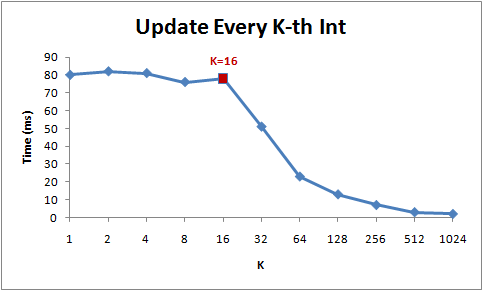
- Memory access patterns, not just computation, often dominate loop performance due to cache lines.
- Accessing any element within a 64-byte cache line is as fast as accessing the first, until the cache line is evicted.
- Performance drops significantly when data size exceeds L1 or L2 cache capacities, leading to more main memory accesses.
- Instruction-level parallelism allows modern CPUs to execute independent operations concurrently, making `a[0]++; a[1]++;` faster than `a[0]++; a[0]++;`.
Engineers working on performance-critical applications should understand these low-level CPU behaviors to write more efficient code and diagnose performance bottlenecks.
7/10