proomt

Search

Search posts, papers, and topics

All posts

Hugging Face Daily PapersNikhil Sharma, Yunlin Gong, Xinyang Cheng1 min readpaperadvanced

Gricea: An Open Science Platform for Conversational AI Research

Summary

Gricea is an open‑science platform that packages conversational AI studies as reusable artifacts. It demonstrated high reproducibility on prior papers and enabled diverse users to build runnable experiments, addressing fragmentation in CAI research.

  • Gricea encodes CAI studies as configurable, deployable artifacts that bind procedures, UI, and task behavior.
  • In a replication of CUI 2026 papers, Gricea reproduced 93% of study configurations, flagging missing details in 96% of papers.
  • A user study showed researchers from varied backgrounds could construct runnable studies addressing open-ended questions using Gricea.
  • The platform supports sharing, inspecting, and extending CAI experiments, facilitating cumulative knowledge building.

Anyone conducting or replicating conversational AI experiments should care, as Gricea provides a systematic way to share and reproduce studies.

7/10

Related reading

  1. The 6 best conversational AI platforms in 2026

    Zapier’s Ben Lyso reviews six conversational‑AI platforms (Fin, Voiceflow, Google Conversational Agents, Decagon, Kore.ai, Cognigy) on criteria like custom agent building, conversation quality, channel coverage, and integration depth, noting pros/cons, pricing, and deployment nuances.

    Zapier Engineeringzapier.com16 min
  2. 9 top conversational AI platforms in 2026

    Twilio’s blog lists the nine leading conversational‑AI platforms for 2026, highlighting how the market consolidated and what capabilities matter when choosing a vendor. It details Twilio’s own infrastructure tools—ConversationRelay, Agent Connect, Orchestrator, and Memory—showing sub‑second latency and full‑stack reliability for voice and messaging.

    Twiliotwilio.com12 min
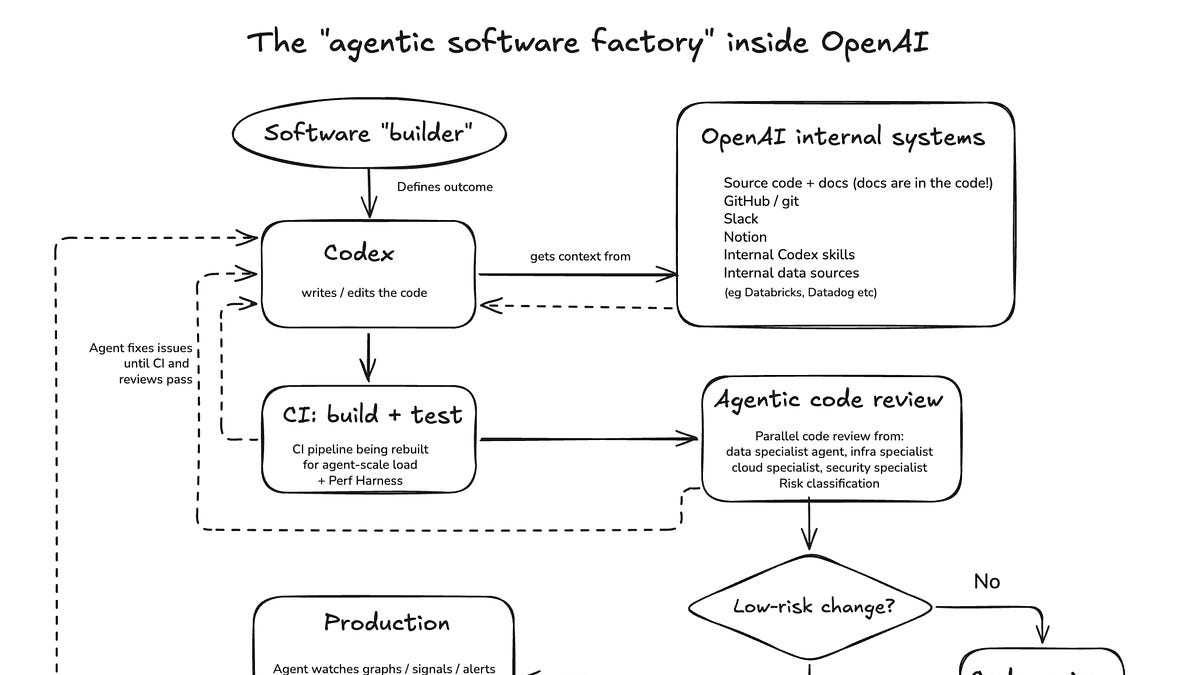
  3. Inside OpenAI’s agentic software factory

    OpenAI has internalized Codex and ChatGPT Work as a universal coding agent, achieving >90% adoption across the company and reshaping tooling, CI/CD load, and engineering roles. The shift has forced a new agentic software factory, massive infra scaling, and a rethink of IDEs, PRs, and code reviews.

    The Pragmatic Engineerpragmaticengineer.com15 minHN1
  4. OmniVChat: Synthesizing, Benchmarking, and Training for Native Audio-Visual Dialogue

    OmniVChat defines native audio‑visual dialogue where a model consumes raw audio and video streams and replies in text. The authors build OmniVChat‑Studio, a multi‑agent simulator that generates single‑ and multi‑turn audio‑visual conversations, and use it to create OmniVChat‑Bench, a benchmark covering five dialogue abilities. They also propose OmniVChat‑RL, a reinforcement‑learning reward that b…

    Hugging Face Daily Papersarxiv.org2 minpaper
  5. Verifiable Social Reasoning for LLM Assistants

    The paper introduces Fuse, a multi‑agent simulation that gives LLM assistants a verifiable ground‑truth task for social reasoning by hiding a target agent’s motive and letting a user‑mediated conversation infer it. Experiments on 12 LLMs show user mediation makes reasoning harder, models are biased by user framing, need more detail than humans, and longer chats don’t always help.

    Hugging Face Daily Papersarxiv.org1 minpaper