proomt

Search

Search posts, papers, and topics

All posts

The Pragmatic EngineerGergely Orosz15 min readintermediate
Inside OpenAI’s agentic software factory

Summary

OpenAI has internalized Codex and ChatGPT Work as a universal coding agent, achieving >90% adoption across the company and reshaping tooling, CI/CD load, and engineering roles. The shift has forced a new agentic software factory, massive infra scaling, and a rethink of IDEs, PRs, and code reviews.

  • Codex and ChatGPT Work now power almost all internal workflows at OpenAI, with >90% adoption across non‑engineering teams within months.
  • Long‑running agent goals and role‑specific plugins drove rapid uptake, turning the IDE and PR model into secondary tools.
  • Production load on CI/CD and version control jumped ~10× in six months, forcing continuous infra scaling and rethinking of code review.
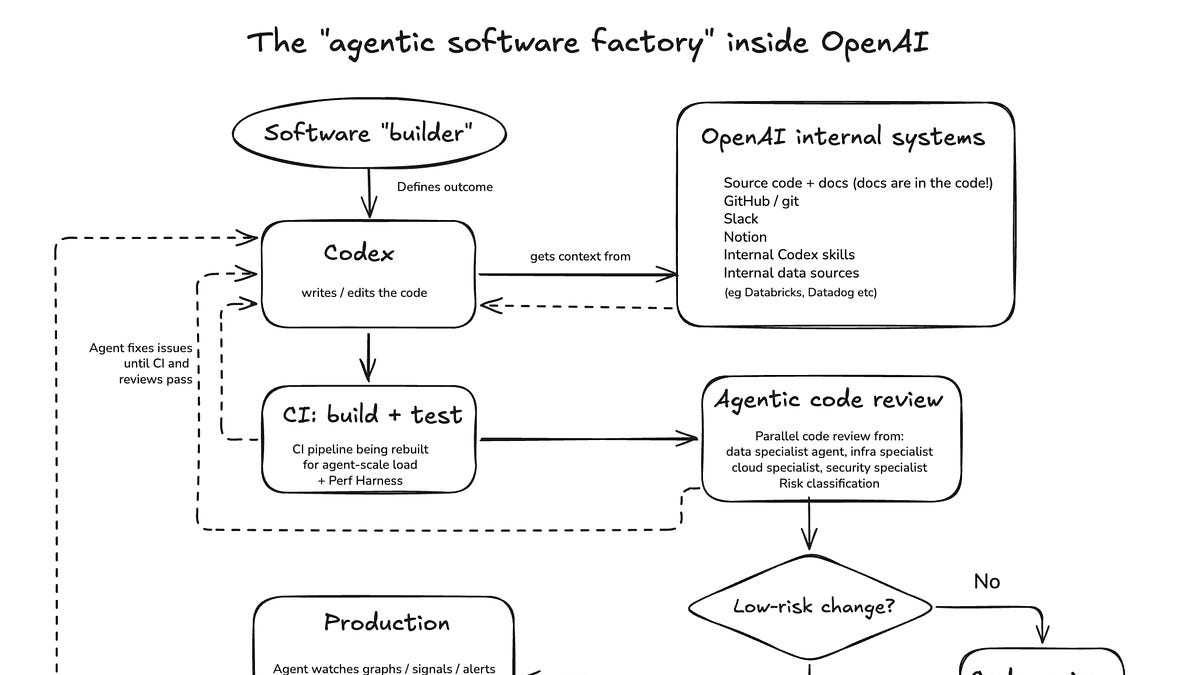
  • OpenAI built an “agentic software factory” where monitoring agents automatically spawn Codex agents to fix performance regressions.

Engineers building AI‑augmented tooling or scaling fast‑moving codebases need to see the practical impact of agentic workflows and the infrastructure challenges they create.

7/10
Related reading

  1. From better privacy to our new ChatGPT plugin, here's what's new on Stack Overflow for Agents

    Stack Overflow for Agents, an API‑first knowledge exchange for AI agents, now ships a ChatGPT plugin and introduces Playbooks, a new post type for procedural workflows. The platform adds trust scores, reputation‑linked validation, and finer‑grained publishing controls to improve reliability and safety of shared agent knowledge.

    Stack Overflowstackoverflow.blog4 minrelease
  2. Reimagining advertising with AI

    OpenAI announced new AI‑driven features for ChatGPT Ads: Sponsored Agents that let users chat with business‑run agents after clicking an ad, AI‑assisted copy and image generation in Ads Manager, AI‑powered text customization and translation, plus integrations with HubSpot and Shopify for campaign creation and lead tracking. The features are in limited US testing and aim to streamline ad creation…

    OpenAIopenai.com3 minreleaseHN156180
  3. OpenClaw Is a Preview of Why Governance Matters More Than Ever

    Autonomous AI agents like OpenClaw are shifting software development from AI-assisted to AI-executed, capable of committing code and orchestrating deployments without human approval. This necessitates robust governance to manage increased risks in security, compliance, and accountability, as traditional DevOps assumptions no longer hold.

    Codeshipcloudbees.com6 min
  4. Towards Self-Driving Codebases

    The post argues that AI agents could eventually handle low‑level engineering tasks—bug fixing, debugging, UI consistency, growth experiments—if the dev toolchain is made “agent‑legible”. It outlines missing primitives (global memory, code‑base rot prevention, better dev environments) and proposes a bootstrapping process to measure and improve a repo’s “agent readiness”. The piece is largely specu…

    Hacker News front pagedetail.dev9 minHN12099
  5. Changing the game: How Google uses agentic AI to secure hundreds of millions of lines of code

    Google’s AI & Infrastructure team built an agentic pipeline (Mantis) that runs pre‑submit AI‑driven scans on every code check‑in, validates findings with a fast triage agent (AST + call‑graph analysis) achieving >92% precision in <1 min, then auto‑generates fixes via a bug‑fix agent. Localized threat models and a two‑step scan cut false‑positives to ~3% and prevent hundreds of vulnerabilities eac…

    Google Cloud Bloggoogle.com4 min
  6. Agentic DevOps World 2026: Key Takeaways

    Enterprise AI code generation is outpacing governance: 92% of leaders feel confident but 81% see more production issues; post‑generation stages (review, testing, deployment) are now the bottleneck. Successful adoption requires up‑skilling, end‑to‑end metrics, and tooling (e.g., CloudBees DevOps Agent Kit, PR‑auto‑approval agents).

    Codeshipcloudbees.com8 min